Nvidia walked into Computex in Taipei on Monday with a chip aimed squarely at a market it has mostly left to Intel and Apple: the personal computer. The RTX Spark superchip, unveiled by chief executive Jensen Huang, pairs a 20-core Arm processor with a Blackwell graphics engine and up to 128GB of memory, and it lands in Windows laptops and desktops from six manufacturers this fall.
On stage the pitch was a consumer revolution, a machine that works for you instead of waiting for clicks. The harder question is what Nvidia gains from a market that will barely register against the data-center business that made it the world’s most valuable company.
What Nvidia Put on Stage in Taipei
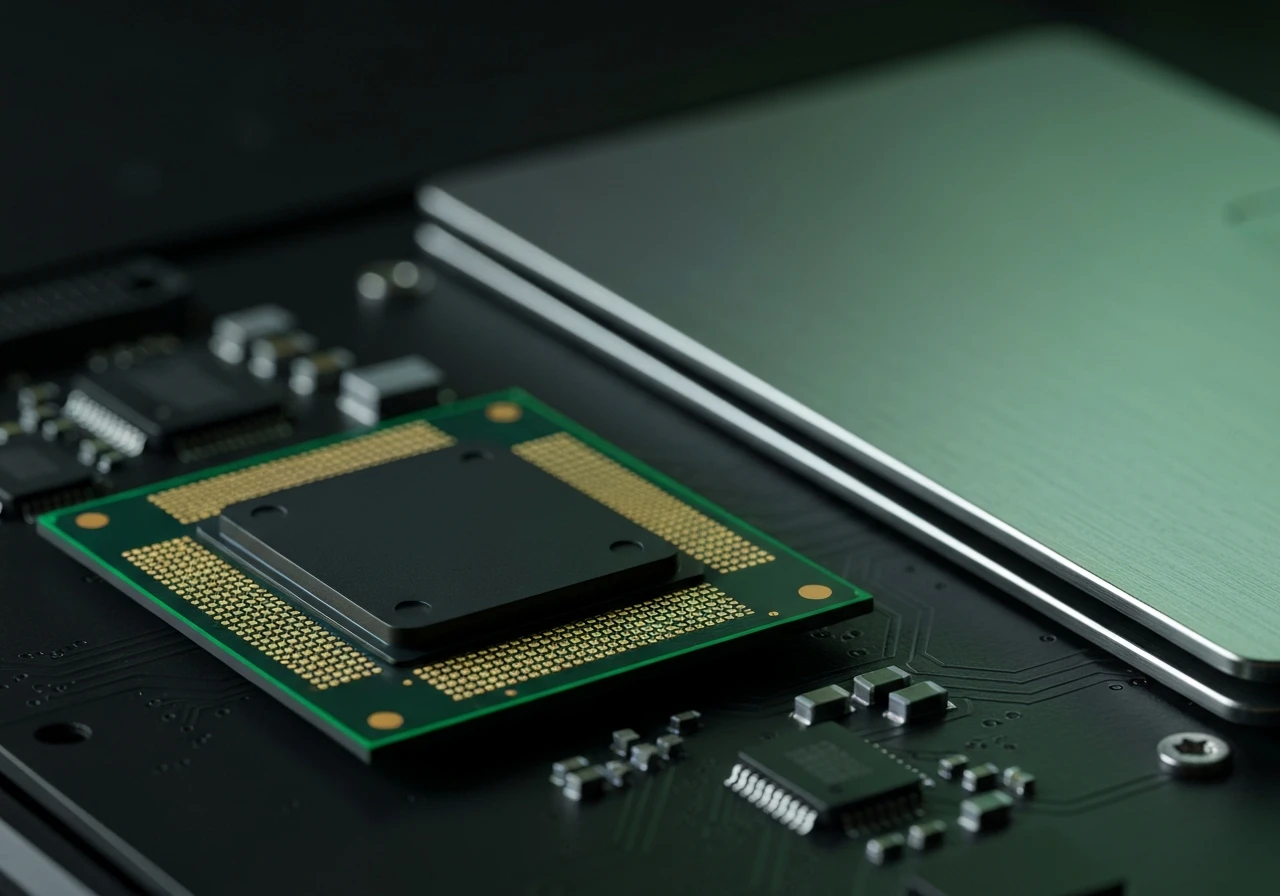
Huang framed the launch in the biggest terms he could reach for, calling the moment a reinvention on the scale of the smartphone. The hardware underneath is a single package that fuses a central processor and a graphics chip, the kind of design Nvidia has sold into servers and is now shrinking into a notebook as thin as 14mm and as light as three pounds.
The specifications, drawn from Nvidia’s official RTX Spark announcement, read like a workstation folded into a laptop chassis. The GPU (graphics processing unit, the chip that handles parallel math for graphics and AI) carries fifth-generation tensor cores; the CPU (central processing unit, the general-purpose brain) uses Nvidia’s own Grace Arm cores, linked by a high-speed chip-to-chip interconnect.
- 6,144 CUDA cores on a Blackwell-architecture GPU
- 20-core Nvidia Grace Arm CPU
- 128GB of unified memory shared across the chip
- 1 petaflop of AI compute on a single mobile part
The first machines will ship from ASUS, Dell, HP, Lenovo, Microsoft Surface and MSI, with Acer and GIGABYTE following later. Nvidia gave no price. Adobe said it is rebuilding Photoshop and Premiere for the platform to run up to twice as fast on AI and graphics tasks.
The PC Move Barely Moves the Revenue Needle
Here is the part the keynote glides past. Nvidia does not need the PC market to make money. For the quarter that ended in late April, the company reported record revenue of $81.6 billion, up 85% from a year earlier, according to its Q1 fiscal 2027 results filed with the SEC.
Almost all of that came from one place. Data-center sales hit $75.2 billion, up 92% year over year, riding the build-out of AI servers around the world. Gaming, the segment a consumer chip would naturally feed, ran at roughly $3.7 billion in the prior quarter, a rounding error next to the server business.
So a laptop chip, even a wildly successful one, cannot meaningfully grow a company already worth more than $5 trillion. That math is the tell. RTX Spark is not a revenue play in any near term that matters to the income statement.
Which means the reason to build it has to live somewhere other than the device. And it does.
Why the Target Is the Developer, Not the Laptop
Nvidia’s strength was never just silicon. It was CUDA (Compute Unified Device Architecture, the software layer developers use to program Nvidia chips), the toolset that has kept AI researchers writing for Nvidia hardware for the better part of two decades. Every model trained on a Nvidia server is, in effect, a customer locked to the stack. The desktop is the one place that habit had not fully reached.
From Component Supplier to Architecture Owner
Analysts read the shift the same way. Charlie Dai, vice president and principal analyst at research firm Forrester, called the announcement a move from “component supplier” to “architecture owner in the PC market.”
This will directly challenge Intel, AMD, and Qualcomm and raise competitive pressure on performance, efficiency, and AI integration.
That was Dai, describing the competitive jolt of a company that supplies parts deciding to own the whole platform instead.
Keeping Agents Inside the CUDA Orbit
The Microsoft side of the deal makes the intent plain. The two companies built new Windows security controls and a runtime called OpenShell, meant to let AI agents run locally on the machine rather than in the cloud. With 128GB of unified memory, the chip can run a 120-billion-parameter language model on-device, the kind of workload that normally needs a rented server.
Semiconductor analyst Dr Ian Cutress put the strategic logic bluntly: by selling a Windows notebook with Nvidia hardware inside, the company gives developers, especially those building AI tools, a reason to stay inside its own software and hardware orbit. The result is a moat that now reaches from the data center to the desk, **keeping AI developers inside Nvidia’s stack** from prototype to production.
Where Intel, AMD, Qualcomm and Apple Get Squeezed
The incumbents are not standing still, but each is being pressured on a different flank. Intel and AMD own the x86 desktop. Qualcomm has spent two years pushing Arm-based Windows laptops. Apple sells the unified-memory design Nvidia is now copying for Windows. Together, Lenovo, HP, Dell and Apple account for almost 75% of global PC shipments, per Gartner’s global PC shipment rankings, so Nvidia is wedging into a tight club.
| Vendor | Core approach | AI-PC strength |
|---|---|---|
| Nvidia RTX Spark | Arm CPU plus Blackwell GPU, one package | Full CUDA stack, 1 petaflop on-device |
| Intel | x86 with integrated neural engines | Volume reach, broad software base |
| AMD | x86 Zen cores plus Radeon graphics | Strong GPU pedigree, gaming installs |
| Qualcomm | Arm Oryon CPU, Adreno GPU | Battery life, mainstream price points |
| Apple | Arm M-series with unified memory | Tight macOS integration, efficiency |
The Price Tag That Caps the Reach
A petaflop in a notebook does not come cheap. Ian Fogg, research director at industry analyst firm CCS Insight, said the platform was “likely to come with a significant price tag” and that Nvidia would be aiming at buyers “looking for workstation-class performance.”
That points at a narrow buyer, at least at first. The audience for a three-pound machine that can render a 90GB 3D scene or edit 12K video is not the average shopper hunting a back-to-school laptop. It is the engineer, the studio, the AI startup.
The constraints worth watching as fall approaches:
- Price: a premium tier that likely sits above mainstream and many gaming laptops, limiting volume.
- Software friction: Windows on Arm still trips on some legacy x86 apps, a problem Qualcomm hit hard.
- Battery and heat: a server-class part in a thin chassis is an engineering bet that has to hold up in the field.
The Export Crackdown Shadowing the Launch
The launch did not happen in a vacuum. A day before the keynote, the US tightened the rules that protect Nvidia’s most profitable products. The Department of Commerce, through its Bureau of Industry and Security export guidance, clarified that a license is now needed to ship the most advanced AI chips to overseas subsidiaries of Chinese-headquartered firms.
That closes a route that had been wide open. For roughly a year, Chinese companies could buy restricted parts such as Nvidia’s Blackwell processors through arms based in places like Malaysia or Singapore. Reporting around the rule change suggests hundreds of thousands of chips reached Chinese-owned buyers that way before the door shut.
The same control regime that limits where Nvidia can sell its server chips is part of what keeps those chips scarce and high-margin. The consumer launch is the company widening its base while its core market stays fenced by Washington and contested by Beijing.
If RTX Spark turns Windows into the cheapest on-ramp to CUDA, the laptop itself is almost beside the point; if the price holds it above workstation tiers, Intel and AMD keep the volume and Nvidia keeps the developers it already had.
Frequently Asked Questions
When will RTX Spark laptops be available?
The first RTX Spark-powered Windows PCs are due in fall 2026 from ASUS, Dell, HP, Lenovo, Microsoft Surface and MSI. Acer and GIGABYTE are expected to introduce devices later.
How much will an RTX Spark PC cost?
Nvidia has not announced pricing. Industry analysts expect a premium, workstation-class price tag rather than mainstream laptop pricing, because the chip packs server-grade compute into a thin notebook.
What can the RTX Spark chip do?
It offers up to 1 petaflop of AI compute, 128GB of unified memory and 6,144 CUDA cores. Nvidia says that lets it run 120-billion-parameter language models locally, generate 4K AI video, render large 3D scenes and play modern games at 1440p above 100 frames per second.
Does RTX Spark run regular Windows software?
The machines run Windows on Arm with platform optimizations and Nvidia’s OpenShell runtime for local AI agents. As with other Arm-based Windows PCs, some older x86 applications may run through compatibility layers rather than natively.
How does it compare with Apple and Intel chips?
Like Apple’s M-series, it uses an Arm CPU with unified memory, but it adds a full Blackwell GPU and Nvidia’s CUDA software stack. Against Intel and AMD, the pitch is far higher on-device AI performance, aimed at developers and creators rather than the mass market.