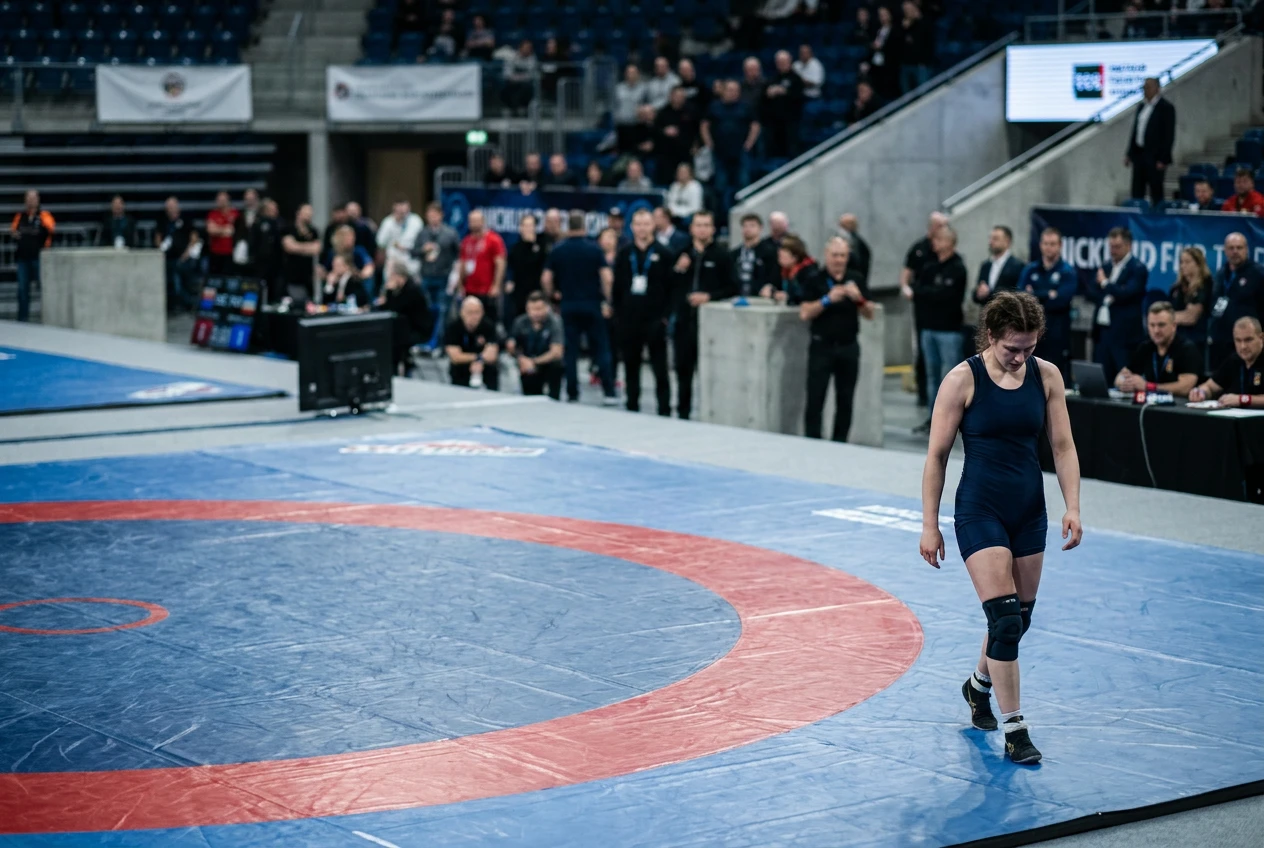
A wry smile, a wave to the stands, and four words aimed at the people who run Indian wrestling: I will be back. That was how Vinesh Phogat closed her comeback bid on Saturday, beaten 4-6 by Meenakshi Goyat in the 53kg semifinal of the Asian Games selection trials at New Delhi’s Indira Gandhi Indoor Stadium. It was her first competition since the Paris 2024 Olympics, and it finished one win short of a place in the squad.
The scoreline tells only the surface story. The deeper one is about time: nearly two years away from the mat, a body that no longer makes the 50kg class she once owned, and a field of younger wrestlers who used that gap to take the category for themselves.
The Semifinal That Closed the Door
Vinesh started tentatively and conceded an early point for passivity. Meenakshi Goyat, who carried the momentum of a recent Asian Championships silver into the bout, pushed her out twice and raced to a 4-1 lead before the contest turned scrappy.
Vinesh answered with a takedown for two points, only for her opponent to claw one back and stretch the margin to 6-3. A successful last-gasp challenge trimmed it to 6-4 at the hooter, but the correction changed the arithmetic, not the result. Vinesh was out.
The bout was ugly to watch and uglier to officiate. Supporters from both camps spilled toward the mat, points were disputed almost as soon as they were scored, and the referees spent as much time managing the crowd as the wrestlers. It set the tone for a day of selection trials in which the wrestling often felt like the smaller argument. You can read the official account of the women’s 53kg trials in New Delhi for the round-by-round detail.
Three Bouts, One Reality Check
Vinesh did not arrive at the semifinal cold. She had already wrestled twice, and the morning carried a warning that the afternoon then delivered. Her opening 7-1 win over Jyoti looked like the old Vinesh. The quarterfinal did not.
Against the unheralded Nishu, she was thrown in the open for a four-pointer and nearly pinned, saved only by the bell ending the first period. The break let her regroup, hit a four-pointer of her own and a takedown to lead 6-5, before a lost challenge tied it 6-6. Nishu’s appeal at the final hooter failed, and Vinesh survived 7-6.
| Round | Opponent | Score | Result |
|---|---|---|---|
| Opening bout | Jyoti | 7-1 | Win |
| Quarterfinal | Nishu | 7-6 | Win |
| Semifinal | Meenakshi Goyat | 4-6 | Loss |
One comfortable win, one escape, one exit. For a wrestler chasing a place at the Asian Games, the trend line mattered more than any single number on the board.
Two Years Away, and a Heavier Class
Vinesh is 31, a three-time Olympian who competed at Rio in 2016, Tokyo in 2020 and Paris in 2024. Her last Olympic morning ended not on the mat but on the scales, disqualified from the gold-medal bout for being 100 grams over the 50kg limit, a decision later upheld in part by sport’s top court. You can review the 100-gram overweight ruling at Paris 2024 for how thin that margin was.
What followed was not a training block. It was retirement, then an election win, then a long public fight with the federation, and only after that a return. The weight class changed too. Saturday’s trials were at 53kg, and she weighed in at 53.9kg, a body that has moved up from the brutal cut that once defined her career.
- August 2024: disqualified at the Paris Olympics, then announces her retirement from wrestling.
- October 2024: wins the Julana assembly seat in Haryana on a Congress ticket, becoming a sitting legislator.
- December 2025: declares a competitive comeback, with the 2028 Los Angeles Olympics as the stated target.
- May 2026: returns to the mat at the Asian Games trials and loses in the 53kg semifinal.
Ring rust is not a metaphor in wrestling. It shows up in the first exchange, in the timing of a defensive sprawl, in how a body that has not been scrambled for points in 21 months reacts when it suddenly is. Nishu found that body in the quarterfinal. Meenakshi finished the job.
The 53kg Order Moved On Without Her
The cruelest part for Vinesh is that the wrestler who beat her did not even win the category. Meenakshi Goyat lost the final 2-3 to Antim Panghal, refusing to accept the decision and holding up the mat in protest before the result stood. The 53kg slot, and the trip to the Asian Games, went to Panghal.
This is the generation Vinesh helped clear a path for during the 2023 protests, now grown into the wrestlers standing between her and a national vest. The final women’s squad reflects a depth chart she is no longer on.
- 50kg: Dipanshee
- 53kg: Antim Panghal
- 57kg: Manisha
- 62kg: Mansi Ahlawat
- 68kg: Nisha Dahiya
- 76kg: Priya
None of the six is a household name in the way Vinesh is. That is the point. India’s women’s wrestling has spent two years building competitors who do not need her brand, and the trials were the day that quietly became official. Her career honours including Asian Games gold still dwarf the resumes of the wrestlers now ahead of her, which is exactly why the loss stings.
‘The Entire System’ and the WFI Standoff
Vinesh did not leave quietly. After the loss she questioned how the trials were run, describing disputes over every point from morning to night and casting the day as a fight against something larger than Meenakshi Goyat.
The entire system is standing on one side, and we are all standing on the other side.
That framing has a long backstory. Vinesh is a lead complainant in the sexual harassment case against former Wrestling Federation of India (WFI, the sport’s national governing body) chief Brij Bhushan Sharan Singh, and the current WFI president, Sanjay Singh, has publicly accused her of politicising the sport on behalf of the Congress party. The federation had issued her a show-cause notice and barred her from sanctioned events until at least June 26, which is why simply reaching the mat on Saturday took a legal fight.
For all that, the trials carried unusual oversight. The Indian Olympic Association (IOA) and the Sports Authority of India (SAI) monitored the event, and the bouts were video-recorded under Delhi High Court orders, a paper trail built precisely so that a losing wrestler could not claim the scoreboard was rigged. Vinesh stopped short of saying the result was fixed. She said the environment was stacked, which is a different and harder charge to settle.
Whatever the truth of it, the appeal she lost in the semifinal was reviewed on camera, and the four-point margin she finished on was the one the officials confirmed.
What the Los Angeles Bet Needs Now
The comeback was never really about these Asian Games. It was about Los Angeles in 2028, the stage Vinesh named when she returned to the sport at the end of last year. Saturday was supposed to be the easy part, a tune-up against a domestic field. Instead it became evidence.
By the time the next Olympics arrive she will be 33, three years deeper into a body that already struggles at 53kg, and she will still have to get past Antim Panghal to wear India’s colours. None of that is impossible for a three-time Olympian. All of it is now harder than it looked when she waved at the crowd in December and promised to come back.
If the next three years follow Saturday’s script, the comeback ends as a footnote to a career that needed none. If Vinesh can solve the wrestlers who just solved her, Los Angeles stays on the board. The trials did not close that door. They only showed how narrow the opening has become.