The Virtual Telescope Project will point its robotic optics at a peculiar full Moon at 01:30 UTC on May 31, the second full phase of May 2026 and, in the same breath, the smallest of the year. The livestream from Manciano, Italy will spend its first hour on a body that looks roughly 6% narrower and 10% dimmer than an average full Moon, a gap thin enough that most backyard observers will not catch it without a side-by-side reference.
That is the catch built into the so-called Blue Micromoon. Folklore promises something rare; orbital mechanics delivers something muted. The two effects land on the same date for the first time in close to three years, and they will not coincide again on a monthly Blue Moon until the closing hours of 2028.
Why May’s Second Full Moon Counts as Blue
A synodic month, the interval between two full Moons, averages about 29.5 days. A calendar month averages a little over 30. The mismatch is small, but it accumulates: a calendar year contains 12 full lunar cycles plus roughly 11 additional days. Every two or three years, that surplus pushes a 13th full Moon into the calendar.
When the extra full Moon arrives, it usually shows up as the second one inside a single calendar month. Anglo-Saxon folklore tagged that second appearance a Blue Moon, and the modern almanac industry kept the label even after the original seasonal definition fell out of use. The 31 May 2026 full Moon meets the popular monthly test cleanly: the Flower Moon already peaked at 17:23 UTC on May 1, leaving the late-month full phase to claim the second slot.
Calendrical Blue Moons are not annual. After May 31 the next monthly Blue Moon does not arrive until 31 December 2028, which means this is the only one between now and the very end of the decade. Seasonal Blue Moons, the older definition where four full Moons crowd into a single astronomical season, fill the gap on 20 May 2027.
The Apogee That Makes This Moon the Smallest of 2026
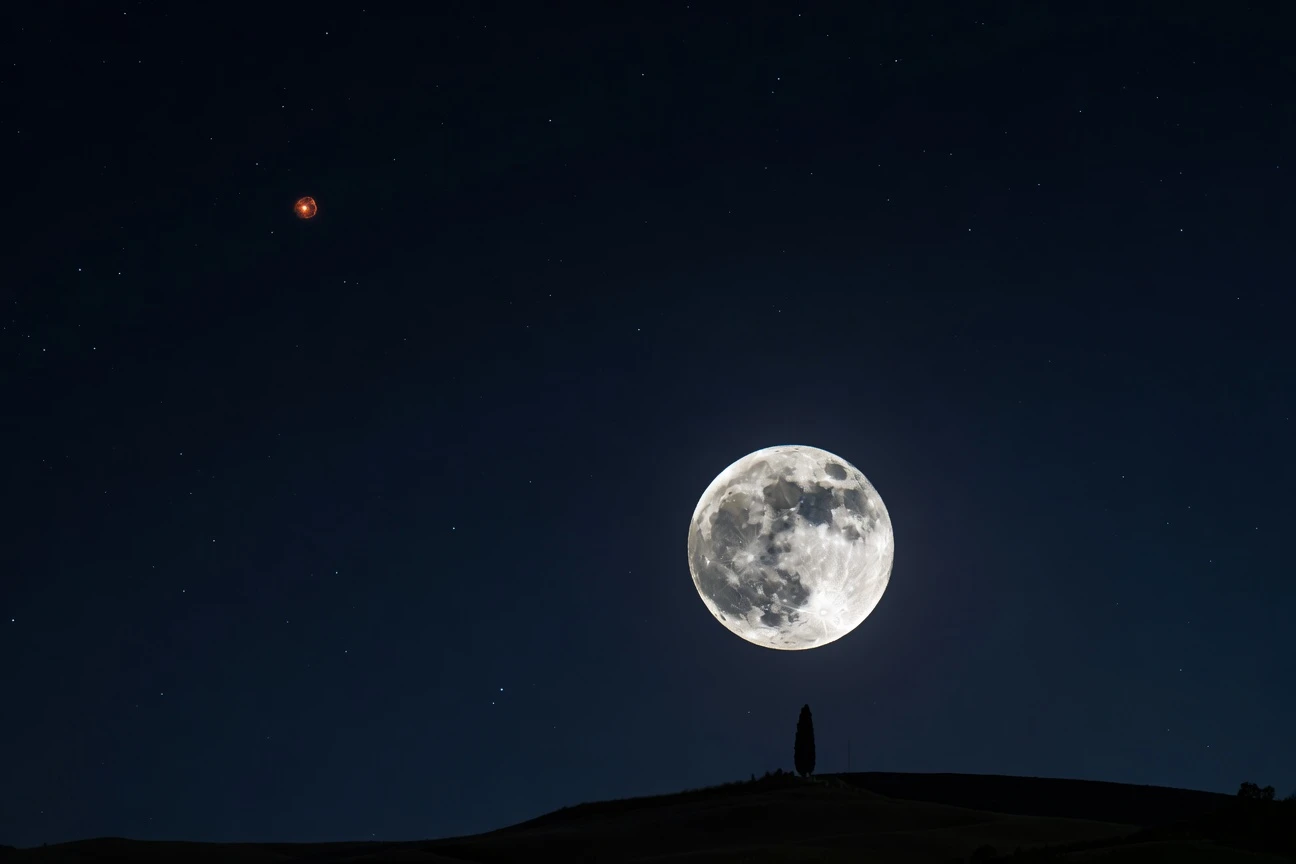
Full phase arrives at 08:45 UTC on May 31. Apogee, the point in the Moon’s orbit farthest from Earth, follows about 19 hours later. The Moon will be 406,135 kilometres (roughly 252,361 miles) from Earth at peak illumination, against an average orbital distance closer to 384,400 kilometres. That gap produces the visible shrinkage.
EarthSky, the BBC’s Sky at Night magazine, and the Old Farmer’s Almanac all settle on the same numerical headline: the Moon’s apparent disk will look about 6% smaller and 10% dimmer than a typical full Moon. Stack that next to a Super Full Moon and the difference is roughly 14% in width and 30% in brightness, the textbook spread between the year’s extreme apparitions.
- 406,135 km distance at peak full phase, the largest Earth-to-Moon figure of 2026
- 19 hours between the full phase moment and lunar apogee
- 6% smaller and 10% dimmer than a mean full Moon, the source of the “micro” tag
- 2,031 days until the next monthly Blue Moon on 31 December 2028
The numerical drama hides a perceptual reality: 6% of disk width is below the threshold most naked-eye observers reliably register. A telephoto frame from the same focal length on the same night, compared against a frame of January’s much closer full Moon, is the cleanest way to see it. That is exactly what the Manciano feed is designed to give viewers.
Watching the Stream From Manciano
Italian astrophysicist Gianluca Masi runs the Virtual Telescope Project’s full Blue Micromoon livestream from a hill site in Manciano, in the Maremma region of Tuscany. The station’s robotic instruments will carry the live imagery; the broadcast will cut between real-time frames of the rising full Moon and archival photographs of past full Moons floating over the Colosseum, St. Peter’s Basilica, and the Roman Forum.
One might therefore call it a ‘Blue Micromoon,’ although the term has no scientific value.
That caveat from Masi, posted alongside the event listing, captures the awkward branding of the night. The Moon is, in a strict sense, neither blue nor unusually small. It is a fully ordinary full phase that happens to coincide with two calendar-and-orbit quirks at once. The label sells the livestream; the imagery is what justifies it.
Viewers outside Italy do not need any equipment beyond a browser. The Virtual Telescope Project’s WebTV page goes live at 01:30 UTC, which is 21:30 EDT on May 30 for the US East Coast, 18:30 PDT on the same date for the West Coast, and 07:00 IST on May 31 for Indian audiences. Anyone with a clear south-easterly horizon and decent weather can watch the same Moon overhead during their local night.
Antares, Scorpius, and an Occultation in the Far South
Astronomical bonus tracks tend to outshine the headline event, and this one has a good candidate. The Blue Moon will cross within a fraction of a degree of Antares, the magnitude 1.0 red supergiant that anchors the constellation Scorpius. For most of the Northern Hemisphere the pairing reads as a tight conjunction: the Moon’s bright limb sits close to the star, and a low-magnification view in binoculars frames both inside the same field.
Observers across southeastern Australia, New Zealand, the southern half of South America, and Antarctica get a stricter treat. From those longitudes the Moon does not pass near Antares; it passes in front of it. The star will disappear behind the Moon’s leading limb, stay hidden for a stretch that depends on local geometry, then reappear on the trailing edge. The Sydney Observatory and similar Southern Hemisphere institutions usually post precise ingress and egress timings the day before.
For everyone else, the conjunction is still worth a look. Antares glows a deep red even next to a full Moon, and the contrast against a washed-out lunar disk is striking through binoculars. The In-The-Sky.org lunar occultation timetable for May 31 lists the exact disappearance windows for southern sites.
A Blue Moon Calendar Through 2028
The interval between Blue Moons sounds long in the abstract and short on a calendar. Monthly events tend to arrive in clusters separated by gaps of two to three years. Seasonal Blue Moons fill the in-between gaps, which is why the next “Blue Moon” tag attaches to a date in 2027 even though the next monthly version is more than two and a half years away.
| Date | Type | Notable Detail |
|---|---|---|
| 31 May 2026 | Monthly (calendrical) | Smallest full Moon of 2026, Antares conjunction |
| 20 May 2027 | Seasonal | Fourth full Moon of meteorological spring |
| 31 Dec 2028 | Monthly (calendrical) | New Year’s Eve full Moon, year’s-end pairing |
The gap matters for sky-watch programming. Public observatories, planetariums, and astronomy clubs schedule their bigger outreach nights around Blue Moons because the label travels through general-interest media reliably. Skipping the May 31 event means waiting until the autumn of 2028 to pitch a household audience a comparable hook.
The Folklore That Made “Blue” Stick
The phrase “once in a blue moon” predates the modern monthly definition by centuries. Early English usage referred to absurd or impossible events, and only later attached itself to genuinely rare lunar occurrences. The seasonal definition, with four full Moons inside a single astronomical season, was the one printed in the Maine Farmers’ Almanac during the 19th century and the early 20th.
The monthly definition that dominates today is, ironically, the product of an editorial mistake. A March 1946 article in Sky & Telescope magazine misread the almanac’s seasonal rule and described a Blue Moon as the second full Moon in a calendar month. That summary was clean, memorable, and easy to print on a wall calendar; it quickly displaced the older convention in popular usage and was repeated for decades before astronomers traced the slip in the late 1990s.
That history has practical consequences. Atmospheric scientists also use the word “blue moon” for actual blue-tinted lunar appearances, the kind caused by smoke or ash particles of a specific size in the upper atmosphere. Those are far rarer than monthly Blue Moons and follow major volcanic eruptions like Krakatoa in 1883 or fire events of unusual intensity. The 31 May event is not one of those: under clear skies the Moon will look its usual silver-white, with the same warm tint near the horizon any full Moon picks up through atmospheric refraction.
Curious readers tracking longer lunar narratives can compare this routine apparition with the science returned from recent Apollo-rock reanalysis findings, and against the cislunar return profile being flown on NASA’s Artemis II crewed flyby mission, both of which depend on the same orbital constants that make the Blue Micromoon happen.
At 01:30 UTC on May 31 the Manciano feed will go live; nine hours later, the Moon will be officially full and quietly receding. The next time a calendar prints “Blue Moon” against a single month, the year on the page will read 2028.