BMW priced the M3 CS Handschalter at $107,100 in the United States and capped Canada’s initial run at 40 cars, drawing a hard ceiling around what is, almost certainly, the last manual gearbox a factory BMW M3 will ever wear. The CS keeps the S58 twin-turbocharged 3.0-liter inline-six but routes 473 horsepower through a six-speed manual and the rear axle only, a layout the M3 has not offered since the F80 generation closed in 2018.
Production starts at the Munich plant in July, with first North American deliveries scheduled for fall. The next M3, whether the electric ZA0 due in early 2027 or the hybrid G84 that follows roughly a year later, has no manual in any leaked or announced configuration.
The Final Manual M3 Is a Rear-Drive Goodbye
“Handschalter” is German for hand shifter, and BMW M, the performance arm based in Garching, has used the badge before only as a marketing flag for the manual-equipped M3 base car. Stamping it on a CS, the lightweight, track-focused trim that previously came only with an eight-speed automatic and all-wheel drive, is a first. The configuration deletes the front driveshaft, the M xDrive transfer case, and the torque-converter automatic in one move.
The car sits 6 mm lower than the standard M3 on new springs and a revised rear axle link, with dampers borrowed from the M4 CSL, the 2023 limited-run coupe BMW M used to test how far it could push the S58 platform before customers rebelled. Steering, throttle, and gearshift response are recalibrated for the manual; BMW’s USA product release for the model spells out that the rev-match algorithm, the clutch travel, and the brake-by-wire feel were tuned specifically for stick-shift use rather than carried over from the automatic CS.
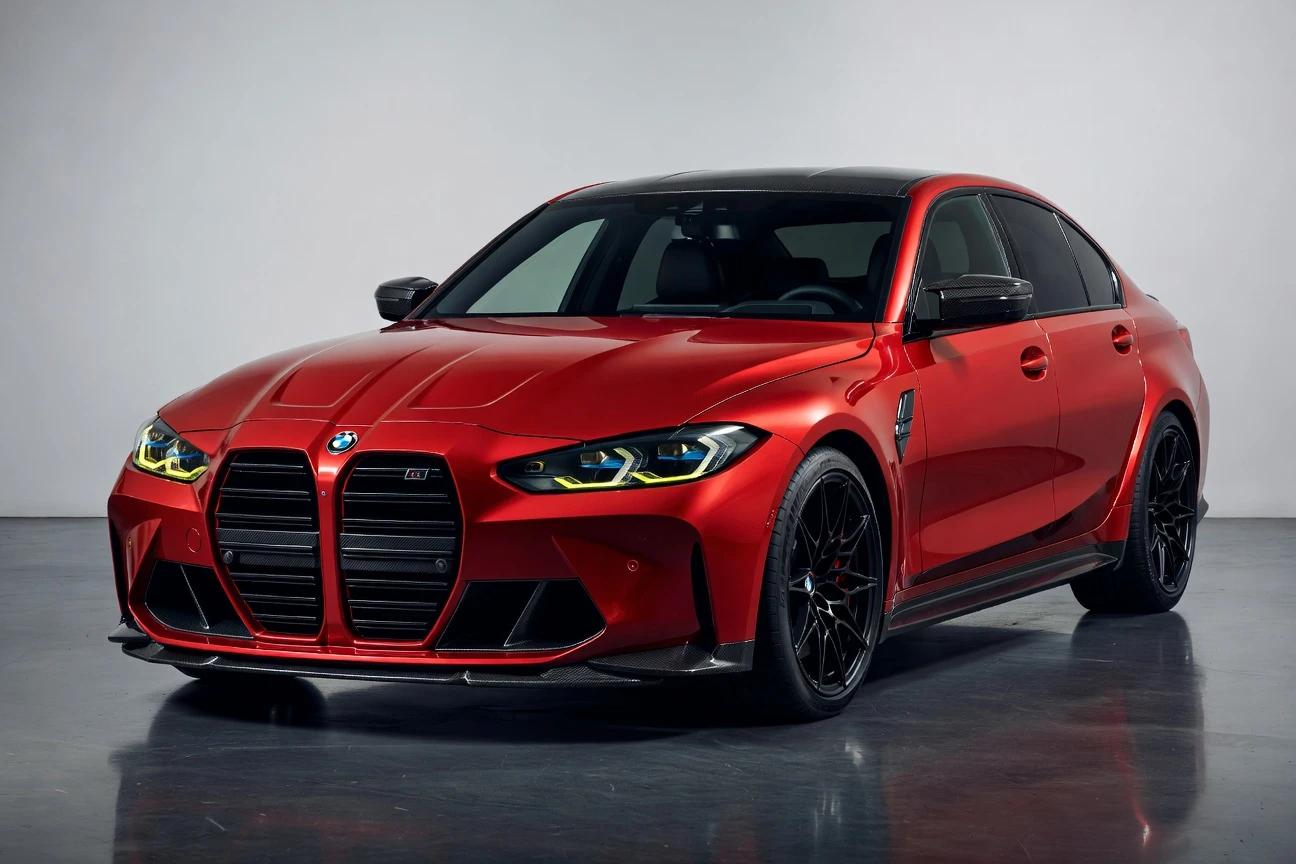
The styling cues are restrained but unambiguous. Yellow accents inside the adaptive LED daytime running lights (DRL, the slim signature line above the headlamp), red contour trim on the frameless kidney grille, an exposed-carbon roof, hood, splitter, mirror caps, rear spoiler, and diffuser. Wheels are forged 19-inch front and 20-inch rear, staggered, in gloss black. Inside, M Carbon bucket seats replace the standard sport seats and save 9.6 kg, with a heated M Alcantara steering wheel and the curved dual-screen dash carried over from the rest of the M3 range.
Where the Six-Speed Loses to the Automatic
BMW M is unusually candid about what the stick costs the buyer. Compared with the M3 CS xDrive Competition, which makes 543 horsepower and 479 lb-ft and reaches 100 km/h in 3.4 seconds, the new car is down roughly 70 hp, gives up about 73 lb-ft of torque, and adds 0.8 seconds to the 0-to-100 km/h sprint. Top speed lands at 290 km/h, identical to the automatic CS with the M Driver’s Package.
The output gap is deliberate. BMW M caps the S58’s output in manual cars because the six-speed gearbox, supplied by ZF and originally engineered for the F80 M3, cannot reliably accept the torque peak of the automatic-only Competition cars. The same self-imposed limit applies to the regular manual M3 sold globally, where outputs match the manual base car rather than the Competition variants.
The deltas, side by side:
- 70 hp less peak power (473 vs. 543)
- 73 lb-ft less peak torque (406 vs. 479)
- 0.8 sec slower 0 to 100 km/h (4.2 vs. 3.4)
- 34 kg lighter than the standard M3 with the optional M Carbon Ceramic brakes
The weight figure matters more than the power one. M Carbon bucket seats (9.6 kg saved), a titanium rear silencer (3.5 kg), the carbon-fiber roof and hood (about 9 kg combined), and the optional M Carbon Ceramic brake package (14 kg) stack to roughly 34 kg of mass off an M3 that already weighs near 1,725 kg. On a circuit, that ratio of weight saved to power lost reshapes how the car turns, not how it accelerates in a straight line.
Chassis Hardware Built for the Three-Pedal Car
BMW’s CS sub-brand has, since the original M3 CS of 2018, been the M3’s track-day insurance policy. Spring rates climb, dampers stiffen, body weight drops, and the engine map sharpens. This version inherits the chassis logic but resets the calibration for a manual transmission’s slower shift cadence and the rear axle’s higher peak slip angles without xDrive arriving to catch slides.
The damper rates are the headline change. The M4 CSL, BMW M’s most extreme inline-six road car to date, used a specification BMW says the new manual CS now shares. Combined with auxiliary springs and the 6 mm ride-height drop, the setup pulls the car’s pitch axis closer to its center of mass, which should reduce the M3’s known tendency to feel nose-heavy under trail-braking.
The body kit carries genuine carbon-fiber reinforced plastic (CFRP, the aerospace-grade composite BMW uses on its lightest M cars) parts rather than the cosmetic carbon trim some performance trims pass off as structural. The specific pieces:
- Roof panel, hood, and front splitter in exposed CFRP weave
- Mirror caps, rear spoiler, and rear diffuser
- Interior trim inlays around the dual-screen cluster
- Optional M Carbon Ceramic brake rotors, which save another 14 kg over the steel set
Buyers also get M Drive Professional as standard, including 10-stage M Traction Control, the M Drift Analyser, and the M Laptimer. None of those are new features; they have been on M cars for two generations. What is new is BMW pairing them with a layout that has no front axle to lean on when the rear breaks loose.
How the Three S58 Specials Compare
This is the third limited-run CS-tier S58 car BMW has built in the G80/G82 family. The other two, the M4 CSL of 2023 and the M3 CS xDrive of 2024, both ran the eight-speed automatic and produced more power. The table below puts the trio on the same line.
| Spec | M3 CS Handschalter | M3 CS xDrive | M4 CSL |
|---|---|---|---|
| Engine | 3.0L S58 I6 twin-turbo | 3.0L S58 I6 twin-turbo | 3.0L S58 I6 twin-turbo |
| Power | 473 hp | 543 hp | 543 hp |
| Torque | 406 lb-ft | 479 lb-ft | 479 lb-ft |
| Transmission | 6-speed manual | 8-speed automatic | 8-speed automatic |
| Drive | Rear only | All-wheel (xDrive) | Rear only |
| 0 to 100 km/h | 4.2 sec | 3.4 sec | 3.7 sec |
| Top speed (M Driver’s Pkg) | 290 km/h | 302 km/h | 307 km/h |
| US base price | $107,100 | $122,000 (2024 MSRP) | $140,895 (2023 MSRP) |
Only one of the three has been sold with three pedals from the factory. The CSL went rear-drive but kept the automatic; the regular CS went automatic and added xDrive. The new manual CS is the first time BMW M has combined rear-drive, manual, and CS-grade hardware on the same car, and the company has confirmed the configuration will not return on the next-generation M3.
This M3 Closes the Stick-Shift Era for BMW M
Manual take rates across BMW’s M3 and M4 lineup in the United States reached 20% in 2023, an unusually high figure for a luxury performance car priced above $80,000. The division had publicly committed to keeping the gearbox available for the foreseeable future. That commitment quietly redraws this week.
The next M3 arrives in two parallel forms. The ZA0, BMW’s first all-electric M3 and the first model on the Neue Klasse platform to wear an M badge, enters production in March 2027 with a quad-motor layout BMW has briefed as delivering between 800 and 900 horsepower. The G84, a mild-hybrid combustion successor running an updated version of the S58 with a 48-volt motor integrated into an eight-speed automatic, follows in July 2028. Neither successor offers a third pedal.
That makes the new CS less a revival of the manual M3 than its eulogy. The G80 platform began deliveries in 2021; the manual base M3 has been the only stick-shift sport sedan in BMW’s lineup since the previous-generation M2 Competition ended production. When the G80 wraps in the second half of 2027, BMW M will, for the first time in its 39-year history, sell no manual-transmission car at all.
A separate question hangs over the ZA0. BMW M’s leadership has said publicly that the electric car will stay true to BMW M DNA, yet every existing M car defines that DNA in terms of an exposed inline-six, mechanical noise, and an audible gearchange. This CS is, in that sense, the last car the division can sell using the old script.
Allocation, Pricing, and the July Window
BMW Canada’s product release confirms an allocation of 40 cars for the Canadian market at a starting MSRP of $132,500 CAD, which works out to roughly $96,000 USD at current rates and undercuts the U.S. sticker by about $11,000 before destination. BMW USA has not published a unit count for the United States, describing the run only as “very limited.”
Three things are confirmed for the launch:
- Production starts at the Munich plant in July 2026.
- First North American deliveries arrive in fall 2026.
- U.S. base price is $107,100, before BMW’s $1,350 destination handling.
The other variable is import duty. BMW assembles the M3 in Munich and ships finished cars to the United States and Canada, so tariff posture matters. The Trump administration’s delay of the proposed 25% EU automotive tariff to July 4 arrived two weeks before the production start; whether the duty lands at 15%, 25%, or stays paused through fall will shape how many of the very-limited units actually reach North American buyers at the published sticker.
If the July tariff schedule holds and Munich ships on time, the new manual CS will reach garages before the first ZA0 mule turns a wheel in public. If either slips, the model that was meant to bookend the sixth-generation M3 may end up overlapping with its replacement, and the question of what a real M3 looks like will be answered by two cars sitting on dealer lots at the same time.