Sony marked ten years of the 1000X series this week with a luxury reissue called the 1000X The Collexion, a stainless steel and vegan leather flagship that lands at $649.99 in platinum and black. The cans go on sale through Sony, Best Buy and Amazon in May, sitting one rung above the WH-1000XM6 that arrived a year ago.
The catch sits inside the new shell. Thinner ear cups passive-isolate less outside noise, the battery shaves six hours off playback compared with the XM6, and the price runs roughly $200 above what the XM6 commands at most retailers. Sony calls the Collexion “the pinnacle of technology and design,” yet the headphones quietly trade away the noise-canceling supremacy that defined the line.
The Anniversary Premium Costs Two Hundred Dollars
Sony Electronics unveiled the Collexion on May 19 with a price tag that places it $100 above the $549 Apple AirPods Max 2 and a clear segment above the rest of the over-ear field. Sony positions the model as a parallel product to the WH-1000XM6, not a successor. The XM6 stays in the lineup as the functional flagship; the Collexion is the luxury sibling.
That distinction matters because nothing about the Collexion replaces the XM6 on spec. Both use the same QN3 noise-canceling processor and the same 12-microphone array. The Collexion adds new drivers and a redesigned chassis. Otherwise the silicon is identical.
The pricing slot is unusual for Sony. The original WH-1000XM4 launched at $349. The XM5 lifted that to $399 and the XM6 to $449. The Collexion jumps to $649.99 and parks Sony in the same shelf as Bang & Olufsen’s Beoplay HX and Apple’s premium tier, a price band Sony has never seriously contested with the 1000X badge.
Vegan Leather and Stainless Steel Replace Plastic
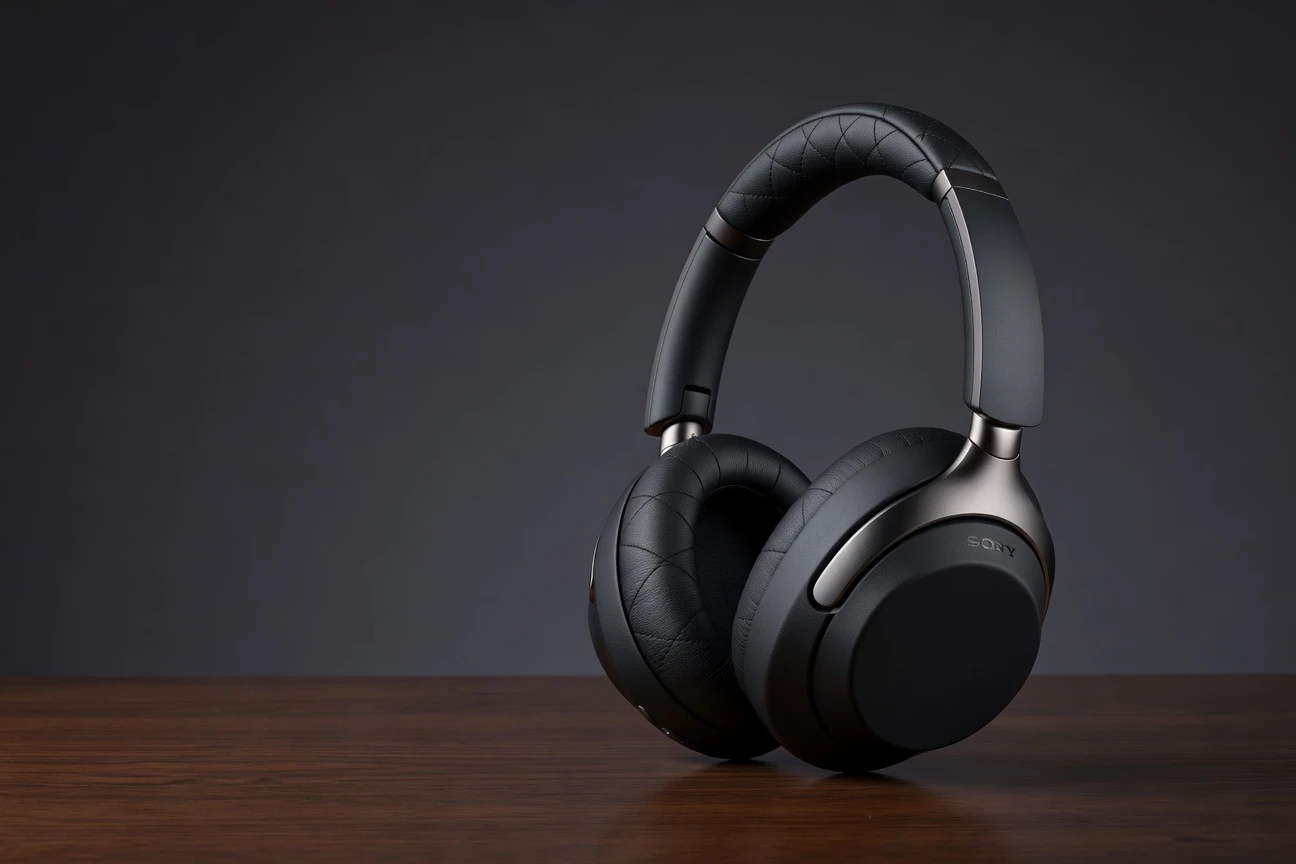
The Collexion borrows the silhouette of the XM6 and then rebuilds the materials. Stainless steel forms the headband core, the yokes, the buttons and even the jack housing. Sony spent two years developing the vegan leather that wraps the cups, the headband cushion and the ear pads, and the cushion itself measures roughly 40 percent thicker and 10 percent wider than the XM6’s.
That density shows up on the scale. The Collexion comes in at 320 grams, up from 253 grams for the XM6. It still undercuts the AirPods Max 2 at 386 grams, but the extra mass is noticeable after roughly 90 minutes of wear, when the top-of-head pressure starts to register.
The ear cup housing is 5 mm slimmer than the XM6 and the joints swivel flat rather than fold. That choice gives the carry case a sleeker profile, with a magnetic clasp and a cutout handle that reads more like a small bag than a hard-shell case. The pads themselves are removable and replaceable, though Sony has not published replacement pricing.
Sony also walked back its color palette. Platinum and black are the only options at launch, with no signal that the Collexion will broaden into the sandstone or midnight blue finishes Sony has run on the rest of the 1000X line. The minimalism reads deliberate; it also caps the model’s appeal to buyers who want their $650 headphones to actually look like a $650 purchase.
Same Processor, Less Passive Isolation
Active noise canceling on the Collexion runs the same algorithm as the XM6. Six microphones per cup feed the QN3 processor, the Adaptive NC Optimizer profiles the listener’s environment, and the cancellation curve is identical on paper. In practice it is not.
The thinner cup housing leaves less air volume between the driver and the listener’s ear, which weakens the passive seal. That gap shows up most in the midrange, around the 500 Hz to 2 kHz band where human voices and HVAC drone sit. The XM6 still hushes those frequencies more thoroughly, and reviewers comparing the two cans head to head have flagged the gap consistently.
ANC performance on The Collexion isn’t as robust as the WH-1000XM6, despite the new model having the exact same QN3 processor, 12-microphone array and noise-canceling optimizer.
That is Sony’s own framing, delivered to reviewers ahead of launch. The company describes the trade as a swap of passive isolation for pressure relief, the slight ear-pop sensation that aggressive cancellation can cause. Buyers who logged the most flight hours per month on the XM4 and XM5 are unlikely to read that as an upgrade.
Battery Drops to Twenty-Four Hours
The slimmer cups also leave less room for the battery. Sony rates the Collexion at 24 hours of playback with noise canceling on and 32 hours with it off. The XM6 rates 30 and 40 respectively. That is a six-hour drop in the configuration most owners will actually use.
Fast charging takes a similar haircut. A five-minute top-up on the Collexion yields 90 minutes of playback. The XM6 squeezes three hours from a three-minute charge. For commuters who plug in at the airport gate and expect to land with a full reserve, the new spec is the wrong direction.
The battery story does not break the headphones. A 24-hour rating still clears most international flights and a full work week of two-hour listening sessions. It does undercut the marketing case, though, because the rest of the over-ear field has been adding hours, not subtracting them.
Carbon Fiber Drivers and a Cleaner High End
The new driver is the engineering story Sony wants buyers to focus on. Each cup houses a 30 mm unit with a soft-edge suspension and a high-rigidity dome built from unidirectional carbon composite. Sony pairs that hardware with its DSEE Ultimate (Digital Sound Enhancement Engine, an AI upscaler that rebuilds bit depth and sampling rate from compressed sources) and a new V3 integrated processor.
The result is a clearer lower midrange and a noticeably brighter top end than the XM6 delivers. Vocals separate from instrument beds more cleanly, and the soundstage feels wider, particularly on acoustic and live recordings. Bass remains generous, sometimes generous enough that dense rock and metal mixes lose detail in the low mids.
Sony also added music and game modes to its 360 Upmix feature, which takes a stereo signal and synthesizes a three-dimensional field. The cinema mode carries over from the XM6. None of the upmix modes match a track actually mixed for spatial audio, but the game mode is the most defensible addition because most console and PC titles ship in stereo regardless of the headset on the listener’s head.
Codec support extends to LDAC, LC3 and the usual SBC and AAC pairings over Bluetooth 6.0. A 10-band parametric equalizer lives inside Sony’s Sound Connect app, which gives buyers the ability to flatten the bass shelf if the stock tuning runs hot for their library.
How the Collexion Stacks Up at $650
The Collexion does not have a direct competitor at its exact price. The closest comparisons sit on either side: the WH-1000XM6 from Sony’s own catalog, the AirPods Max 2 from Apple, and the Bose QuietComfort Ultra Headphones that still anchor the premium ANC tier.
| Spec | 1000X Collexion | WH-1000XM6 | AirPods Max 2 | Bose QC Ultra |
|---|---|---|---|---|
| Price (USD) | $649.99 | $449.99 | $549 | $429 |
| Weight | 320 g | 253 g | 386 g | 250 g |
| Battery, ANC on | 24 hours | 30 hours | About 20 hours | 24 hours |
| Fast charge | 5 min, 1.5 hr playback | 3 min, 3 hr playback | 5 min, 1.5 hr playback | 15 min, 2.5 hr playback |
| Headband core | Stainless steel | Plastic | Aluminum | Plastic |
| Folds | Swivel only | Folds | Swivel only | Folds |
Read across that table and the Collexion’s value proposition narrows. It costs more, weighs more and lasts less than the XM6 it nominally sits beside. Against the AirPods Max 2, it weighs less and lasts longer, but trades a closed Apple ecosystem for an open Android-friendly one. Against the Bose, it is a luxury statement competing with a budget statement.
Who the Collexion Is For
Sony’s framing of “functional XM6, luxury Collexion” is honest about the audience. These headphones are for buyers who already own a strong pair of ANC cans and want the upgrade to be visible, not just audible. Stainless steel headbands and quilted vegan leather pads earn their keep at a coffee shop bar, on a commuter train, or on a video call where the headset is in frame.
Listeners who fly often, who depend on ANC to flatten cabin drone, who charge in short bursts between meetings, are better served by the XM6 and the $200 they keep in their pocket. The same applies to anyone whose listening day exceeds the 24-hour battery in two or three sessions per week.
The Collexion arrives in a year when Sony’s audio business has been pushing premium across the board. The company also unveiled two new BRAVIA Theatre soundbar systems in India earlier this spring, with a starting price north of ₹39,990 and a similar pitch around premium build and spatial audio. Pricing the Collexion at $649 is part of the same playbook: extend the badge upward and let the existing flagship hold the volume tier.
Whether enough buyers say yes at $650 is the open question. The 1000X line has built its reputation on being the best total package for the money. The Collexion is not arguing that case. It is arguing that some buyers want the badge, the leather and the steel more than they want the noise-canceling crown, and Sony has built a headphone for exactly that customer.
For everyone else, the WH-1000XM6 remains the smarter $449.