The iPhone 18 Pro and iPhone 18 Pro Max are expected to launch in September 2026 with a 5,100mAh battery, an estimated 35% narrower Dynamic Island, Apple’s first 2nm A20 chip, and a new C2 modem. Leaks point to flat starting prices in India and the United States despite a global memory crunch and a reported $280 A20 chip cost.
That second number is the one to watch. Industry analyst Ming-Chi Kuo of TF International Securities and Jeff Pu of GF Securities have both told clients Apple intends to hold the iPhone 18 Pro at $1,099 and the Pro Max at $1,199. In India, that would translate to Rs 1,34,900 and Rs 1,49,900 if Apple repeats the iPhone 17 Pro ladder. Pulling it off means swallowing what supply-chain reporting calls the most expensive mobile chip Apple has ever shipped, at exactly the moment OnePlus, Nothing and Xiaomi have lifted flagship prices in India.
What the A20 Chip Costs Apple
Taiwan’s Economic Daily News, citing supply-chain checks, puts the A20 wafer cost at roughly $280 per unit, an 80% jump on what Apple paid for the A19. TSMC’s 2nm process node roadmap indicates wafer pricing will run at least 50% above 3nm because of equipment depreciation and the slow yield ramp on N2.
Apple buys these chips by the tens of millions. An 80% per-unit increase on a part used across two top-margin SKUs is not a rounding error. Kuo’s view, posted on X in March 2026, is that Apple negotiates DRAM (dynamic random-access memory, the working memory inside every smartphone) on a quarterly cadence rather than every six months. That schedule lets the company buy aggressively when spot prices dip.
Most Android brands sign six- or twelve-month memory contracts, which freezes them at whatever the prevailing rate was on signing day. Apple’s volume gives it a second lever: SK Hynix, Micron and Samsung all compete for the iPhone allocation, and the loser of any given quarter wants the next one badly.
The strategic read is straightforward. Apple is willing to compress its hardware gross margin, lean on services revenue to fill the gap, and use the moment to take share from rivals already passing memory costs to buyers. Whether that hold survives a full production year depends on where memory contract prices settle by July.
The Spec Sheet Tipsters Have Settled On
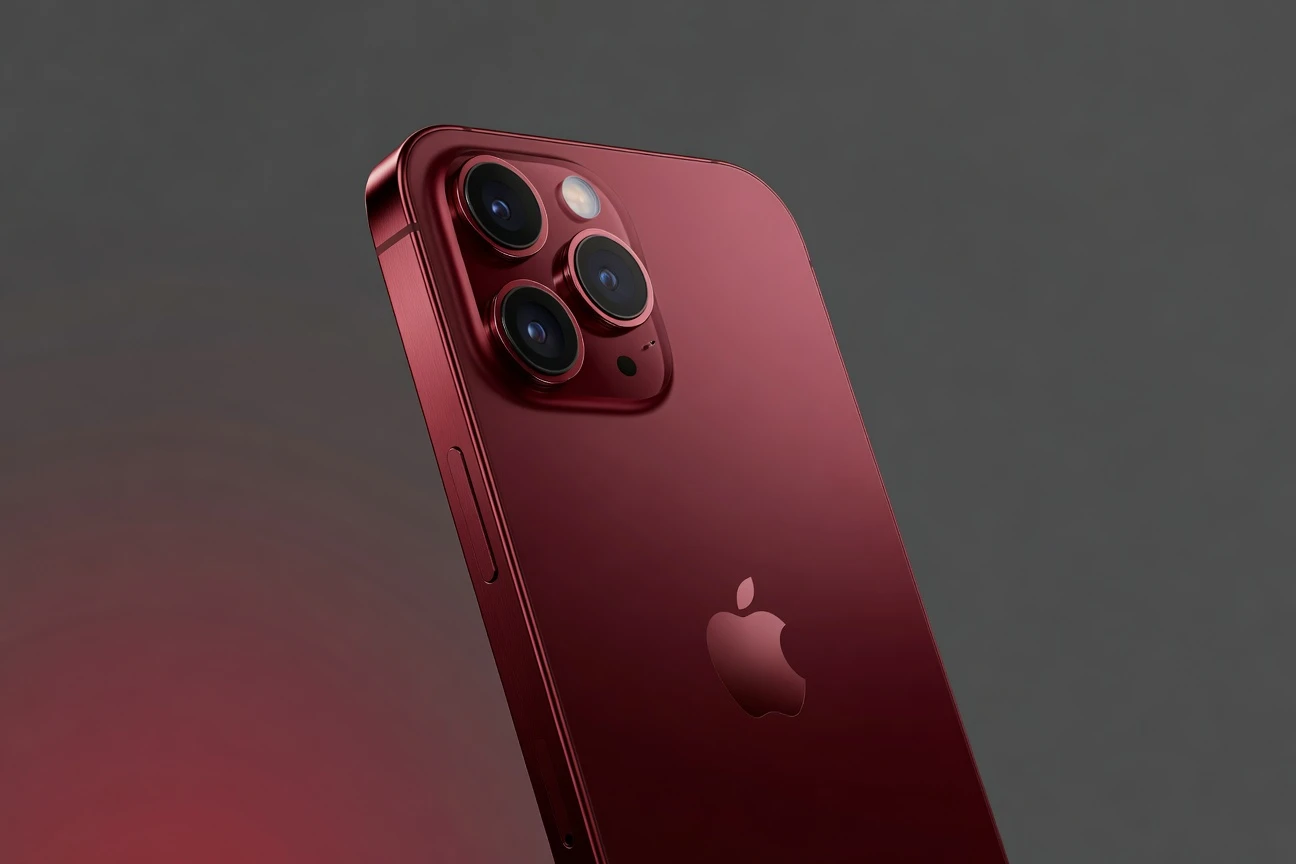
Most of the iPhone 18 Pro leaks now triangulate. Ice Universe, Majin Bu and Jeff Pu have converged on a similar feature list, while earlier rumours, like under-display Face ID, have been quietly walked back. The hardware shifts are real but measured: a tick-tock year, not a redesign year. The full colour set, including the leaked Dark Cherry finish for the iPhone 18 Pro, surfaced in April from Chinese supply-chain accounts.
| Specification | iPhone 17 Pro Max (current) | iPhone 18 Pro Max (leaked) |
|---|---|---|
| Display | 6.9-inch LTPO OLED | 6.9-inch LTPO+ OLED |
| Dynamic Island width | 20.76mm | ~13.49mm (35% narrower) |
| Chassis thickness | 8.75mm | 8.8mm |
| Battery | 5,088mAh | 5,100 to 5,200mAh |
| Chipset | A19 Pro (3nm) | A20 Pro (2nm) |
| Modem | Apple C1 (sub-6 GHz) | Apple C2 (mmWave + NR-NTN) |
| Main camera | 48MP fixed aperture | 48MP variable aperture |
| Image sensor | Sony stacked CMOS | Samsung three-layer PD-TR-Logic |
| US starting price | $1,199 | $1,199 (Kuo, Pu projection) |
| India starting price | Rs 1,49,900 | Rs 1,49,900 (projected) |
The Dynamic Island figure is the visual headline. Ice Universe’s measurement of the pill shrinking from 20.76mm to 13.49mm matches the CAD renders that leaked from case-makers in April 2026. Apple has not moved Face ID under the display because the under-panel module’s accuracy is not yet at parity with the current TrueDepth array, according to display-chain reporting. The thickness bump of 0.05mm sounds trivial, but it is the volume Apple needs to fit the larger cell, and combined with the LTPO+ panel it is what carries the rumoured one-to-two hour gain in video playback.
Camera Hardware Is Where the Money Went
The camera changes carry the iPhone 18 Pro’s argument for an upgrade more than the screen does. Three shifts are tracking through multiple leakers, and each one closes a specific gap with Android flagships.
- Variable aperture on the main 48MP wide. Apple is testing a mechanical iris that opens between roughly f/1.8 and f/4. The change matters most for portrait depth control and for low-light shots where a wide aperture pulls in light without lifting ISO into noisy territory.
- Samsung’s three-layer stacked sensor. Supply-chain reports from Korean outlet The Elec describe a sensor called PD-TR-Logic. It separates the photodiode, transistor and logic layers onto three stacked wafers, which is meant to cut readout noise and lift dynamic range. At least one Pro model is expected to ship with it. Samsung Semiconductor’s mobile image-sensor portfolio lists the architecture in development.
- Telephoto upgrades. The 5x periscope module gains a wider aperture, and Apple is reportedly testing a teleconverter element that could extend optical reach beyond 5x without sacrificing sharpness.
The variable-aperture mention has been a long time coming. Huawei shipped variable aperture on the P60 Pro in 2023, and Xiaomi followed with the 13 Ultra. Apple’s late arrival means reviewers already know what to test for, but the integration with computational photography is where the iPhone usually pulls ahead.
One caveat is worth flagging. The Samsung sensor has appeared in supply-chain reporting but reads more like a roadmap item than a confirmed 2026 lock. If Apple defers the three-layer stack to the iPhone 19 Pro, the camera story shrinks to variable aperture plus a marginally better telephoto, a thinner pitch than the current leak ecosystem implies.
A20, C2 Modem, and a Bet on Satellite
The A20 Pro is the first Apple silicon to integrate RAM directly onto the processor package using a method called WMCM (wafer-level multi-chip module). Shorter data paths between CPU, GPU, Neural Engine and memory translate to better Apple Intelligence performance on-device and slightly more internal volume for battery and camera modules.
Apple’s performance claim, surfaced through supply-chain leakers, is roughly 15% faster CPU and GPU throughput and 30% better power efficiency against the A19 Pro. The efficiency number is the one that pairs with the larger cell to produce the two-day stamina rumour on the Pro Max.
The C2 modem is the more strategically interesting upgrade. Apple’s first-generation C1, in the iPhone 16e, was sub-6 GHz only. C2 adds mmWave 5G and, importantly, support for NR-NTN (New Radio Non-Terrestrial Networks), the 3GPP standard for satellite cellular connectivity that lets a phone treat a low-earth-orbit satellite as a backhaul cell. Apple Maps and Photos are expected to work over satellite from day one, with a third-party API to follow.
If the satellite implementation is genuinely transparent, meaning a user does not need to point the phone skyward, Apple gains a hardware moat Android cannot match this calendar year. Qualcomm’s competing satellite stack is still in trial with Iridium. SpaceX’s Starlink Direct-to-Cell partnership with T-Mobile is text-only on the consumer side. The gap matters most in markets with patchy rural coverage, which includes large parts of India.
Why India Pricing Holds While Rivals Hike
India is where Apple’s flat-price strategy will be tested first. The country is now Apple’s fastest-growing premium-smartphone market by revenue, and the standard iPhone 17 ranked among the best-selling smartphones globally in Q1 2026 according to Counterpoint Research. Holding the price ladder is what protects that momentum. Apple India’s iPhone 17 Pro listing shows the current floor at Rs 1,34,900.
How OnePlus, Nothing, and Xiaomi Reacted to Memory Inflation
While Apple sits on quarterly memory contracts, the rest of the Android premium tier has already capitulated. DRAM and NAND spot pricing has climbed sharply since late 2025, driven by AI data-center demand for HBM (high-bandwidth memory) and DDR5 pulling capacity away from mobile suppliers.
| Brand and model | Launch price (India) | Current price (May 2026) | Increase |
|---|---|---|---|
| OnePlus 15 (12GB / 256GB) | Rs 72,999 | Rs 77,999 | Rs 5,000 |
| Nothing Phone 4a Pro | Rs 39,999 | Rs 44,999 | Rs 5,000 |
| Redmi Note 15 Pro+ | Rs 37,999 | Rs 39,999 | Rs 2,000 |
Nothing’s chief executive Carl Pei told reporters in April 2026 that smartphone prices were about to climb across the industry, citing memory specifically. CyberPowerPC’s component price tracker has shown DRAM spot pricing up several-fold from 2024 levels with SSD pricing roughly doubled, and neither curve has rolled over yet.
What Apple’s Memory Negotiation Cadence Looks Like
Apple’s leverage is volume plus timing. The company purchases enough DRAM and NAND in any given year to nudge spot pricing the other direction by buying ahead of contract resets. Kuo’s January note described Apple as locking quarterly deals with Micron, SK Hynix and Samsung, which means the company can buy aggressively in any quarter where contract prices soften. That cadence is what lets Apple absorb cost rather than pass it.
Where India Buyers Land on the Ladder
If the leaked $1,099 and $1,199 US prices translate cleanly, the iPhone 18 Pro lands at Rs 1,34,900 and the Pro Max at Rs 1,49,900 in India, identical to the iPhone 17 Pro line. That keeps the 256GB Pro within reach for Apple’s primary India buyer cohort, the upgrade-from-iPhone-15-or-16-Pro user on a 24-month EMI. A Rs 5,000 hike, mirroring the OnePlus 15 move, would push the Pro Max into a tier where it competes directly with the Samsung Galaxy S26 Ultra rather than sitting clear at the top.
The risk is the higher storage tiers. Kuo flagged that 512GB and 1TB configurations may absorb $100 to $200 of the memory cost. In rupees that is a Rs 8,000 to Rs 16,000 bump on the upper SKUs even if the base price holds, which would put the 1TB Pro Max within touching distance of Rs 2 lakh for the first time.
The Cost Curve Between Now and September
Three production realities will decide whether Apple’s flat-price target survives the September launch window. TSMC’s 2nm defect density remains elevated relative to where 3nm sat at the same point in its ramp, which raises the cost per good die. Apple has historically eaten the difference rather than delay, but the chip cost ceiling is real and visible in the $280 figure.
The DRAM and NAND contract cycle is the second. Apple’s Q3 negotiations close in July. If spot pricing stays elevated through June, the contract price Apple locks for the iPhone 18 production run becomes the number that decides whether the company can keep absorbing or has to pass the bill to buyers. Foldable supply momentum, visible in the Asian Apple-supplier rally tied to the foldable iPhone schedule, suggests the upstream chain is still bracing for a normal launch cadence.
The third is what rivals do. If Samsung holds the Galaxy S26 Ultra at its current Indian band, Apple’s flat hold reads as routine competition. If Samsung raises in August, Apple takes pricing power without lifting a sticker. The Cupertino event will tell most of the story; the India price drop, usually two to three weeks later, will tell the rest.