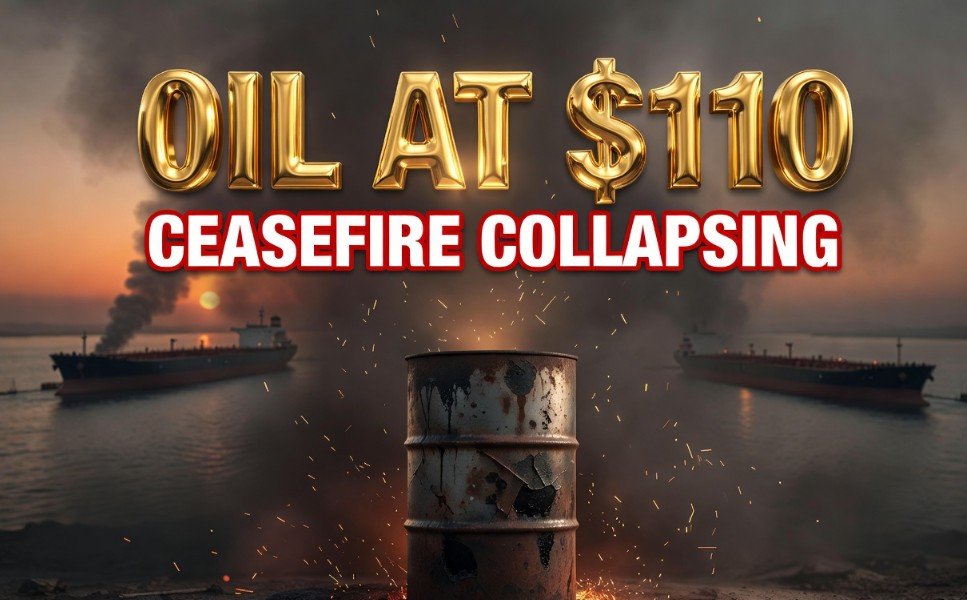
President Donald Trump sent global oil markets into overdrive this week after declaring the US-Iran ceasefire is now “on massive life support.” Brent crude surged above $107 per barrel and is now knocking on $110, while American drivers are paying $4.52 a gallon at the pump. With Gulf oil infrastructure shattered and peace talks stalled, the world is watching with growing dread.
Oil Markets Surge on Trump’s Blunt Ceasefire Warning
Brent crude futures climbed 3.4% on Tuesday to close at $107.77 per barrel, extending sharp gains from the session before. West Texas Intermediate was not far behind, rising 4.2% to settle at $102.18 per barrel, crossing the symbolic $100 mark once again.
The market reaction was swift and direct. Speaking from the Oval Office on Monday, Trump pulled no punches after rejecting Iran’s latest peace proposal as “garbage.”
“I would say the ceasefire is on massive life support, where the doctor walks in and says, ‘Sir, your loved one has approximately a 1% chance of living,'” the president told reporters.
Iran had reportedly demanded that the United States lift its naval blockade and ease sanctions, while also seeking to retain some authority over traffic through the Strait of Hormuz. Washington rejected all of it.
Trump also said he was planning to meet with a large group of generals to weigh potential next steps, raising fresh concerns about a possible return to active military operations.
Gas prices at the pump have now risen more than 28% compared to a year ago, according to Labor Department data. Prices remain 52% higher than when the war first started in late February, per AAA motor club figures.
Gulf Oil Infrastructure Won’t Fully Recover Until 2027
The physical damage to Gulf energy infrastructure is now severe enough that both Saudi Arabia and the UAE have signaled full repairs to drone-hit facilities will not be possible until at least next year.
Saudi Aramco CEO Amin Nasser delivered a stark warning to global markets: the world is losing roughly 100 million barrels of oil supply every single week the Strait of Hormuz remains effectively shut.
The list of damaged and disrupted assets tells the full story of how widespread the destruction has been:
- Ras Tanura, Saudi Arabia: Aramco’s largest crude processing plant, with 550,000 barrels per day of capacity, was temporarily shut after a direct drone attack in the early days of the war.
- Ruwais, UAE: One of the world’s biggest refineries suffered multiple fires from falling debris produced by air-defense interceptions.
- Shah Gas Field, UAE: Operations were fully suspended after an Iranian drone attack sparked a fire at the massive natural gas facility in March.
- Ras Laffan, Qatar: QatarEnergy’s LNG facilities were struck by Iranian missiles, triggering fires and extensive damage, including at Shell’s gas-to-liquids plant, with force majeure declared on some long-term supply contracts.
The cumulative toll on OPEC output is historic. A Reuters survey found the 12-member group lost a combined 830,000 barrels per day in April alone, bringing total output down to just 20.04 million barrels per day. That is the lowest level of OPEC production recorded in more than 26 years.
Kuwait absorbed the sharpest individual blow, posting the largest single-country drop of 640,000 barrels per day, reflecting a full month of severe export disruptions.
The US Energy Information Administration now estimates that Iraq, Saudi Arabia, Kuwait, the UAE, Qatar, and Bahrain collectively shut in 10.5 million barrels per day of crude oil production in April. The agency also expects global oil inventories to draw down by an average of 8.5 million barrels per day in the second quarter of 2026, keeping Brent prices elevated around $106 per barrel through May and June.
China’s Refining Machine Slows to a Crawl
China, the world’s largest crude oil importer, is absorbing the Hormuz shock in a way that is quietly reshaping the global energy balance. With Gulf supply stranded, Chinese crude imports fell by a hefty 2.4 million barrels per day month over month in April, averaging just 9.25 million barrels per day. That is the lowest pace of Chinese crude imports since July 2022.
The sharpest pain is concentrated in Shandong province, home to China’s independent teapot refiners, where operating rates have collapsed to just 50% of capacity in May.
These refiners are being squeezed from every angle. Sky-high crude costs are crushing margins, while Beijing’s ban on refined product exports blocks them from selling to more profitable overseas markets to offset their losses.
| Pressure Point | What It Means for Chinese Refiners |
|---|---|
| Elevated crude input costs | Gulf supply disruption has pushed feedstock prices to painful highs |
| Refined product export ban | Beijing restricts overseas product sales to protect domestic supply |
| Weakening domestic demand | Sluggish consumer activity limits any margin recovery |
| NDRC production floor order | Government mandates run rates at or above 2024-2025 averages, or import quotas get cut permanently |
China’s state planner, the National Development and Reform Commission, has warned that independent refiners cutting run rates below historical averages risk losing their crude import quota allocations for good. That puts these operators in an almost impossible bind, forced to choose between losing money on every barrel they process or losing their right to import crude entirely.
Despite lower imports, Chinese crude inventories remain broadly flat at around 1.34 billion barrels in May, according to Kayrros data. That suggests refiners are compensating for the import shortfall primarily by cutting production rather than drawing down their stockpiles.
China’s nominations for June-loading Saudi oil barrels have also collapsed to just 333,000 barrels per day, down from a 2025 average of 1.4 million barrels per day, as consistently high Saudi formula prices make the kingdom’s oil commercially unattractive.
Sanctions, the Xi-Trump Summit, and What Comes Next for Oil
The Trump administration this week announced new sanctions targeting Chinese and UAE companies accused of facilitating Iranian crude shipments to China. The State Department went a step further, offering a reward of up to $15 million for new information on the IRGC’s oil trading networks.
Beijing fired back immediately, calling the measures “illegal unilateral pressure” and activating a blocking statute, first passed in 2021 and never previously used, that prohibits any Chinese entity from recognizing or complying with the US measures.
All of this is unfolding as President Trump has departed for Beijing to meet Chinese President Xi Jinping. The summit, delayed from its original March schedule because of the Iran war, now carries weight well beyond trade and tariffs.
China currently buys more than 80% of Iran’s shipped oil, making Beijing the most powerful external actor with any real ability to bring Tehran back to the negotiating table.
There is a painful irony baked into Washington’s position. Years of US sanctions helped push Iran into a corner, and now the Trump administration finds itself needing China’s goodwill to bring Iran to a deal.
China is not immune to the pain either. Beijing imports roughly half its crude oil and nearly a third of its liquefied natural gas from Middle Eastern countries caught in the Hormuz disruption, according to China’s General Administration of Customs. The Strait’s closure is hitting China’s export-driven economy just as hard as it is hurting its energy supply.
Oil market analysts are watching the Beijing summit as the single most important near-term event for crude prices. Citi analysts note that risks remain tilted to the upside, as Iran controls the timing of any Hormuz deal. JPMorgan expects Brent to average around $97 per barrel for the full year 2026, assuming no quick recovery even once the strait eventually reopens.
Iran’s Islamic Revolutionary Guard Corps added another alarming development this week, announcing it had expanded its zone of control around the Strait of Hormuz to an area 10 times wider than before the conflict started, stretching all the way to Sirri Island, roughly 250 kilometers from Hormuz itself.
Iran’s own energy authorities have also warned that repairing the country’s badly damaged infrastructure, with particular damage to the South Pars gas field, could take up to two years and require serious investment.
Over the past 11 weeks, a regional military standoff has grown into a genuine global economic emergency. Oil is nearing $110 per barrel, gas prices are at record highs, and refineries across Asia are running at half capacity. The Trump-Xi summit in Beijing now carries a weight far beyond trade agreements, and its outcome may determine how much longer ordinary families around the world pay this painful price. What do you think will come out of Beijing? Share your views in the comments below.