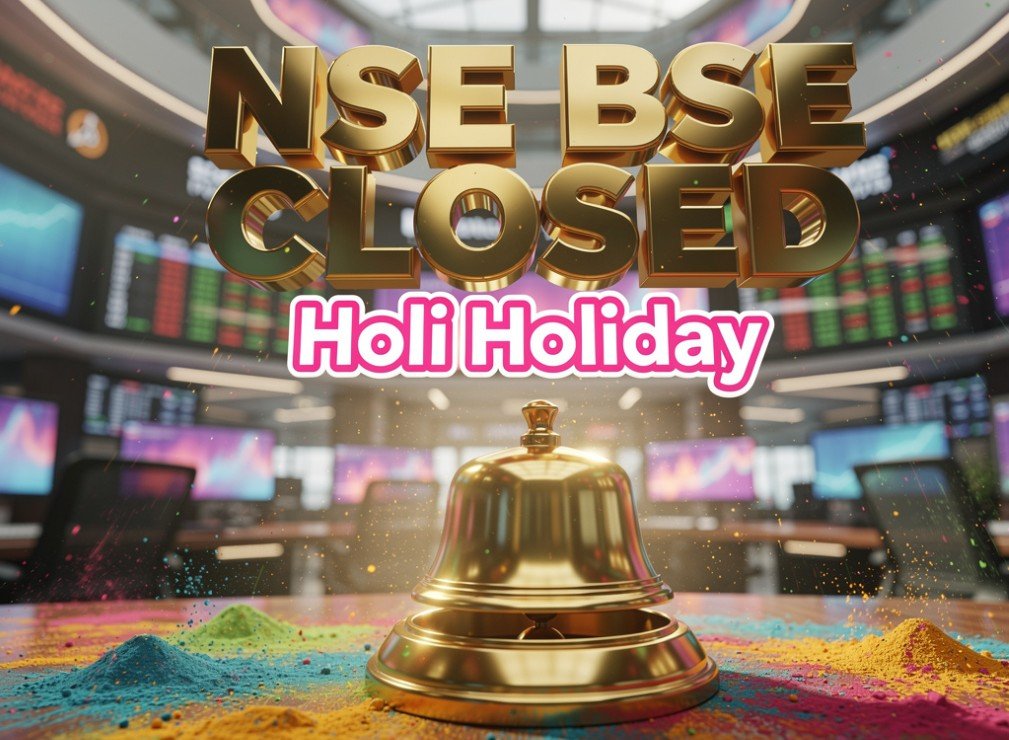
Investors logging into trading apps this morning were greeted with a pause instead of price ticks. India’s leading stock exchanges NSE and BSE are closed today, March 3, 2026, on account of the Holi holiday. The festival of colors may be celebrated across many states on March 4, but the market holiday has been observed today as per the official exchange calendar.
Here is a complete breakdown of what is open, what is closed, and what traders should expect next.
NSE and BSE Closed for Holi 2026
Both the National Stock Exchange and the Bombay Stock Exchange are not conducting trading activities today. This includes:
-
Equity trading
-
Equity derivatives
-
Currency derivatives
-
Securities lending and borrowing
The holiday was pre scheduled in the 2026 trading calendar released by the exchanges. Even though Holi festivities will peak in several regions on Wednesday, March 4, the official trading holiday falls on Tuesday, March 3.
No settlement, clearing, or market operations will take place during regular trading hours today.
Investors should note that markets will reopen on Wednesday, March 4, unless otherwise notified by the exchanges.
MCX and NCDEX Trading Schedule Today
While equity markets are fully closed, commodity markets have a slightly different schedule.
Here is how commodity exchanges are operating:
| Exchange | Morning Session | Evening Session |
|---|---|---|
| MCX | Closed | Open from 5 pm to 11:30 pm |
| NCDEX | Closed | Closed |
The Multi Commodity Exchange of India is shut during the morning session from 9 am to 5 pm. However, trading will resume in the evening session starting at 5 pm.
The National Commodity and Derivatives Exchange remains closed for both sessions today.
This split schedule is important for traders active in gold, silver, crude oil, and other commodities.
Market Recap Before the Holiday Break
The holiday comes after a sharp sell off in Indian equity markets on Monday.
The benchmark Nifty 50 index fell 313 points, or 1.24 percent, to close at 24,865.70. Meanwhile, the 30 share Sensex dropped 1,048 points, or 1.29 percent, settling at 80,238.85.
Sector wise weakness was visible across:
-
Financial stocks
-
Auto shares
-
Consumer companies
Broader market sentiment turned cautious as volatility spiked. The India VIX, often called the fear index, surged 25 percent to settle at 17.13.
The sharp rise in volatility reflects growing nervousness among investors.
Technical analysts observed that Nifty is now trading near key support levels around 24,600. A decisive break below this zone could push the index toward 24,400, while resistance remains near 25,000 to 25,250.
Market experts have advised traders to keep positions light and maintain disciplined risk management in the current environment.
Full List of Upcoming Stock Market Holidays in 2026
The exchanges had initially announced 15 trading holidays for 2026. An additional holiday was later added in January due to local elections.
Here are the remaining key holidays in 2026:
March
-
March 3: Holi
-
March 26: Shri Ram Navami
-
March 31: Shri Mahavir Jayanti
April
-
April 3: Good Friday
-
April 14: Ambedkar Jayanti
May
-
May 1: Maharashtra Day
-
May 28: Bakri Id
June
-
June 26: Muharram
September
-
September 14: Ganesh Chaturthi
October
-
October 2: Gandhi Jayanti
-
October 20: Dussehra
November
-
November 10: Diwali Balipratipada
-
November 24: Guru Nanak Jayanti
December
-
December 25: Christmas
An important detail is that Diwali in 2026 falls on a Sunday. Therefore, there is no separate weekday holiday for Diwali. However, Muhurat Trading will be conducted on Sunday, November 8, 2026. The exact trading window will be announced separately.
Investors should remember that exchanges can modify holiday schedules through official circulars.
Why Stock Market Holidays Matter to Investors
Market holidays may appear routine, but they carry practical implications.
When exchanges are closed:
-
No trades can be executed
-
Orders remain pending
-
Settlement cycles shift
-
Global market events may create gaps at reopening
If global markets move sharply during the holiday, Indian indices may open with a gap up or gap down on the next trading day.
Long weekend holidays can also impact liquidity and trading volumes before and after the break.
For derivatives traders, holidays can influence option pricing due to time decay adjustments.
What Should Traders Do During a Market Holiday
Instead of viewing the closure as downtime, experienced investors use holidays strategically.
Here are a few practical steps:
-
Review portfolio allocations
-
Assess exposure to volatile sectors
-
Study global market cues
-
Re evaluate stop loss levels
-
Prepare watchlists for reopening
With volatility rising recently, reviewing risk exposure becomes even more important.
Periods of market closure offer valuable time to think clearly without price fluctuations influencing decisions.
Global Factors to Watch Before Markets Reopen
When trading resumes, investors will closely monitor:
-
US market performance
-
Crude oil prices
-
Dollar index movement
-
Asian market trends
-
Global geopolitical developments
These factors can significantly influence opening sentiment in Indian markets.
With recent volatility and sector specific weakness, traders may adopt a cautious stance on Wednesday’s opening.
A Pause Before the Colors Return
As India celebrates Holi, the festival of joy and renewal, Dalal Street takes a brief pause. Markets may be closed for a day, but financial activity never truly sleeps. Global developments continue, and investors prepare for the next session.
Today’s closure is temporary, but the larger story of market momentum continues.
Are you using this market holiday to review your portfolio or stepping away to enjoy the festival? Share your thoughts in the comments and tell us how you prepare during trading breaks.