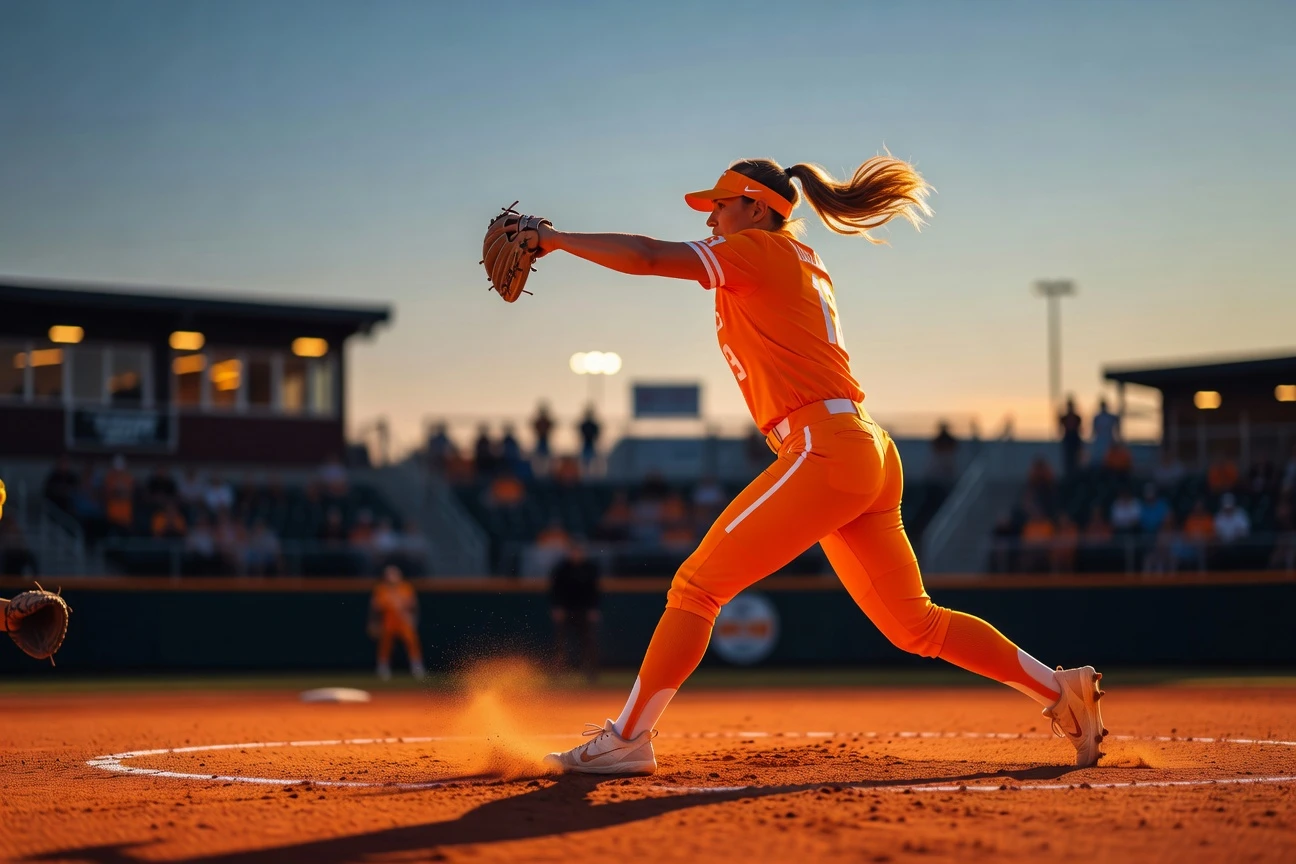
The Tennessee Lady Vols allowed 3.46 hits per seven innings this season, the lowest mark in the country. The Georgia Bulldogs hit .354 as a team, third in the Southeastern Conference (SEC, the league both schools play in). Those two numbers will stare at each other across the dirt at Sherri Parker Lee Stadium on Thursday night, and they will largely decide whether the seventh-seeded Lady Vols (45-10) reach the Women’s College World Series for the second straight year. Tennessee hosts No. 10 seed Georgia (41-18) in a best-of-three NCAA super regional series starting May 21 at 7 p.m. ET on ESPN2.
The script favors the home team. The Bulldogs counter with a lineup peaking at the right time and a pitching staff that has quietly cut its ERA in half over six postseason games, which complicates the math the Lady Vols would otherwise prefer to lean on.
The Pickens Factor and Tennessee’s Pitching Edge
Karlyn Pickens, the Tennessee senior right-hander who set the NCAA softball record with a 79.4 mph fastball last postseason, threw a complete game in the regional final against Virginia, allowing one run with nine strikeouts. She did not have to be perfect because she rarely is asked to carry the staff alone.
Tennessee head coach Karen Weekly has rotated three legitimate starters all year. Pickens, Sage Mardjetko and Erin Nuwer each opened a game in the Knoxville Regional. The Lady Vols swept it. That depth turned a one-ace problem into a three-arm bullpen-and-rotation hybrid in May.
The team numbers speak louder than any single line score.
- 1.37 ERA, first in the SEC.
- 0.84 WHIP (walks plus hits per inning pitched), first in the SEC.
- 440 strikeouts, second in the SEC.
- 3.46 hits allowed per seven innings, first in the nation.
For a Bulldog lineup that thrives on contact rather than power, those numbers map onto the exact shape of the matchup. Georgia ranks ninth in the SEC in strikeouts (236), which means its hitters will put balls in play. Tennessee’s challenge is what happens after the ball leaves the bat, not before.
Georgia’s Bats Found a Different Gear in May
The Bulldogs spent most of the SEC slate looking like a team that would be lucky to host a regional. They lost four conference series, including a sweep at Oklahoma. Then they flipped the second half of May on its head.
Georgia closed the regular season by upsetting Florida. The win sent them on a run to the SEC Tournament semifinals that included a second upset of the Sooners. In their NCAA regional, they shut out UNC Greensboro and Clemson on the way to a sweep, racking up 26 hits and 18 runs across three games.
The offensive resume on the season is real. Per the conference’s official softball statistics, the Bulldogs sit third in batting average (.354), fourth in runs scored (409), fourth in RBIs (384) and second in doubles (105). They double up well, which is the kind of damage Tennessee’s strikeout-light staff (relative to the top SEC arms) tends to give up before erasing the next runner.
The bigger development is in the circle. Georgia’s pitchers, who allowed at least nine hits in 16 regular-season games, have averaged only 3.83 hits allowed across six postseason outings. The staff ERA has dropped from 3.23 on the year to 2.10 in the postseason. That is not a small adjustment. That is a different team showing up in May.
The Matchup by the Numbers
The side-by-side reads less like a mismatch and more like a stylistic puzzle. Tennessee’s strength is at the point of attack. Georgia’s strength is what it does to the next pitch.
| Metric | Tennessee (45-10) | Georgia (41-18) |
|---|---|---|
| Team ERA | 1.37 (SEC 1st) | 3.23 season / 2.10 postseason |
| Team WHIP | 0.84 (SEC 1st) | not in SEC top tier |
| Team batting average | middle of SEC | .354 (SEC 3rd) |
| Runs scored | fewer than Georgia | 409 (SEC 4th) |
| Doubles | middle of SEC | 105 (SEC 2nd) |
| Strikeouts (offense) | middle of SEC | 236 (SEC 9th, fewer Ks) |
| Hits allowed per 7 innings | 3.46 (NCAA 1st) | roughly 3.83 in postseason |
| Recent form | 3-0 regional sweep | 3-0 regional sweep |
A few interpretations follow from the table. Tennessee’s pitching is the cleanest tier of any number on the board. Georgia’s bats and Georgia’s bullpen are both moving in the right direction at the same time, which is rare and usually a sign of a team that has solved something internally. The series will swing on whether the Bulldogs’ contact approach finds the Lady Vols’ gloves or finds the outfield gaps, because the strikeouts are not going to come easily.
Defense Carries the Hidden Burden
The Lady Vols can be the best pitching staff in the country and still lose this series if they kick the ball around in the third inning. Georgia is not a team that misses on mistakes.
A Bulldog lineup ranked second in the SEC in doubles will punish anything that gets through the infield. The team’s ability to stretch singles into runs has shown up in the postseason hit totals. Tennessee’s defense graded out well in the regional, but Virginia is not Georgia, and a single fielding error in a one-run game would invert the leverage.
The mental side matters too. Pickens, Mardjetko and Nuwer pitch to contact more often than not because they trust the seven players standing behind them. That trust holds when the defense plays clean. It frays when it does not. The biggest internal variable for the home team across three days is whether the routine play stays routine.
Georgia’s pitchers will face the inverse test. Their postseason ERA suggests something has clicked, but they have not yet seen an SEC offense that draws walks at Tennessee’s rate or punishes mistakes the way the Lady Vols’ middle of the order can on a good night.
Tennessee’s Offense Found a Pulse in Regionals
The bats were the inconsistent half of the Tennessee equation all season. The Knoxville Regional was the first sustained sign that side of the team has caught up to the pitching.
The three regional lines were ordinary on the surface and meaningful underneath.
- 3 runs on 8 hits against Northern Kentucky in the opener.
- 7 runs on 7 hits against Virginia in the second game.
- 5 runs on 6 hits against Virginia in the regional final.
Across those three games the Lady Vols posted 14 RBIs, five home runs and drew 11 walks. The walk count is the part of the line that has not been there for most of the season. Patience at the plate against Georgia’s improving staff is the difference between a long inning and a quick one.
One pattern from the regional is worth pulling out. Every time the opponent scored, Tennessee answered in the next half-inning. That response rate has not been a season-long trait for the Lady Vols. It was a trait of the LSU and Kentucky series, which were the two best offensive weekends of the spring, and it was a trait of the regional. If it carries into the super regional, Georgia’s road to two wins gets steep, because a one-run lead does not survive long enough to feel safe.
The lineup also scored in four straight innings during the regional final. Sustained scoring rather than one big inning is the version of the Tennessee offense that travels.
Series Schedule and the Path to Oklahoma City
The winner of this series advances to the Women’s College World Series in Oklahoma City, which opens late next week. The full schedule for the Knoxville Super Regional is set, with broadcast windows confirmed across the ESPN networks.
- Game 1: Thursday, May 21 at 7 p.m. ET on ESPN2.
- Game 2: Friday, May 22 at 3 p.m. ET on ESPN2.
- Game 3 (if necessary): Saturday, May 23 at 11 a.m. ET on ESPN.
A Tennessee trip to Oklahoma City would mark the first back-to-back WCWS appearance for the program since 2012 and 2013, when sisters Ivy and Ellen Renfroe and All-American slugger Lauren Gibson carried the Lady Vols. The drought is not a championship drought. It is a back-to-back drought, which is its own measure of program stability.
For Georgia, a win in Knoxville would be the program’s first super regional breakthrough since its last appearance in the bracket’s host slot. The Bulldogs have been good enough to make the field regularly. They have not been good enough to win on the road at a top-eight seed for several cycles.
The Prediction
Tennessee wins the series, and the sweep is the most likely shape. The Lady Vols swept Virginia in the regional with their bats settling in as the games went on. Pickens looked rested and dominant in the closer. Mardjetko and Nuwer have been near-aces in their own right per the Tennessee softball roster page. The home team owns the matchup variable that has held all season.
The case for Georgia rests on a single condition: their postseason pitching improvement holds for two more games against a deeper lineup. If it does, the series goes three, and the third game is a coin flip on a Saturday morning. If it does not, the Lady Vols’ contact rate against a less proven staff produces the kind of four-inning scoring stretch that decides best-of-three sets.
The pick: Tennessee in two. The thing to watch is not the Pickens line. It is the second-inning at-bats from the bottom of the Bulldog order. If those hitters draw walks and find the gaps, this becomes a real series. If they get bored against Tennessee’s rotation, the Lady Vols are in Oklahoma City by Friday night.