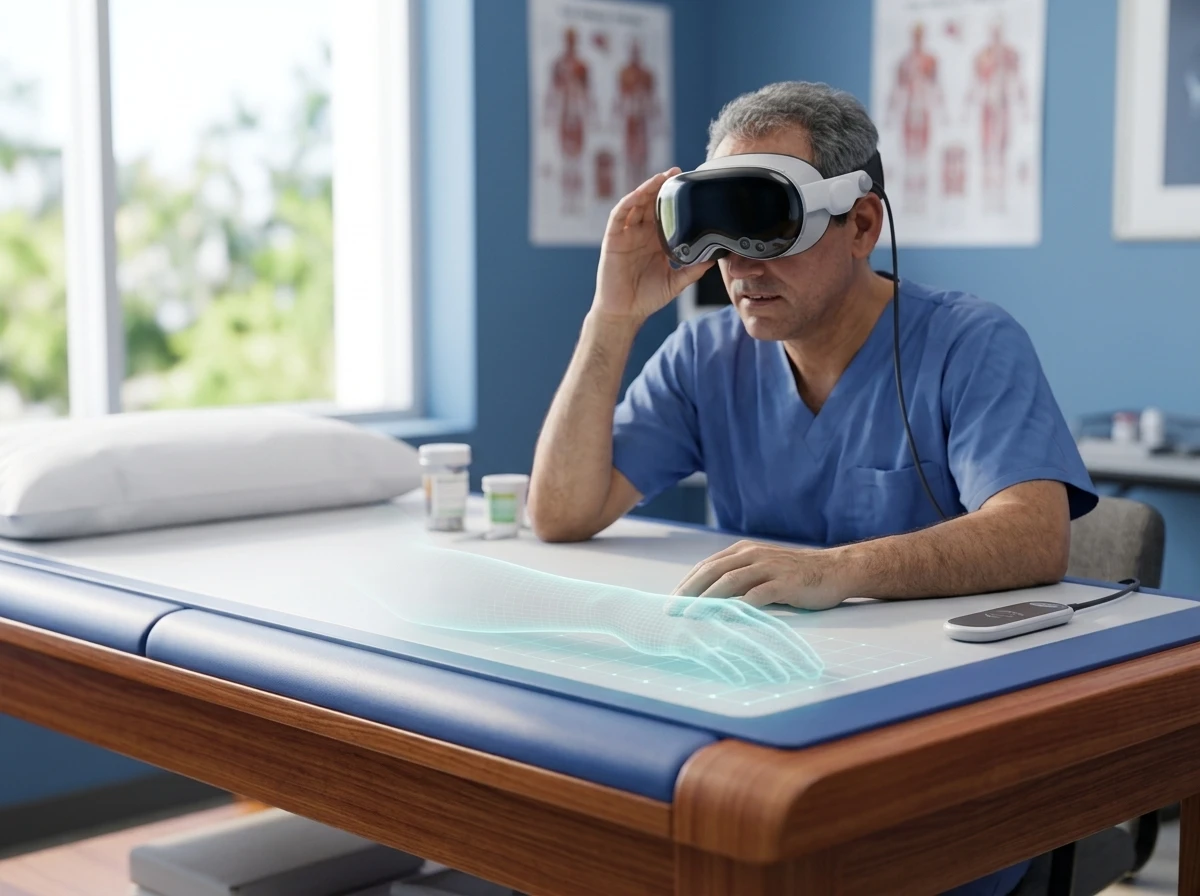
University of Georgia engineering professor Kyle Johnsen will receive the 2026 Innovation Award from Georgia Life Sciences tonight for Targeted Brain Rehabilitation, a gaze-controlled virtual reality therapy that helps amputees retrain neural pathways and ease phantom limb pain.
The honor lands at the Golden Helix Awards Ceremony during the Georgia Life Sciences Summit Welcome Reception at the Sandy Springs Performing Arts Center. Johnsen helped create the system now licensed to Axolo Health and registered as a Class II Software as a Medical Device.
Four Progressive Phases Retrain the Brain
TBR walks patients through four stages that rebuild control over a missing limb without drugs. The approach grows directly from Johnsen’s long study of how virtual environments can reshape neural signals after amputation.
| Phase | Focus | Goal |
|---|---|---|
| 1. Laterality Recognition | Identifying left versus right hand images | Restore the brain’s quick sense of side and reduce confusion that feeds pain |
| 2. Guided Meditation | Calming focus exercises | Lower overall arousal linked to pain signals |
| 3. Mirror Therapy | Visual feedback of an intact limb | Rebuild the brain’s map of the missing part |
| 4. Full VR Simulation | Gaze-controlled manipulation of a projected intact limb | Restore agency and further quiet phantom pain |
Upper-limb therapy is available now. Lower-limb work continues in development. The system runs hands-free through eye gaze so patients who lack residual motor control can still participate.
- Post-surgical patients
- People living with long-term chronic phantom limb pain
- Those with digit amputations
- Patients who experience intermittent flares
Johnsen directs UGA’s Virtual Experiences Laboratory, which he founded after joining the faculty in 2008. Nearly two decades of human-computer interaction work on VR and multimodal interfaces fed the design.
From Athens Lab Bench to Licensed Device
Axolo Health, co-founded by OrthoCarolina surgeons R. Glenn Gaston and Bryan J. Loeffler, holds the license. The pair run a dedicated reconstructive center for lost limbs and pair TBR with surgical methods such as targeted muscle reinnervation.
Derek Eberhart, associate vice president for research and executive director of Innovation Gateway, tied the award to UGA’s broader record. “Johnsen’s Innovation Award highlights UGA’s commitment to translating research discoveries into life-changing solutions,” he said. “This recognition illustrates the vital synergy between academic ingenuity and industry partnerships, a key driver of UGA’s No. 1 ranking among U.S. universities for bringing new discoveries to the marketplace.”
Winning the Innovation Award means a lot, honestly. Georgia has a deep and very serious life sciences community and to have that community recognize the innovation in our research is such a strong signal to us that we are on the right path.
Kyle Johnsen, professor, University of Georgia College of Engineering
Johnsen noted constant iteration. “We keep having breakthroughs in our work, and it happens every time we have patients use our systems,” he said. “Each person’s amputation is fundamentally different, and those differences require new innovations to address their needs and the ones that came before them.”
Details on the Targeted Brain Rehabilitation phases and patient fit appear on the company’s site, including home-use options under clinical guidance.
The Pain Burden TBR Targets
Phantom limb pain remains common and stubborn. Roughly PLP affecting 60% to 85% of amputee patients appears across studies, with many estimates clustering near 72 percent. Some patients feel burning, cramping or pressure within days of surgery; others carry it for years.
The Amputee Coalition reports more than 5.6 million Americans with limb loss or difference, including nearly 2.3 million living with limb loss. Hundreds of thousands of new amputations occur each year in the United States alone.
- Prevalence range: 60-85 percent of amputees experience PLP
- U.S. limb-loss population: nearly 2.3 million
- Total limb loss or difference: 5.6 million-plus
- Common descriptors: burning, cramping, squeezing, telescoping
Traditional options lean heavily on medications, including opioids, with mixed long-term success and well-known side effects. TBR offers a nonpharmacological route that patients and clinicians already discuss as a practical addition when neural maps refuse to quiet. On social platforms, people living with chronic post-amputation pain often describe the brain’s stubborn map of the missing limb and express interest in any immersive tool that restores a sense of agency without another prescription.
UGA’s Product Pipeline Keeps Ranking First
The award arrives while UGA continues to lead national technology-transfer metrics. For the fourth consecutive year the university ranked No. 1 among U.S. universities for new commercial products brought to market from its research, according to the latest AUTM survey. Industry partners and startups released 58 such products in the most recent fiscal year.
Innovation Gateway handles protection, licensing and startup support. Johnsen’s work sits inside that same machinery that has kept UGA in the top five for 13 years running and produced strong results on active licenses, deal flow and startups.
A recent UGA ranked No. 1 for new commercial products update also placed the university high on licensing revenue and active startup companies among public institutions. The TBR path from Virtual Experiences Laboratory experiments to Class II registration follows the same translation route.
Georgia’s Summit Stage and the Wider Cluster
Georgia Life Sciences, the state’s largest advocacy and business leadership group for the sector, presents the Golden Helix Awards each year to mark individuals, organizations, partnerships and investments that advance innovation and patient care. The full set of 2026 Golden Helix Awards categories and honorees also includes Focused Cryo in the Innovation Award, Micron Biomedical with Emory and the CDC for the Phoenix Award, multiple Deal of the Year recipients, and community and education honorees.
The ceremony opens the Georgia Life Sciences Summit. Recent national coverage has noted Georgia’s climb among emerging biopharma clusters, citing major investments and the organization’s own ten-year roadmap. Johnsen’s recognition adds a digital-health and academic-engineering thread to that story.
Johnsen also leads the Georgia Informatics Institutes for Research and Education. His broader portfolio covers VR applications in health, education and the environment. The Innovation Award specifically honors work that steps outside traditional paradigms to create unique technology.
Tonight’s ceremony simply makes the translation public. Patients already using the upper-limb system, clinicians pairing it with surgical reinnervation, and the licensed company pushing lower-limb versions forward now carry the next practical steps.
Frequently Asked Questions
What is Targeted Brain Rehabilitation and how does it work?
TBR is a gaze-controlled virtual-reality program that guides amputees through four progressive stages of neural retraining, beginning with left-right hand recognition and ending with active manipulation of a projected intact limb, all without requiring residual hand or arm movement.
Who developed TBR and who commercializes it?
Kyle Johnsen of the University of Georgia College of Engineering and Virtual Experiences Laboratory collaborated on the system; Axolo Health, founded by OrthoCarolina surgeons Glenn Gaston and Bryan Loeffler, holds the license and markets it as a Class II Software as a Medical Device.
How common is phantom limb pain among amputees?
Studies place the prevalence between 60 and 85 percent, with several large reviews centering near 70-72 percent; many patients report onset within the first week after amputation and some experience lifelong symptoms.
Is TBR available for home use and for lower-limb amputees?
Upper-limb therapy is live and supports home use under appropriate clinical oversight; lower-limb versions remain in active development according to the company.
What does the Georgia Life Sciences Innovation Award recognize?
The award goes to individuals or teams whose work steps beyond traditional paradigms to create unique technology with potential impact on human health, agriculture or environmental sustainability; Johnsen shares the 2026 honor with Focused Cryo.
Disclaimer: This article is news reporting and analysis of a university award and related medical technology for general information only. It does not constitute medical advice, diagnosis, treatment recommendations, or any form of clinical guidance. Readers considering any therapy for phantom limb pain or other conditions should consult a qualified physician or pain specialist before making decisions. Figures, regulatory status, and availability details reflect publicly available sources as of August 25, 2026, and may change.