Israel has stopped renewing a 2021 agreement that supplied Jordan with an extra 50 million cubic metres of water each year, leaving the kingdom without the supplemental supply for the past eight months and pushing the dispute toward a trilateral summit in Abu Dhabi. The New Arab and Israeli outlets reported that Energy Minister Eli Cohen refused to extend the arrangement, despite pressure from the United States and recognition of Jordan’s role intercepting Iranian drones, because of criticism by Foreign Minister Ayman Safadi of Israel’s war in Gaza and its policies in the occupied West Bank.
Israel still delivers the 50 million cubic metres guaranteed under the 1994 peace treaty. The extra 50 million cubic metres, signed in 2021 under then-prime ministers Naftali Bennett and Yair Lapid, had been doubled the flow each year. Jordan asked for a five-year extension and a further increase to 80 million cubic metres annually; Israeli media reported the request was never answered, and Cohen stopped renewing the side agreement in November 2025.
What Israel Says It Wants
The cancellation was framed, in public, as a question of diplomatic tone. An unnamed Israeli official told Ynet that Israel has “no obligation to provide additional quantities” beyond the 1994 treaty and would only consider doing so with “goodwill between the two countries.” The same official said: “Jordan needs the water, but when you help your neighbors, you expect warmer relations. If there is a meeting, everything will be on the table: normalization, water, and strengthening bilateral ties.”
The Jerusalem Post reported on July 7, 2026 that Dr. Ronen Yitzhak of the Moshe Dayan Center read the timing as “a stab in the back,” given Jordan’s intercept of Iranian missiles and drones during the war with Iran. “They supported Israel against Iran, and now Israel is returning evil for good,” Yitzhak said. He added that any Jordanian concession would be “selling support for Palestinians” in a country where more than half of citizens are of Palestinian origin. Dr. Jemima Oakey, a research fellow at the Carboun Institute, told The New Arab the dispute “fits into a broader pattern in which regional water cooperation has become increasingly vulnerable to geopolitical tensions.”
Why Jordan Needs the Water
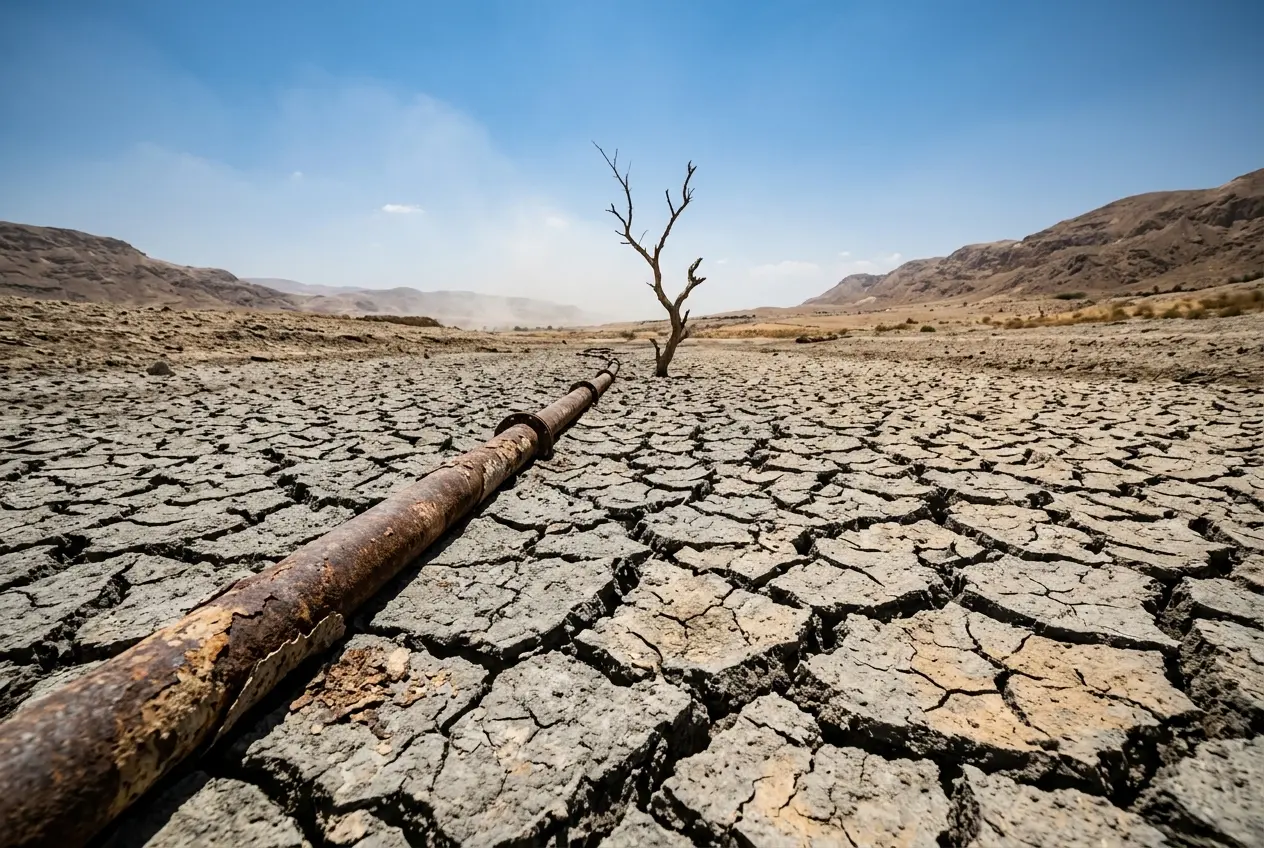
Jordan has 61 cubic metres of renewable fresh water available per capita each year, according to the US Commerce Department, against a UN water scarcity threshold of 500 cubic metres per capita annually. The kingdom sits on an annual water deficit of about 500 million cubic metres, a figure cited by both Ynet and the Arab Weekly, and supplies rooftop tanks in Amman roughly once a week.
Demand is rising fast. Jordan’s population has passed ten million, swelled by more than 1.5 million Syrian refugees since 2011, and the agricultural sector still consumes more than half of the country’s freshwater resources. The government has identified the Aqaba-Amman Water Desalination and Conveyance Project, designed to deliver 300 million cubic metres of desalinated water a year through a 438-kilometre pipeline from the Red Sea, as the long-term fix. The Green Climate Fund says the project is designed to cover about 40 per cent of municipal needs by 2030 and 45 per cent by 2040, with construction due to begin in 2026 and operations targeted for 2030.
The Intercepts That Didn’t Buy Goodwill
Jordan’s intercept of Iranian projectiles during the war with Iran was, until November 2025, a central reason the additional 50 million cubic metres kept flowing. Energy Minister Cohen had renewed the deal every six months partly in response to US pressure and partly because Jordan helped shoot down Iranian drones during regional hostilities, according to Ynet and the Jerusalem Post. The Jerusalem Post quoted Yitzhak as saying: “The timing of the Israeli announcement not to renew the agreement is not good for Jordan because it comes at the height of the war with Iran and the aid that Jordan gave to Israel during the war.”
The intercepts, however, came from a country whose foreign minister had become one of the region’s loudest critics of Israel’s campaign in Gaza and its settlement activity in the West Bank. Safadi has accused Israel of seeking “to empty Gaza of its people,” a framing reported by Al Jazeera in December 2023, and has continued to condemn settlement expansion and what he has called “de facto annexation” of the occupied West Bank. Israeli officials told both Ynet and the Times of Israel that those statements were a central reason Cohen stopped renewing the side deal.
The UAE Summit and What It Would Lock In
Israeli and Israeli-linked outlets reported that the United Arab Emirates is promoting a trilateral energy summit in Abu Dhabi, to be attended by Israeli, Jordanian and Emirati energy ministers, in an effort to revive cooperation. On the table, according to Ynet and the Jerusalem Post: a fresh agreement under which Israel would supply Jordan with another 50 million cubic metres of water annually on top of the 1994 treaty quota, alongside revival of the “Prosperity” initiative, a water-for-energy project under which Israel would build a desalination plant supplying both countries while Jordan develops a 600 megawatt solar field supplying electricity to both Jordan and Israel.
On its face, the summit looks like classic shuttle diplomacy: a third party supplies cover, a face-saving deal is signed, and the status quo returns. The consequential effect runs the other way. By conditioning the additional 50 million cubic metres on “goodwill,” “normalization,” and “warmer relations,” Israel is institutionalising the principle that Jordan’s water can be switched on and off in line with its foreign-policy tone. The same unnamed official who set out the condition told Ynet: “If the atmosphere following the war continues to calm, this agreement could return.” That framing, with water indexed to political weather, is now part of the regional template, ready to be cited in any future dispute, with any neighbour, over any resource.
The Pattern Behind the Pause
The collapse of the 2021 side agreement is the third major regional water initiative to stall in recent years. The Red Sea-Dead Sea conveyance project, signed in 2013 and revived in 2015, was effectively shelved after Jordan told Israel there was “no real Israeli desire” for the plan to proceed, the Kan public broadcaster reported. The Israeli-Jordanian-Emirati water-for-energy agreement, signed in November 2022 under the Prosperity banner with backing from the Emirati renewable energy company Masdar, was frozen after the outbreak of Israel’s war on Gaza, according to the Jordan Times.
Jordan’s response has been to spread the risk. The Aqaba-Amman desalination project, with financial close expected before the end of next month, is on track to become the kingdom’s largest infrastructure project to date. Amman has also reopened water talks with Syria after the fall of the Assad regime in December 2024, launching a joint water platform with Damascus in September 2025, and continues to draw from the Disi/Saq fossil aquifer under a long-running agreement with Saudi Arabia. The aim, officials told the Jordan Times, is to reduce the political leverage that any single neighbour can exercise over Jordan’s taps.
What Israel Says at Home
Israeli officials have offered a domestic rationale alongside the diplomatic conditions. The same unnamed official told Ynet that 2025 was Israel’s driest year in the past 100 years and that the government had made refilling domestic reservoirs and supplying local agriculture a priority. Israel still delivers the 50 million cubic metres owed under the 1994 peace treaty, drawn largely from Lake Tiberias, and has not publicly proposed cutting that flow.
King Abdullah of Jordan declined repeated requests from Prime Minister Benjamin Netanyahu to meet in March, according to Israeli media reports cited by the Times of Israel. One of the king’s reported conditions for a meeting was renewal of the water agreement. Both countries have been without ambassadors on each other’s soil since the Hamas attack of October 7, 2023; Jordan recalled its envoy in protest at the Gaza bombardment and Israel has not maintained an ambassador in Amman since.
What Comes Out of Abu Dhabi
Israeli officials framed the proposed summit as the venue to settle water, energy and bilateral ties in a single sitting. “If there is a meeting, everything will be on the table: normalization, water, and strengthening bilateral ties,” the unnamed Israeli official told Ynet. The UAE’s role, an Israeli official told the same outlet, is to provide “an umbrella of goodwill” under which cooperation can restart.
Even if a deal is signed, the precedent set by the past eight months will remain in force. Water is now on the regional menu of conditional transfers, renewable year to year, and renewable only when the diplomatic tone suits the supplier. The Aqaba-Amman desalination project, expected to start operations in 2030, is designed to shrink that dependency. Until it does, every cubic metre Jordan receives above the 1994 baseline will arrive with a political string attached.