Indian scientists have uncovered fresh clues about the Moon’s violent early days. A team from IIT Kharagpur and the Physical Research Laboratory recreated extreme conditions deep inside the Moon. Their work explains how rare iron and titanium rich rocks shaped the Moon’s history and could directly help India’s upcoming sample return mission.
Ancient Rocks That Hold the Moon’s Secrets
The study zeroes in on ilmenite bearing cumulates or IBC. These are dense rocks packed with iron and titanium that formed when a global ocean of molten rock covered the Moon 4.3 to 4.4 billion years ago. As that magma ocean cooled, lighter minerals floated up to form the crust while heavier ones like ilmenite sank deep inside.
This sinking process locked away a record of the Moon’s birth. Scientists have long suspected these layers played a big role in later volcanic activity that created dark patches on the Moon. Yet exactly how they melted and mixed with the mantle remained unclear until now.
The new research published in the journal Geochimica et Cosmochimica Acta provides solid experimental proof. It shows how these ancient rocks interacted with the surrounding mantle to produce the titanium rich lavas seen on the surface.
Lab Work That Recreated Lunar Depths
Researchers at IIT Kharagpur used a piston cylinder device to mimic pressures up to three gigapascals. That equals conditions hundreds of kilometers deep inside the Moon. Temperatures climbed above 1500 degrees Celsius in the tests.
They prepared synthetic IBC material and placed it against olivine, a mineral that stands in for the Moon’s magnesium rich mantle. In some runs they layered the materials. In others they mixed them. These setups copied what happens when dense IBC sank and touched hotter mantle rock.
First author Himela Moitra led much of the lab work. The experiments produced melts with titanium dioxide levels from nine to 19 percent. That matches the high titanium basalts collected by Apollo astronauts and spotted by orbiters.
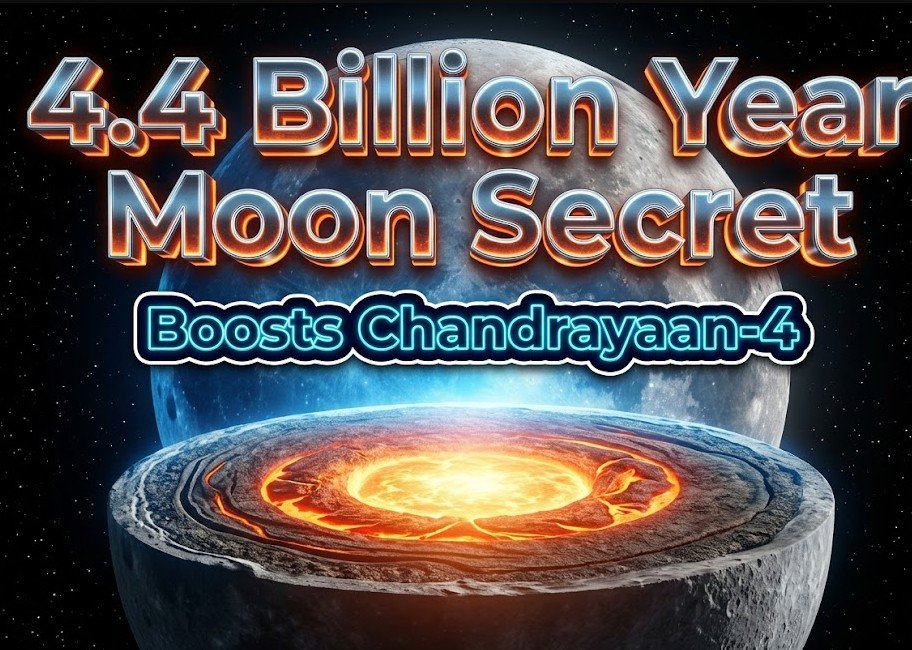
Higher temperature melts created intermediate titanium compositions. Lower temperature ones made very titanium rich but magnesium poor liquids. These later mixed with rising low titanium magmas to form the exact compositions seen in lunar samples.
Key findings from the experiments include:
- Partial melts from IBC can rise to the surface at lower pressures and feed volcanoes.
- At higher pressures some melts sink back down showing a complex recycling process.
- The model explains why high titanium volcanism lasted for billions of years across the Moon.
Prof Sujoy Ghosh from IIT Kharagpur stressed the importance of this work. He said these results give an experimental framework to understand where lunar samples come from and what they reveal about the Moon’s history.
Linking Deep Interior to Surface Features
This research builds on earlier ideas about lunar mantle overturn. After the magma ocean mostly solidified, the dense IBC layer became unstable. Parts of it sank and stirred the mantle. The new study adds hard data on what happens when those sinking rocks heat up and melt.
Such processes help explain the wide range of basalt types across the Moon. Some areas show low titanium while others are loaded with it. The IIT PRL team showed how mixing and fractionation during ascent can create this diversity.
India’s own Chandrayaan 3 mission added support to the magma ocean idea. Its rover Pragyan found chemical patterns near the south pole that fit with a once molten Moon. This latest lab work takes that story deeper by explaining the fate of the heaviest materials.
Why This Matters for Chandrayaan-4
Chandrayaan 4 is India’s first sample return mission. Planned for launch around 2028 it aims to bring back roughly three kilograms of lunar material from the south pole region. Sites near Mons Mouton and areas close to the Chandrayaan 3 Shiv Shakti landing zone are under consideration.
The new study gives mission planners a better map of what to look for. Understanding IBC and their melts will help scientists pick spots where ancient deep materials or their volcanic products might be exposed. It also prepares labs on Earth to interpret the chemistry of returned rocks.
When the samples come back instruments will check mineral makeup and exact element ratios. The IIT findings offer a guide to trace those signatures back to their deep origins. This could reveal how long the magma ocean lasted how the mantle mixed and whether water or other volatiles played hidden roles.
Prof Ghosh noted that regions near the south pole targeted for Chandrayaan 4 have already been mapped well by Chandrayaan 2 and international orbiters. His team’s work adds the deep interior view that was missing.
India has come far in planetary science. High pressure experiments once done only abroad now run successfully at IIT Kharagpur. This homegrown capability strengthens the whole Chandrayaan program and future missions.
The Moon still holds many secrets from its first billion years. Those early days set the stage for everything that followed including the giant impacts that scarred its face and the lava flows that filled the basins. By decoding the IBC story scientists get closer to understanding how rocky worlds like Earth and the Moon formed and evolved.
The findings also connect to bigger questions. Similar processes may have happened on Mars or other bodies. Each piece of data from the Moon helps build better models for the entire solar system.
This breakthrough comes at the perfect time. With Chandrayaan 4 moving forward and international partners eyeing lunar returns too the timing feels right. India is not just landing on the Moon anymore. It is preparing to bring pieces of it home for study.
The work reminds us how much we can learn from careful lab experiments and smart collaboration. A small team in Kharagpur and Ahmedabad just opened a new window on events from billions of years ago.
What do you think about India’s growing role in unraveling the Moon’s past? Share your thoughts in the comments below. If this story excites you tell your friends and family about the amazing science powering Chandrayaan 4.