Garmin launched the Fenix 9 and Fenix 9 Pro on August 25 with the series’ first full titanium watch case on the Pro models, AMOLED panels reaching 3,000 nits, optional solar MiP displays delivering up to 291 days in power-save mode, and inReach satellite-plus-LTE connectivity now offered across every size including 43 mm. Orders open August 28. Base Fenix 9 starts at $999.99; Pro models begin at $1,099.99.
The hardware changes look incremental on paper. Their second-order effect is clearer: buyers no longer face the Fenix 8 Pro’s forced choices between battery life, screen type, size and standalone connectivity.
The Titanium Pro Case Arrives
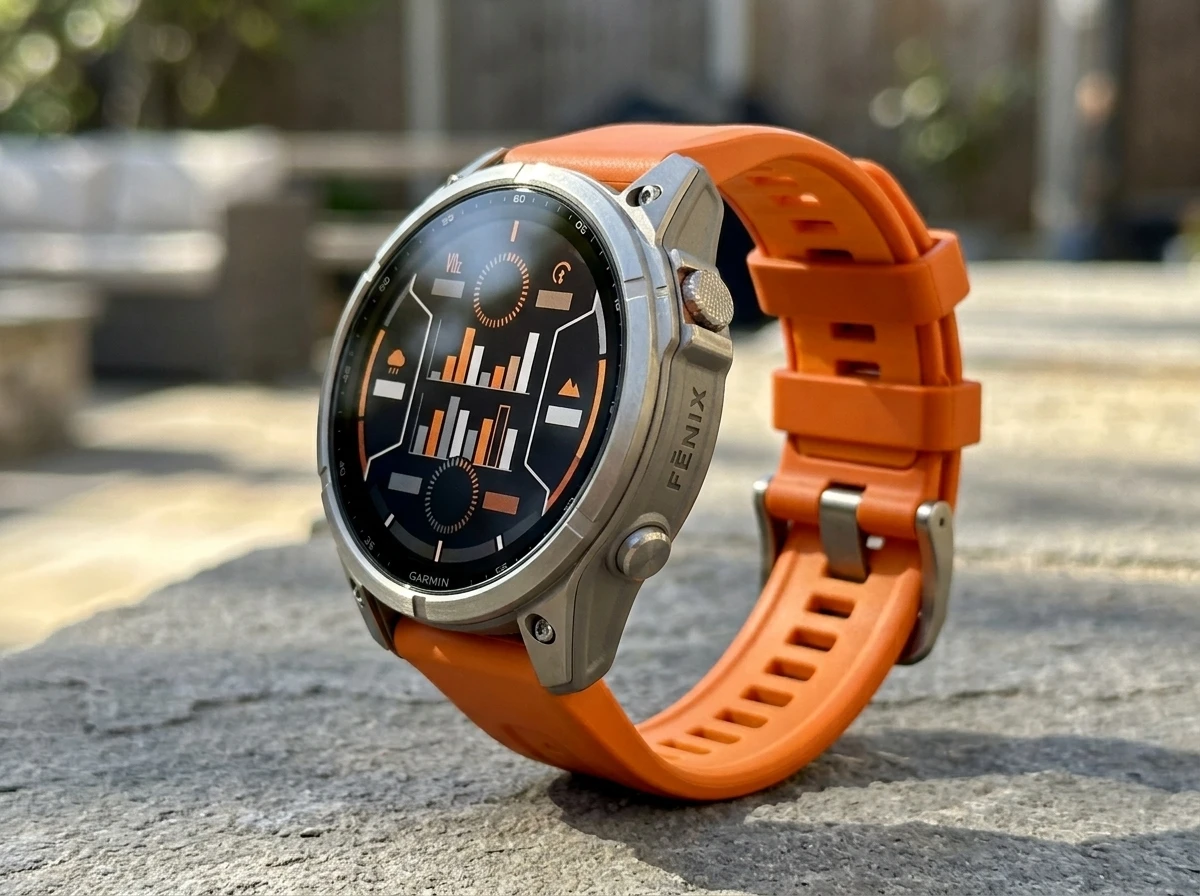
Fenix 9 Pro is the first Fenix to use a titanium watch case throughout. Garmin combined metal and plastic at the molecular level with nano-molding technology. The result trims overall thickness while keeping the familiar rugged profile, five buttons, sapphire lens and leakproof construction.
Susan Lyman, Garmin Vice President of Consumer Sales and Marketing, said in the official Garmin launch announcement that the watches are “purpose-built for those who want to perform better and venture farther.”
Standard Fenix 9 keeps a fiber-reinforced polymer mid-case with titanium bezel and back, closer to the Fenix 8 layout. Pro models show bare metal flanks and an engraved “Fenix” logo on the right side. Weights for the 47 mm Pro land around 78 g with case only at 56 g. The 43 mm Pro drops to 13.3 mm thick and 62 g total.
- Full titanium case on all Pro models via nano-molding
- Reduced thickness versus prior polymer-hybrid builds
- Sapphire crystal, MIL-STD-810, 10 ATM and 40 m dive rating retained
- Integrated LED flashlight now includes green mode for night vision
Early product images that leaked a day earlier matched the final titanium look and color SKUs, including Autumn Orange and Pebble Gray Solar finishes.
Display Choices and Battery Reality
AMOLED versions hit 3,000 nits on Pro models, double the brightness of many prior Fenix screens and higher than the base Fenix 9 (which does not publish a peak nit figure). The 51 mm Pro AMOLED jumps to a 1.5-inch panel, 15 percent larger area than the previous 1.4-inch size without growing the case. Smaller sizes stay at 1.3-inch (43 mm) and 1.4-inch (47 mm).
Solar models return on the Pro tier with energy-efficient MiP displays and Power Sapphire charging lenses. They are limited to 47 mm and 51 mm. The 51 mm Solar reaches 57 days in smartwatch mode and 291 days in power-saving mode under Garmin’s 3-hour daily outdoor test at 50,000 lux. AMOLED 51 mm tops out at 31 days smartwatch and 42 days low-power.
Storage doubles to 64 GB on every model, enough for roughly 7,000 songs plus more offline maps. Elevate Gen 5 optical heart-rate sensor carries over with Pulse Ox, ECG (region-dependent), skin temperature and the usual suite. No new sensor generation arrived.
| Mode | 43 mm AMOLED | 47 mm AMOLED | 51 mm AMOLED |
|---|---|---|---|
| Smartwatch | Up to 10 days | Up to 18 days | Up to 31 days |
| Low Power | Up to 15 days | Up to 24 days | Up to 42 days |
| Activity Normal | Up to 18 hours | Up to 32 hours | Up to 56 hours |
| Max Battery GPS | Up to 50 hours | Up to 87 hours | Up to 151 hours |
| Expedition | Up to 10 days | Up to 18 days | Up to 31 days |
Solar figures sit higher still; exact Solar tables appear on the detailed battery life table by size compiled from Garmin’s regional sheets. Always-on display numbers were not broken out separately at launch.
What inReach Adds Across Sizes
For the first time inReach (LTE plus satellite two-way messaging, voice, LiveTrack and interactive SOS via Garmin Response) is available on every Fenix 9 Pro size, including the new 43 mm. An active subscription is required. Coverage and feature limits vary by region and situation; Garmin publishes specific requirements.
New perks with an active plan include LiveTrack notifications and Garmin Locate in the Messenger app over LTE, plus weather forecasts delivered by satellite. The $100 premium over non-connected Pro models buys phone-free communication that previously forced buyers into larger cases or separate devices.
Base Fenix 9 models lack the modem. Crowds on X noted the 43 mm inReach option as the quiet headline for smaller wrists that still need emergency coverage on long trips.
Software and Training Tools That Matter
Garmin Epic lets users group multi-day or multi-week activities into one shareable story in Connect, complete with photos, health metrics and performance data. Stamina tracking gains zones and a curve that shows how endurance shifts with fitness gains. Indoor rowing now reports VO2 Max and power curves when paired with a compatible machine. Rucking supports pack-weight changes mid-activity, GORUCK workouts and targets up to 100 kg.
Maps run on 50 percent more RAM with a faster engine; panning improves up to 30 percent and a new perspective view adds depth. Other additions include ArcheryX real-time aim cues, mixed multisport sessions and sports scores in the daily glance.
- Garmin Epic multi-activity storytelling
- Stamina zones and curve for pacing
- Expanded rucking and indoor rowing metrics
- Faster routable maps with perspective view
- 64 GB storage for maps and music
Some features listed as new are refinements or renames of existing tools, according to early feature audits. The core outdoor and training stack remains familiar.
Pricing, Sizes and Who Should Buy
Fenix 9 (AMOLED, polymer hybrid case) starts at $999.99 across 43/47/51 mm. Fenix 9 Pro AMOLED (43 and 47 mm) and Pro Solar (47 mm) list at $1,099. The 51 mm Pro AMOLED or Solar reaches $1,199. Adding inReach costs another $100. Select colors and band bundles run higher. Availability begins August 28 on Garmin’s site and retailers.
| Model | Sizes | Starting Price (USD) | Key Differentiator |
|---|---|---|---|
| Fenix 9 | 43/47/51 mm | $999.99 | Polymer hybrid, AMOLED |
| Fenix 9 Pro AMOLED | 43/47/51 mm | $1,099.99 | Full titanium, 3,000 nits |
| Fenix 9 Pro Solar | 47/51 mm | $1,099-$1,199 | MiP + solar charging |
| Pro + inReach | All Pro sizes | +$100 | LTE + satellite |
The lineup now spans more SKUs than the Fenix 8 generation. Serious multi-day users who hated AMOLED drain can pick Solar Pro. Smaller wrists finally get satellite options. Owners happy with Fenix 8 battery and maps may see less urgency because the optical sensor stayed the same.
New ComfortFit fabric bands with QuickFit join the accessory range for stretch and moisture resistance.
How It Stacks Against the Fenix 8 Pro
Versus the Fenix 8 Pro, the 9 Pro swaps the polymer mid-case for full titanium, lifts AMOLED peak brightness, doubles storage, enlarges the 51 mm screen, restores dedicated Solar MiP models and brings inReach to 43 mm. MicroLED disappears entirely after its limited 51 mm run on the 8 Pro. Thickness drops, especially on smaller sizes. Battery on AMOLED is comparable or modestly improved; Solar stretches far beyond.
Key deltas at a glance:
- Case: full titanium nano-molded vs polymer hybrid
- Display: 3,000 nits AMOLED or MiP solar; 1.5-inch on 51 mm
- Storage: 64 GB vs 32 GB
- Connectivity: inReach optional on all Pro sizes including 43 mm
- Sensor: Elevate Gen 5 unchanged
The Fenix 9 Pro 43 mm product page already lists configurations and the August 28 order window. Early reaction on X mixed excitement for the titanium finish and 43 mm inReach with complaints about the sheer number of variants and premium pricing.
Garmin kept the Fenix formula of choice overload but removed several previous dead-ends. Buyers who need long battery, small size and satellite no longer have to pick two of three. Those seeking a pure sensor leap will wait for the next cycle.
Frequently Asked Questions
What sizes does the Garmin Fenix 9 Pro come in?
Fenix 9 Pro AMOLED ships in 43 mm, 47 mm and 51 mm. Solar MiP versions are limited to 47 mm and 51 mm. Base Fenix 9 AMOLED also covers all three sizes. inReach can be added to any Pro size.
How long does the Fenix 9 Pro battery last on solar models?
The 51 mm Pro Solar reaches up to 57 days in smartwatch mode and 291 days in power-saving mode with three hours of daily outdoor exposure at 50,000 lux. AMOLED 51 mm maxes at 31 days smartwatch. Smaller sizes scale downward; exact Solar tables vary by region.
Does the Fenix 9 Pro use a new heart-rate sensor?
No. It retains the Elevate Gen 5 optical sensor for continuous heart rate, Pulse Ox, skin temperature and ECG (where available). No Gen 6 or major hardware health upgrade arrived with this generation.
What is the starting price of the Fenix 9 and Fenix 9 Pro?
Fenix 9 starts at $999.99. Fenix 9 Pro AMOLED and Solar begin at $1,099.99 for 43/47 mm sizes; 51 mm Pro is $1,199. Adding inReach costs an extra $100. Orders open August 28, 2026.
Is the Fenix 9 Pro case fully titanium?
Yes on all Pro models. Garmin uses nano-molding to create a titanium case that eliminates the polymer mid-section of earlier Fenix designs while reducing thickness. Base Fenix 9 keeps the hybrid polymer-plus-titanium construction.