Mahindra unveiled the Scorpio Lifestyler dual-cab pickup on 14 August 2026 with an India starting price below ₹19.79 lakh ex-showroom and a market debut by April 2027. That figure lands more than ₹12 lakh under the ninth-generation Toyota Hilux, which opened in July 2026 from ₹31.99 lakh.
The gap is large enough to rewrite who can actually buy a lifestyle pickup in India.
The Twelve-Lakh Gap Changes the Segment
Official Mahindra language positions the truck as both payload and “playload.” Three special expressions appeared at the reveal: Valley Edition in Artemis Grey, Reef Edition in Aquareef, and Trail Edition in Sahara Beige. Each carries distinct exterior accents and adventure-oriented accessories.
The Hilux range tops out at ₹36.69 lakh for the VX 4×4. Even the base GX 4×2 sits at ₹31.99 lakh. Buyers looking at the Mahindra therefore keep roughly ₹12 lakh that can fund fuel, a canopy, a winch, or years of ownership costs.
- Scorpio Lifestyler target: below ₹19.79 lakh ex-showroom, launch by April 2027
- Hilux range: ₹31.99 lakh to ₹36.69 lakh, already on sale
- Gap at entry: more than ₹12 lakh, or roughly 38 percent
- Closest rival Isuzu V-Cross: ₹25.50 lakh to ₹30 lakh
On X, one widely viewed post framed the difference as an entirely different budget. Replies split between buyers who see the saving as decisive and owners who still default to Toyota for long-term peace of mind and residual value.
That split matters because the lifestyle pickup segment in India has long been thin and expensive. A buyer who once faced a choice between the Hilux and the Isuzu V-Cross now sees a third door open well below both. The saving is large enough to change the conversation from badge prestige to total cost of getting a dual-cab on the road.
The three special editions also signal how Mahindra wants the truck read. Valley, Reef and Trail are not fleet labels. They point at weekend use, travel and light adventure, the same ground the Hilux has owned on image even when its price kept many shoppers out.
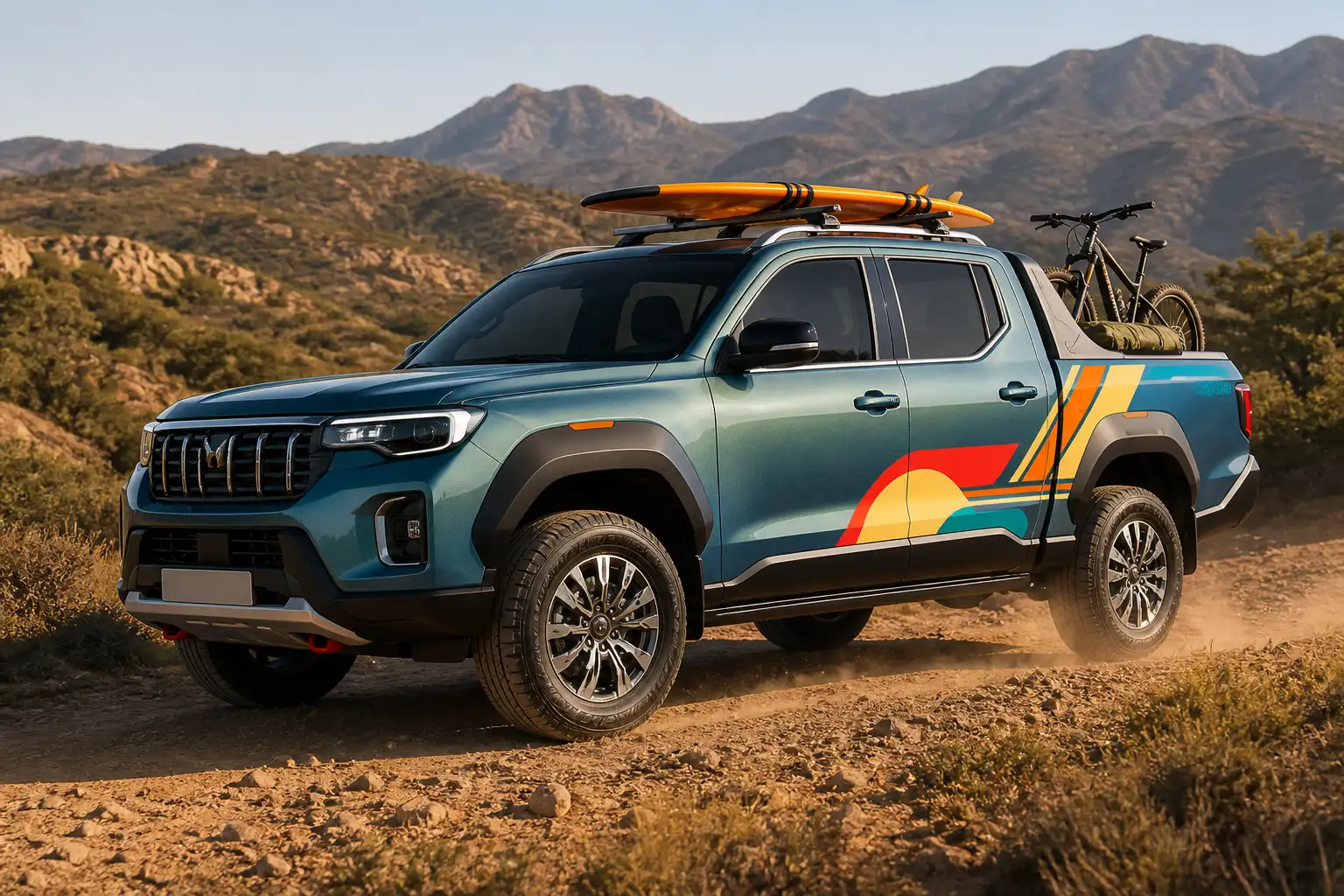
Bold Stance Meets Proven Rugged Look
From the front the Scorpio Lifestyler runs squared-off LED headlamps with integrated DRLs, a large chrome-studded grille and a chunky bumper that places LED fog lamps vertically. The Hilux takes the “Cyber Sumo” route: slim LED lamps, Toyota lettering across the grille, a large honeycomb mesh and sculpted bumper with silver inserts.
In profile the Mahindra reads smaller than the Hilux’s 5,320 mm length, though its wheelbase is expected to stretch beyond the Scorpio-N’s 2,750 mm to free up bed space. Both are dual-cabs with big cargo areas and all-terrain rubber. The Lifestyler wears 18-inch alloys; the Hilux sticks to 17-inch units. A rising window line appears on both, chrome-trimmed on the Mahindra.
At the rear each truck uses C-shaped LED lamps and embossed brand lettering on a flat tailgate. Mahindra’s design team at MIDS Mumbai and engineering at MRV Chennai kept the Global Pik Up concept’s muscular proportions almost intact from the 2023 Cape Town show car.
The visual brief is clear. Mahindra wants the truck to look ready for both city streets and rough tracks without copying the Hilux’s Cyber Sumo face. Larger alloys and the chrome-trimmed rising line give the Lifestyler a slightly dressier side view, while the squared front and vertical fog lamps keep the stance blocky and purposeful.
Keeping concept proportions from Cape Town also reduces the usual show-to-showroom shrink. Buyers who liked the 2023 form should recognise it on the production truck, which helps the model feel intentional rather than diluted for cost.
Cabin Mood and Everyday Kit
Interior sketches and reveal images show the Lifestyler cabin leaning modern and premium. A large portrait-oriented touchscreen sits in a dual-tone dash with gloss-black accents. A four-spoke or flat-bottom wheel carries silver inserts and controls. Expected equipment borrowed from the Scorpio-N family includes wireless Android Auto and Apple CarPlay, a digital driver display, wireless phone charging, dual-zone climate control, a premium audio system, a single-pane sunroof and an auto-dimming mirror.
The Hilux cabin stays deliberately rugged. Top VX models get a 12.3-inch touchscreen with wireless smartphone mirroring, an 8-speaker system, wireless charging, a 7-inch digital cluster and height-adjustable seats. Lower grades drop to an 8-inch screen and fewer speakers. Climate control remains manual across the range. The overall feel is built-to-last rather than lounge-like.
Safety expectations also diverge. The Lifestyler is tipped for Level-2 ADAS, a 540-degree camera, six airbags, ESC, TPMS, ISOFIX and hill-hold. The Hilux counters with seven SRS airbags as standard, panoramic view monitor on the VX, front and rear sensors, vehicle stability control and downhill assist on 4×4 versions.
| Item | Scorpio Lifestyler (expected) | Toyota Hilux |
|---|---|---|
| Infotainment | Portrait touchscreen, wireless AA/CP | 8-inch or 12.3-inch, wireless AA/CP on top |
| Driver display | Digital | 7-inch digital |
| Climate | Dual-zone expected | Manual |
| Airbags | 6 | 7 |
| Camera suite | 540-degree expected | 360-degree / rear on variants |
| ADAS | Level-2 expected | Core electronic aids |
The Mahindra list reads closer to a modern SUV. The Toyota list stays focused on durable essentials plus proven 4×4 hardware.
That contrast will shape test drives. Shoppers coming from Scorpio-N SUVs will find familiar comforts: dual-zone climate, a portrait screen, wireless charging and a sunroof. Hilux buyers who prize simple controls and manual climate may see those same items as extras they did not ask for. Neither approach is wrong; they target different daily habits.
On safety kit the gap is narrower than the marketing tone suggests. Toyota leads on airbag count with seven as standard. Mahindra answers with a wider camera view and expected Level-2 ADAS. Buyers who tow or drive loaded trails may still favour the Hilux hardware stack. Buyers who want driver aids in traffic may lean the other way once final specs are locked.
Two Engines Against One Proven Diesel
Mahindra has not locked final outputs, yet the platform points to the familiar 2.0-litre mStallion turbo-petrol (around 203 PS and up to 380 Nm) and 2.2-litre mHawk diesel (up to roughly 175 PS and 400 Nm). Both should pair with 6-speed manual or automatic gearboxes and offer rear- or four-wheel drive with terrain modes.
The Hilux brings a single 2.8-litre diesel with 500 Nm of torque, 150 kW (about 204 PS), mild-hybrid assistance and a 6-speed automatic only. Drive options run 4×2 or part-time 4×4 with low range, electronic rear diff lock and Multi-Terrain Select on higher grades. An 80-litre tank supports long hauls.
| Spec | Scorpio Lifestyler petrol | Scorpio Lifestyler diesel | Hilux 2.8 diesel |
|---|---|---|---|
| Power | 203 PS | Up to ~175 PS | 204 PS / 150 kW |
| Torque | Up to 380 Nm | Up to 400 Nm | 500 Nm |
| Gearbox | 6MT / 6AT | 6MT / 6AT | 6AT only |
| Drive | RWD / 4WD expected | RWD / 4WD expected | RWD / 4WD |
Hilux torque advantage is clear for heavy towing or loaded trails. Mahindra’s dual-fuel choice and manual option give buyers more ways to match budget and use case.
The petrol path is especially useful in a segment that has leaned diesel for years. A 203 PS mStallion with up to 380 Nm gives urban and mixed-use buyers a route that avoids diesel ownership patterns, while the mHawk still covers those who want torque closer to the Isuzu’s 360 Nm and the Hilux’s heavier pull.
- Hilux strength: 500 Nm, mild-hybrid assist, low range and rear diff lock on higher 4×4 grades
- Lifestyler strength: petrol or diesel, manual or automatic, expected terrain modes
- Shared ground: dual-cab layout, RWD or 4WD paths, six-speed gearboxes in some form
Power figures sit close at the top end, with the Hilux at about 204 PS and the Mahindra petrol around 203 PS. The real split is torque and transmission flexibility. Toyota’s automatic-only 2.8-litre suits buyers who want one proven recipe. Mahindra’s wider menu suits buyers who want to choose fuel and shift type against price.
From the outset, our vision was to create a world-class global pickup that raises the bar for the segment while remaining true to Mahindra’s strengths in authentic capability and value.
Dr Velusamy R, President of Automotive Business at Mahindra & Mahindra, made that case at the Mumbai unveil. The truck will also wear the Mahindra Lifestyler name in export markets across Australia, New Zealand, South Africa, Africa, the Middle East and Latin America.
Who Feels the Pressure and Who Gains Access
The Lifestyler joins a thin lifestyle-pickup field. The Isuzu V-Cross official specifications list a 1.9-litre diesel making 163 hp and 360 Nm, priced from ₹25.50 lakh to ₹30 lakh for 4×4 manual and automatic grades. It sits between the two newcomers on price yet trails both on power and expected tech density.
Mahindra already sells high volumes of Scorpio-N SUVs and has a long pickup history overseas. The earlier Scorpio Getaway left the market years ago; this model revives the idea with far more polish. Readers can revisit the full Scorpio Lifestyler pickup unveiling details for the concept-to-production path.
Buyers who want the badge, the residual value and the global reputation still have a clear path to the Hilux. Everyone else now has a properly styled dual-cab that undercuts the Japanese truck by the price of a mid-size SUV.
Isuzu feels the squeeze from both sides. The V-Cross undercuts the Hilux yet now faces a Mahindra entry well below its own ₹25.50 lakh floor, with higher expected power and denser kit. Toyota’s pressure is different: defend residual value and durability prestige while a local rival talks value and lifestyle at a far lower sticker.
- 2023: Global Pik Up concept shown in Cape Town with the muscular proportions later kept for production
- July 2026: ninth-generation Hilux goes on sale in India from ₹31.99 lakh
- 14 August 2026: Mahindra unveils the Scorpio Lifestyler in Mumbai with a sub-₹19.79 lakh target
- By April 2027: Lifestyler market debut planned in India, with export badging as Mahindra Lifestyler
Export Markets Broaden the Truck’s Brief
Dr Velusamy’s global framing is not a side note. The same truck is set to carry the Mahindra Lifestyler name across Australia, New Zealand, South Africa, Africa, the Middle East and Latin America. That list covers right-hand-drive strongholds where Mahindra already knows pickup buyers, plus wider regions where value dual-cabs compete on capability and price together.
India still sets the headline numbers: a start below ₹19.79 lakh and a debut by April 2027. Export volume, though, can steady the business case if local take-up is gradual. A model that must only win against the Hilux and V-Cross at home carries more risk than one that also sells into markets used to Mahindra pickups.
Design and engineering credits reinforce that dual brief. MIDS Mumbai shaped the look; MRV Chennai handled engineering; the Cape Town concept set the stance. The production truck is meant to read as a global product that happens to open a new price lane in India, not as an India-only special.
For Indian buyers the export plan is a soft signal of confidence. A pickup aimed at Australia and South Africa as well as Mumbai needs durable bones and a cabin that can travel. Whether that promise holds will show up in ride quality, bed usability and service experience after April 2027.
How Saved Rupees Reshape the Purchase
The more than ₹12 lakh gap at entry is not only a showroom talking point. It is money that can move into fuel, insurance, a canopy, a winch, tyres or simply lower EMIs. Against a Hilux that runs from ₹31.99 lakh to ₹36.69 lakh, the Lifestyler’s target below ₹19.79 lakh leaves room equal to a large share of another vehicle.
Stack the field another way and the pattern holds. The Isuzu V-Cross occupies ₹25.50 lakh to ₹30 lakh. The Mahindra aims to open beneath that band; the Toyota owns the band above it. Shoppers who were priced out of both Japanese options now have a styled dual-cab path that does not require mid-30-lakh budgets.
| Truck | Price band (ex-showroom) | Power snapshot |
|---|---|---|
| Scorpio Lifestyler | Below ₹19.79 lakh (target) | ~203 PS petrol / up to ~175 PS diesel |
| Isuzu V-Cross | ₹25.50 lakh to ₹30 lakh | 163 hp diesel |
| Toyota Hilux | ₹31.99 lakh to ₹36.69 lakh | 204 PS diesel |
Social reaction already mirrors that math. Some see the saving as decisive. Others still want Toyota peace of mind and residual value. Both views can be true for different users. Commercial and long-distance drivers may keep paying for the Hilux reputation. Family and weekend buyers may decide the Lifestyler’s kit and price close the case.
Mahindra’s Scorpio-N volumes and overseas pickup history give the brand a base to support that second group. The old Scorpio Getaway left the stage years ago. This truck returns to the idea with modern electronics, special editions and a global nameplate plan that the earlier model never carried in the same way.
A Different Kind of Pickup Buyer Emerges
Service-network skepticism remains the loudest counter-argument on social platforms. Toyota’s reputation for durability still carries weight among long-distance and commercial users. Yet Mahindra’s recent SUVs have shifted perceptions on refinement and features, and its international pickup reputation is already established in several right-hand-drive markets.
If the final Lifestyler delivers the promised capability, ride quality and electronics at the stated price, the lifestyle pickup stops being a rarefied Toyota or Isuzu purchase. It becomes a realistic alternative for families who want a bed for weekend gear without stretching into the mid-30-lakh bracket.
The truck that arrives in showrooms by April 2027 will decide how quickly that shift happens. For now the price alone has already done the heavy lifting.