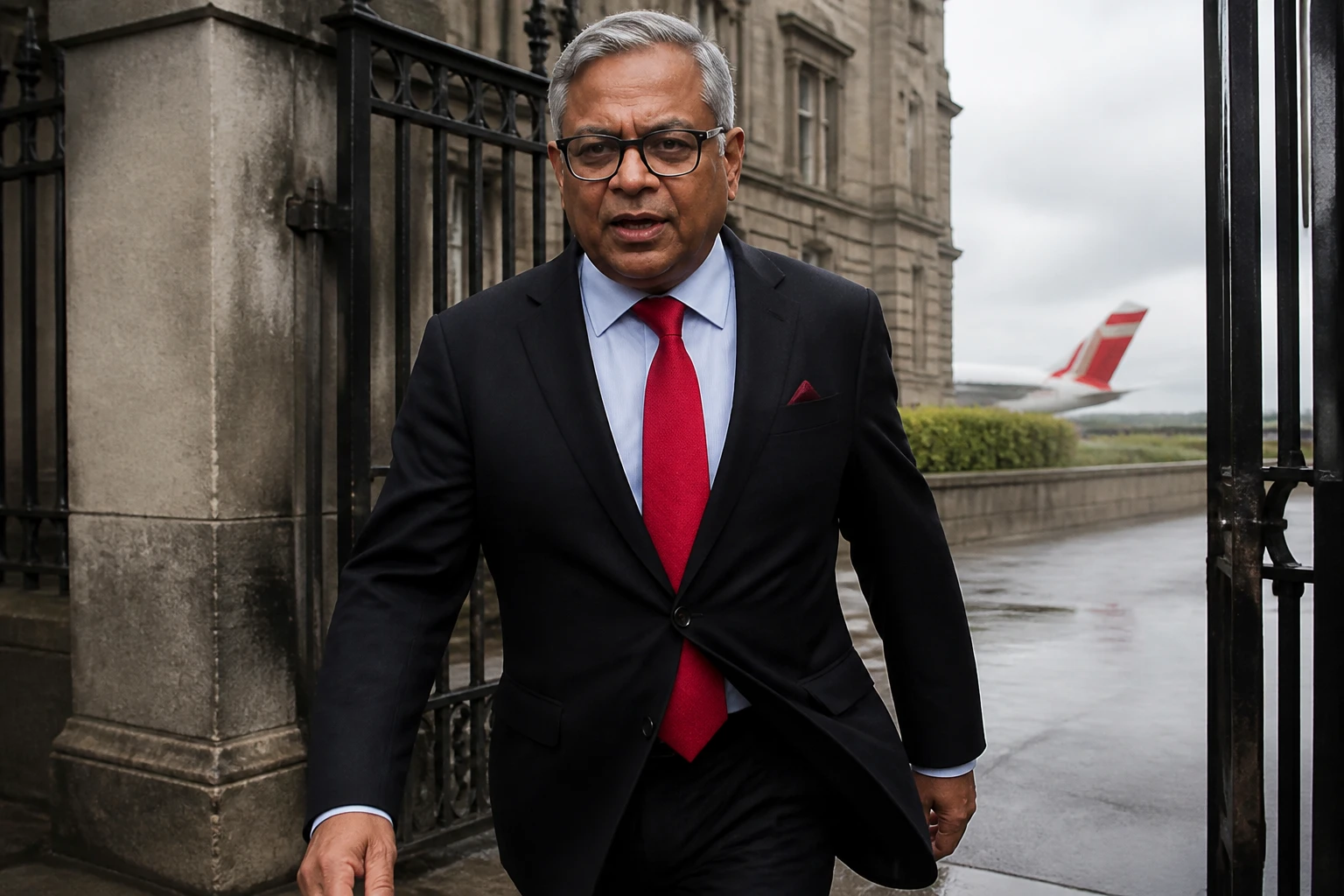
N. Chandrasekaran will step down as Tata Sons chairman when his term ends on February 20, 2027, after one board director blocked a five-year extension and six months of deadlock followed. The decision lands squarely on Air India, where losses more than doubled and the turnaround he championed now faces a new CEO plus tighter scrutiny from Tata Trusts.
Chandrasekaran, 63, has led Tata Sons since 2017. His exit opens succession just as the group digests heavy losses at the airline it reclaimed in 2022.
The Losses That Ended the Extension
Air India posted a loss of Rs 22,238 crore in FY26, up from Rs 10,859 crore the year before. Revenue slipped to Rs 71,870 crore from Rs 78,636 crore. Tata Digital added a Rs 4,974 crore loss.
Tata Sons’ own standalone profit after tax rose 21.8 percent to Rs 31,961 crore on revenue of Rs 42,367 crore. Consolidated figures told a different story: net profit fell 35 percent to about Rs 26,600 crore as the new businesses dragged. Group listed market value dropped 12 percent over the year.
| Metric | FY25 | FY26 |
|---|---|---|
| Air India revenue | Rs 78,636 Cr | Rs 71,870 Cr |
| Air India loss | Rs 10,859 Cr | Rs 22,238 Cr |
| Tata Sons standalone PAT | Rs 26,232 Cr | Rs 31,961 Cr |
| Tata Digital loss | – | Rs 4,974 Cr |
External shocks hit hard. Airspace closures, West Asia fuel spikes, currency moves and the AI171 crash made FY26 the toughest year since the takeover. Chandrasekaran told shareholders the airline’s NPS had climbed from -35 in FY23 to +42 by June 2026 and that it led India on on-time arrivals that month. He still framed the full rebuild as a five- to ten-year transformation journey.
- Rs 22,238 crore, Air India FY26 loss, more than double the prior year
- +42 NPS, customer score in June 2026 after starting at -35
- Best OTP, on-time arrival leader in India for June 2026
- 5-10 years, stated horizon for the full turnaround
How Tata Rebuilt the Flag Carrier
Tata completed the Air India purchase on 27 January 2022 through Talace. The group then folded in its other carriers. The Vistara merger that gave SIA 25.1 percent created a combined full-service and low-cost operation that became India’s top international carrier and number-two domestic player.
- January 2022, Tata closes 100 percent acquisition of Air India
- November 2022, Vistara merger framework with Singapore Airlines investment agreed
- 2023-2024, massive narrow-body and wide-body orders totaling nearly 600 aircraft placed; integration of four airlines begins
- November 2024, Vistara operations cease into Air India
- 2025-2026, narrow-body cabin refits largely finished; wide-body work targeted for end-FY28; training academy, simulators and MRO base started
Campbell Wilson, the first post-privatisation CEO, oversaw the mergers, added roughly 100 aircraft, modernised systems and launched new cabins. He told the board in 2024 he would leave in 2026 once foundations were set. Narrow-body interiors won positive feedback. The order book still looms large from 2027 onward.
The Fracture Inside Bombay House
Chandrasekaran’s reappointment proposal cleared the trusts and the nomination committee. It reached the Tata Sons board on 24 February 2026. One director withheld support. No name was given in the official statement, yet multiple reports identified Noel Tata, who chairs the Tata Trusts that control roughly two-thirds of Tata Sons.
It has been six months since that Board meeting, and no resolution has been reached to date. Tata Sons is a very large institution and there are many strategic projects that are under critical stages of execution. It is not only necessary to have a leader in place to lead the Group beyond Feb 2027, but also clarity on leadership is important for employees, investors, partners and other stakeholders.
Chandrasekaran wrote those words in the letter detailing the six-month delay before announcing he would not seek another term. Differences went beyond the airline. Noel Tata sought assurances against a public listing of Tata Sons and clearer options for an exit by the Shapoorji Pallonji Group. Capital allocation to long-gestation businesses became the flashpoint.
Air India absorbed the bulk of the newer-business losses. Analysts noted the airline was also damaging the Tata brand through operational stumbles. Trusts rely on Tata Sons dividends; they preferred conservatism while TCS faces AI pressure and the group sits deep in investment cycles for chips, electronics and batteries.
A New Pilot Takes the Controls
On 5 August 2026 the Air India board appointed Tewolde Gebremariam as CEO and managing director, succeeding Wilson. Gebremariam spent more than a decade running Ethiopian Airlines Group. Under him the carrier grew revenue more than fourfold and fleet size nearly threefold, becoming Africa’s largest and most profitable airline group.
- Proven mega-scale turnaround and profitable expansion record
- Deep experience building global hubs and long-haul networks
- Track record in MRO, training infrastructure and safety culture
- Workforce upskilling and high-performance service focus
Chandrasekaran, who also chairs Air India, called the hire the right fit for the “critical execution and expansion era” after the stabilisation phase. Gebremariam said the chance to build a world-class carrier matching India’s economic rise was uniquely exciting. Transition details are still being finalised. The timing means the new CEO inherits both the loss numbers and the political weight of the parent-company change.
What the Trusts Now Control
Tata Trusts hold the kingmaker role. They nominate the bulk of the five-member selection committee that will propose the next Tata Sons chairman. Three members come from the Sir Dorabji and Sir Ratan Tata Trusts, one from the board, and one independent. The process is already under way ahead of the 18 August AGM.
The dual power structure has history. Cyrus Mistry’s 2016 ouster followed public clashes with Ratan Tata when the latter headed the trusts. Roles have flipped in some eyes: Chandrasekaran pushed bold, long-horizon bets while the trusts now press for returns and caution. Successors will have to deliver course correction without signalling retreat to markets that already marked group stocks down after the resignation news. TCS fell over 4 percent; other major Tata names dropped around 2 percent.
Chandrasekaran himself remains executive chairman until February 2027 and has urged an orderly hand-over. The trusts issued a statement respecting his decision and pledging support for a smooth transition.
Brand Strain Meets Capital Reality
Crowd conversation on the exit quickly tied Air India’s operational reputation to the capital fight. Cumulative losses since the 2022 takeover are estimated near Rs 48,000 crore by some tallies. Talk of deferring large blocks of the aircraft orderbook for 2027-28 has circulated, even as the airline publicly restates commitment to the plan. Safety residual from the 2025 crash, Pakistan airspace issues and currency pressure on dollar costs all feed the same question: how much more patient capital remains?
Chandrasekaran’s letter and annual report still speak of national ambition: a flag carrier that connects India to the world, creates jobs across aviation and tourism, and turns the country into a hub rather than a spoke. Narrow-body feedback and on-time gains give the new team tangible progress to defend. Yet the doubled loss, the blocked extension and the Trusts’ preference for discipline mean the next chairman will inherit a tighter leash on the airline and on every other long-gestation bet Chandra backed.
The reckoning is already here. The five-to-ten-year clock is still running, but the man who set it is leaving the room.