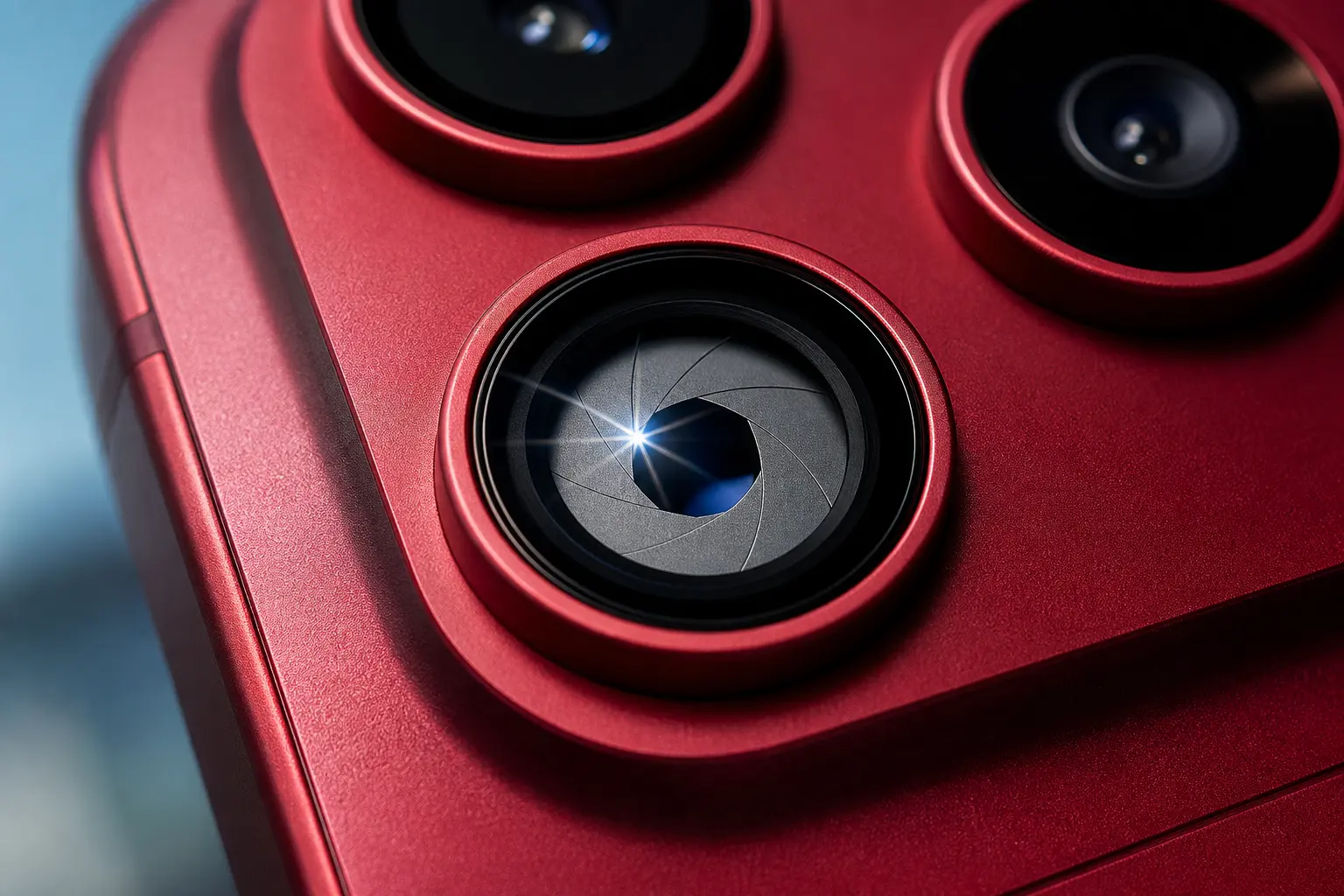
A leaked diagnostics log has done what Apple almost never allows this early: confirm a marquee iPhone feature months before its unveiling. The file, pulled from stolen Tata Electronics data, shows the iPhone 18 Pro and iPhone 18 Pro Max will ship this September with a variable aperture main camera, a mechanical system that controls exactly how much light reaches the sensor.
Samsung got there first. It built nearly the same hardware into the Galaxy S9 back in 2018, then quietly killed it a year later. Now, with Apple about to claim the spotlight, Samsung is reportedly racing to bring its own abandoned idea back from the dead.
A Leaked Log Beats Apple to Its Own Reveal
The evidence traces back to Notebookcheck, which sifted through more than 630 gigabytes of internal files a ransomware group called World Leaks stole from Tata Electronics, one of Apple’s Indian assembly partners, in June. Buried in that trove is a diagnostics log built around a new Sony IMX905 sensor, replacing the IMX903 used in the iPhone 17 Pro Max.
Pixel size holds steady at 1.22 microns. A calibration block tied to the sensor reads actuator data for a mechanical aperture, the same kind of hardware DSLR cameras use to widen or narrow their iris.
That mechanism does more than dim exposure. It changes depth of field on demand and can turn a distant streetlight into a clean, pointed starburst, effects that used to require swapping a physical lens on a real camera.
YouTuber and leaker John Prosser detailed the sensor change in a new video and called it the most important new feature of the whole lineup. The numbers back him up. Every iPhone from the 14 Pro through the 17 Pro has shipped with a fixed f/1.78 aperture. The 18 Pro breaks that run for the first time in the product’s history.
Samsung Already Ran This Experiment in 2018
Samsung introduced a variable aperture to a flagship phone years before anyone else tried it. The Galaxy S9, launched in 2018, could physically switch its main lens between f/1.5 and f/2.4 using mechanical blades borrowed straight from traditional camera design.
A teardown of the S9’s camera showed the iris sitting just outside the lens glass, stopping down light before it reached the sensor in a split-second mechanical motion. It worked, and reviewers at the time called it a genuine step forward for mobile photography.
Samsung dropped the feature after the Galaxy S10 landed in 2019, citing the added bulk and cost it piled onto the camera module. Rapid gains in computational photography made a software fix feel like the smarter trade-off, and variable aperture disappeared from Samsung’s lineup entirely. It stayed gone for seven years.
Samsung Is Reportedly Racing to Copy Its Own Idea Back
That changed in February, when Korea’s ET News reported that Samsung had asked multiple camera module makers, including Samsung Electro-Mechanics and MCNEX, to develop new variable aperture prototypes. Early testing is reportedly already underway.
Industry sources described Samsung as “strongly committed” to bringing the feature back, framing physical hardware control as “necessary to increase camera competitiveness” rather than leaning on software alone.
The timing lines up. Apple’s plans for the iPhone 18 Pro’s variable aperture had already surfaced in supply chain reports before Samsung’s reported about-face, and outlets covering the Korean report drew the connection directly: Samsung does not want to be left behind on a feature it pioneered.
Samsung’s original version only ever toggled between two fixed settings, f/1.5 and f/2.4, with nothing in between. It was useful. It was never the reason anyone bought a Galaxy S9.
Huawei Never Left the Variable Aperture Race
One phone maker never gave up on the idea. Huawei has shipped a variable aperture main camera on both the Mate 50 Pro and the P60 Pro, and its version goes much further than Samsung’s ever did.
Independent lab testing found the P60 Pro offers an aperture range from f/1.4 to f/4 on a large main sensor, one of the widest ranges ever fitted to a phone. Instead of two fixed positions, the P60 Pro adjusts across ten distinct steps, letting the camera pick a precise aperture for a scene rather than choosing between two extremes.
Huawei said the wide setting boosts light intake by close to three times over its prior flagship, while the narrow end keeps daylight shots from blowing out. The phones carry real handicaps outside China, including missing Google services and limited 5G support in some markets, but the camera hardware kept advancing while Samsung’s sat shelved.
| Phone | Debut Year | Aperture Range | Status Today |
|---|---|---|---|
| Samsung Galaxy S9 | 2018 | f/1.5 to f/2.4 (2 fixed steps) | Discontinued after the Galaxy S10 in 2019 |
| Huawei P60 Pro | 2023 | f/1.4 to f/4.0 (10 steps) | Still central to Huawei’s current flagship camera |
| iPhone 18 Pro Max | Expected 2026 | Not yet disclosed | Confirmed via leaked diagnostics log, launch expected in September |
Apple enters that race last, with a supply chain built around a single supplier and a launch date already circled on the calendar.
The Price of Light Control
Hardware like this doesn’t come free. Supply chain analyst Ming-Chi Kuo’s note from May put the variable aperture lens at roughly 50% more per unit than a high-end fixed lens, with Sunny Optical supplying somewhere between 40% and 50% of the components.
That cost, layered on top of an ongoing memory chip shortage, is fueling reports that the iPhone 18 Pro and Pro Max could carry price increases of up to $200 over last year’s models. Not every leak points the same direction. An earlier RDS News look at the phone’s expected specs described a 2nm chip paired with a price hold rather than an increase.
Where the estimates diverge:
- Ming-Chi Kuo’s May supply chain note points to lens costs that could push retail prices up by as much as $200.
- Other supply chain leaks describe a smaller increase than Kuo’s figure suggests.
- Earlier spec leaks pointed to Apple holding the line on price despite the new camera hardware.
Nobody outside Apple knows which number survives contact with the actual keynote.
Why Does the iPhone 18 Pro Need Two Different Modems?
Because Apple’s in-house C2 modem still cannot handle mmWave (millimeter wave) 5G, the fast, short-range band US carriers rely on. Leaked Tata Electronics files show Apple keeping a Qualcomm modem in US iPhone 18 Pro units for that reason, while international models switch fully to the C2 chip.
The camera isn’t the only piece of the phone that looks different depending on where it’s sold. The same Tata breach, first analyzed by AppleInsider in late June, points to Apple splitting modem hardware by region for the first time on a Pro-line iPhone.
US models are expected to keep a Qualcomm modem built around parts like the SDX80M chip, supporting mmWave 5G. International units are expected to switch to Apple’s own second-generation C2 modem instead, ending a run of Qualcomm hardware in the Pro line that stretches back to the iPhone 12.
Buyers outside the US may come out ahead anyway. Reports point to better battery efficiency, a carrier-privacy feature, and possible satellite internet support on the C2 versions, even without mmWave.
The Rest of the Leak Points to Bigger Batteries and a Smaller Notch
Prosser’s video and the leaked files agree on most of the rest of the phone. The iPhone 18 Pro and Pro Max are expected to run on Apple’s A20 Pro chip, built on a 2nm process, inside a thicker aluminum frame than last year’s model.
- Battery: 4,288 mAh in the iPhone 18 Pro and 5,567 mAh in the iPhone 18 Pro Max, both larger than their iPhone 17 counterparts.
- Dynamic Island: A smaller cutout, backed by leaked motherboard schematics showing a revised Face ID component layout.
- Colors: A lead Dark Cherry red finish, alongside blue, silver and dark gray options shown briefly in Prosser’s video.
- Case: A thicker aluminum body built to hold the larger batteries and new camera hardware.
The 5,567 mAh figure for the Pro Max would mark a battery capacity gap closed against Samsung, reversing years of Apple trailing on raw capacity alone. Apple is expected to unveil the lineup on September 8 or 9 at Apple Park, though other reporting on a staggered release breaking Apple’s usual September pattern suggests the on-sale date could shift for some models.
Frequently Asked Questions
What Does Variable Aperture Actually Change in a Photo?
It physically adjusts how much light reaches the camera sensor, similar to a DSLR’s iris. That control changes exposure without relying only on software, sharpens depth of field for portraits, and can turn a bright point of light into a defined starburst instead of a blown-out blur.
Is Samsung’s Variable Aperture Comeback Actually Confirmed?
Not yet. ET News described the technology as being in an early development phase, with Samsung Electro-Mechanics and MCNEX preparing test samples. Sources called Samsung “strongly committed,” but no Galaxy model or launch window has been named.
Will Every iPhone 18 Pro Model Get the New Camera?
The leaked diagnostics log that surfaced the Sony IMX905 sensor and its aperture actuator specifically documents the iPhone 18 Pro Max. Separate supply chain reporting, including claims examined by MacRumors, extends the same camera hardware to the smaller iPhone 18 Pro.
When Will Apple Finally Drop Qualcomm Modems Completely?
Not with this generation. Reporting on the Tata leak indicates Apple’s full break from Qualcomm hardware likely won’t happen until 2027 or later, since the in-house C2 modem still lacks mmWave 5G support that US networks depend on.
What Else Might Launch Alongside the iPhone 18 Pro?
Some leaks describe the Pro and Pro Max arriving in September alongside a new iPhone Ultra model, expanding Apple’s top-end lineup beyond the usual two Pro variants. Apple has not confirmed the name or the timing.