Leaked pricing for Google’s Pixel 11 lineup shows an effective $100 jump at the entry level, done by quietly retiring the cheapest storage tier instead of raising a sticker price. Pixel 11 Pro and Pro XL models are also splitting RAM by storage size for the first time. Google has confirmed none of it.
The pattern is not unique to Google, though. Samsung already blamed a nearly identical hike on a global memory shortage industry insiders now call RAMageddon, and Nothing’s own CEO warned months ago that every phone maker was about to get more expensive.
A Storage Shuffle Dressed Up as Stable Pricing
According to a leaked European pricing report, Google is not technically raising Pixel 11 prices. It is discontinuing the 128GB base model across the range and adding a 512GB tier at the low end, while 256GB pricing holds steady. The effect is the same as a straight hike: the cheapest way into a Pixel 11 costs more than the cheapest way into a Pixel 10 did.
US listings that briefly went live on Amazon and were pulled down give a clearer picture. The base Pixel 11 lineup reportedly starts at $899, with the range topping out at $2,249 for a 1TB Pixel 11 Pro Fold. The Pro Fold itself starts at $1,899 and, in one leak, ships with a smaller 4,750mAh battery, down from 5,000mAh last year, alongside a redesigned camera visor already spotted in a leaked Pine colorway.
Four separate changes are stacking on top of each other in the Pro tier:
- The 128GB storage option disappears from every Pixel 11 model.
- A new 512GB tier gets added to the standard Pixel 11.
- The 256GB Pixel 11 Pro and Pro XL drop from 16GB of RAM to 12GB.
- Only the 512GB and 1TB Pro and Pro XL models keep the full 16GB.
That is a real departure. Every Pixel 10 Pro configuration shipped with 16GB of RAM regardless of storage. Splitting RAM by storage tier is a new lever for Google, and it is the same lever chipmakers have been warning phone makers to expect since late 2025.
Why Every Phone Maker Is Fighting Over the Same Chips
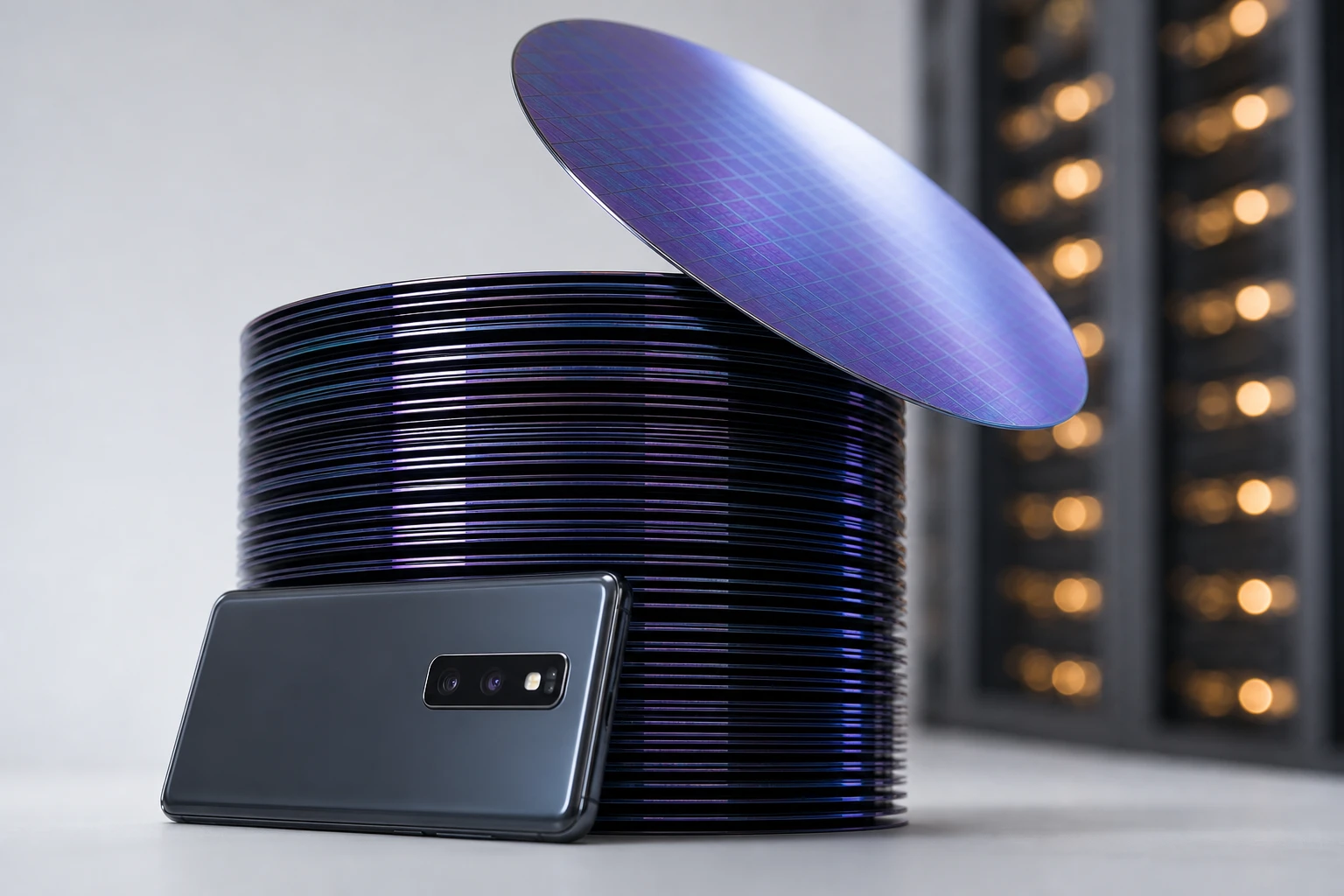
The mechanism behind all of this sits upstream, in the memory chip supply chain. Memory can represent 15 to 20% of a mid-range phone’s total build cost, according to IDC, the technology research firm, and roughly 10 to 15% for a flagship. When that input spikes, phone makers raise prices, cut specs, or both.
The spike is real. Counterpoint Research told CNBC it now expects average smartphone selling prices to jump 6.9% this year, nearly double its earlier forecast, while global shipments could fall 2.1%. TrendForce, a separate market intelligence firm, has tracked mobile DRAM prices rising in successive violent jumps through 2026, including a projected 78 to 83% quarter-over-quarter surge in LPDDR5X contract prices during the second quarter alone.
This is not really about phones. It is about servers. Samsung, SK Hynix and Micron control most of the world’s DRAM and NAND production, and hyperscalers such as Microsoft, Google, Meta and Amazon are paying a premium for high-bandwidth memory to feed AI data centers. Every wafer that goes into an HBM stack for an Nvidia GPU is a wafer that does not go into a phone’s memory chip. Phone-grade DRAM has landed third in line, behind server memory and HBM, and it is losing.
Samsung Already Put a Number on the Chip Crisis
Google is hardly alone here, and the clearest proof sits one flagship over. Samsung’s Galaxy S26 and S26 Plus launched roughly $100 more expensive than the S25 and S25 Plus, according to Android Authority’s breakdown, even after Samsung doubled base storage to 256GB to soften the blow.
We’ve been able to maintain prices for a pretty long time.
Drew Blackard, Samsung America’s senior vice president of mobile product management, offered that line to Tom’s Guide when asked to justify the increase, pointing to years of added features rather than component costs. Samsung’s own PR line has stopped short of blaming memory directly, but IDC has separately warned the current memory shortage is the worst the phone industry has faced, and the same research firm expects smartphone shipments to fall as much as 12.9% this year.
| Brand and Phone | 2026 Price Move | What Changed | Company’s Line |
|---|---|---|---|
| Samsung Galaxy S26 / S26 Plus | Up roughly $100 over S25 / S25 Plus | Base storage doubled to 256GB | Cites added features; RAM shortage widely suspected |
| Google Pixel 11 (leaked) | Effective $100 rise at entry | 128GB tier scrapped; Pro RAM splits 12GB/16GB by storage | No comment from Google |
| Nothing | CEO warned of increases up to 30% | 2026 lineup pricing not yet released | Publicly flagged rising costs ahead of launch |
| Xiaomi | Warned of higher 2026 prices | Specific figures undisclosed | Cited memory costs directly |
| Apple iPhone 18 | No confirmed hike; pressure building | More component cost absorbed into margins in Q1 | Tim Cook says Q2 impact will be “a bit more” |
Nothing’s chief executive, Carl Pei, was blunter than Samsung. He warned on LinkedIn that Nothing’s own 2026 phones would cost more, in a post titled bluntly about rising smartphone prices, though he stopped short of naming a figure. Nothing’s next handset, the Phone 3, has its own pricing and colourway details already circulating ahead of launch. Xiaomi has issued similar warnings without giving specifics, and Apple has been the most guarded of all, with Tim Cook telling investors memory had a “minimal impact” on first-quarter margins before adding that the second quarter would feel “a bit more” of it.
Does the Cheapest Pixel 11 Still Run Gemini?
One number decides whether the entry Pixel 11 remains a fully capable AI phone: 12. Google’s own developer documentation sets 12GB of RAM as one of the requirements for Gemini Intelligence, the on-device AI system Google introduced alongside Gemini Nano v3 in May 2026. An earlier round of leaks suggested Google might drop the base Pixel 11 to 8GB to save money, which would have pushed a brand-new 2026 flagship below its own AI system’s minimum spec.
A batch of Amazon listings that surfaced on July 13, 2026, before Google took them down, put that fear to rest: the base Pixel 11 paired 12GB of RAM with 256GB of storage, matching the Pixel 10’s memory configuration rather than cutting it.
- What we know: Google has confirmed a Made by Google event for August 12, 2026, in New York; the 128GB storage tier is being retired across the range; base Pixel 11 RAM holds at 12GB; Pro and Pro XL RAM splits 12GB and 16GB by storage.
- What’s unconfirmed: official pricing and configurations, since Google has verified none of the leaked figures; the exact base price of the standard Pixel 11 Pro; a separate claim that Google may be sourcing cheaper memory from a Chinese supplier; most details of the Pixel Glow feature itself.
Storage moved in the buyer’s favor. RAM, on the Pro models at least, moved against it. Price did not move in anyone’s favor.
The Pixel 10 Still Wins on Value
Jon Gilbert, a features writer at Android Police who has covered Android since 2021, has been living with this exact tradeoff. He bought a Pixel 10 Pro at 40% off shortly after launch and has used it as his daily phone since, and he has since concluded the standard Pixel 10, not the Pro, would have suited him just as well.
His reasoning holds up against the leaked Pixel 11 specs. The only substantial hardware upgrades reported for the Pixel 11 are a new Tensor G6 chip, built on a more advanced 2nm process, and new camera sensors. The GPU is not new: leaks describe the same PowerVR CXTP-48-1536 graphics chip carried over from the Tensor G5, a design that traces back to 2021. A faster CPU will not fix a bottleneck that was never CPU-shaped to begin with, and Google already routes most heavy AI processing to the cloud because its Tensor chips are not powerful enough on their own.
Then there is price. A 256GB Pixel 10 normally runs $899, but a current discount brings it down to $699, a $200 saving on a phone that, per the leaks, will match the Pixel 11’s price at that storage tier while running the same GPU and a camera system that already made a massive jump over the Pixel 9. The base 128GB Pixel 10, which pairs a Tensor G5 chip with 12GB of RAM and a 5x telephoto lens, carries a seven-year update commitment and currently sells at a discount as well.
Relief Isn’t Coming Before 2027
The bigger question is how long this lasts. TrendForce forecasts global smartphone production could fall roughly 10% this year, to around 1.135 billion units, with a bear case reaching 15% or worse if memory prices keep climbing. Omdia estimates memory already eats close to 60% of the total bill of materials in phones under $400, and TrendForce has predicted DRAM prices could still climb another 50% or more before the year is out.
New fab capacity is coming, just slowly. SK Hynix’s M15X facility, built for HBM and DRAM, is due to start production this year, while Micron’s Idaho fabs are not expected online until the second half of 2027. Estimates on when prices actually ease diverge: some analysts expect meaningful relief by late 2027, while others put it closer to 2028. Either way, nobody credible is calling for a quick fix.
Google is set to lay out its actual Pixel 11 pricing at its Made by Google event on August 12, 2026. Until then, every number in this story carries a leak label, not a Google one.
Frequently Asked Questions
When will Google confirm the Pixel 11 lineup?
Google has already confirmed a Made by Google event for August 12, 2026, in New York, and leaked retail listings point to pre-orders opening around August 20. None of the pricing, RAM or storage details reported so far come from Google itself.
How did the Pixel 11 pricing and RAM details leak?
A reader found official-looking Amazon listings on July 13, 2026, by searching Google’s own internal model numbers: 4CS4 for the Pixel 11, CGY4 for the Pixel 11 Pro, PKK4 for the Pixel 11 Pro XL and 9YI4 for the Pixel 11 Pro Fold, before Google pulled the pages down.
What is Pixel Glow?
Details are still thin, but leaks tie the name to a new RGB LED array built into the camera bar on the Pro and Pro XL models, replacing the temperature sensor Google added starting with the Pixel 9 Pro.
Is the memory shortage only hitting phones?
No. IDC has warned the same DRAM and NAND squeeze threatens the PC market, where Microsoft’s Copilot+ requirements already call for a 16GB minimum, and Lenovo, Dell, HP, Acer and ASUS have all flagged 15 to 20% cost increases heading into the second half of the year.
Will the discounted Pixel 10 stay cheap after the Pixel 11 launches?
Google’s store currently lists the 256GB Pixel 10 at $699 after a $200 discount, but Google has not said whether that price holds once Pixel 11 pre-orders open in August.