Commissioners in Early County, Georgia, voted unanimously Monday night to adopt the county’s first data center ordinance, locking in a 1,000-foot setback from homes, schools and churches, new noise limits and a requirement for water-efficient cooling on any future project. The vote followed a packed meeting at the Early County Theatre, where residents pushed leaders to slow down and toughen the rules before anyone breaks ground.
The new rules bind whatever gets built inside Early County’s borders. The aquifer underneath, and the neighboring county across the line, do not answer to a county ordinance.
Commissioners Vote Unanimously After a Packed Theatre Meeting
Leighanne Willis lives across from the proposed site. She said she only found out what was coming after noticing survey activity in a nearby field and looking into it herself.
I’m scared to death.
Willis told commissioners that, according to WTVY’s coverage of the meeting. The session ran about 50 minutes and unfolded in two parts, an administrative discussion where opponents and supporters each got time to speak, followed by the vote itself, Rickey Stokes News reported.
Early County Commission Chairman Hank Jester told the room the county was trying to get ahead of the issue, saying that without clear rules, development could turn “like the Wild Wild West.” Commissioners said they spent roughly seven months drafting the measure, reviewing policies from about 15 counties across Georgia before bringing it to a vote.
| Requirement | What Early County Adopted |
|---|---|
| Setback | 1,000 feet between a data center and any home, school or church |
| Cooling | Water-efficient cooling systems required for all new facilities |
| Noise | New county noise limits apply to data center operations |
| Power | A utility power agreement must be finalized before any permit is granted |
| Research | Drafted after reviewing ordinances from roughly 15 Georgia counties |
| Timeline | About seven months of drafting, from December to the July vote |
Not every resident thinks it goes far enough. A Blakely-area resident named Davis called the ordinance basic and said it would not make a developer think twice about coming to Early County.
QTS and the $700 Million Plan Called Project Blue Hole
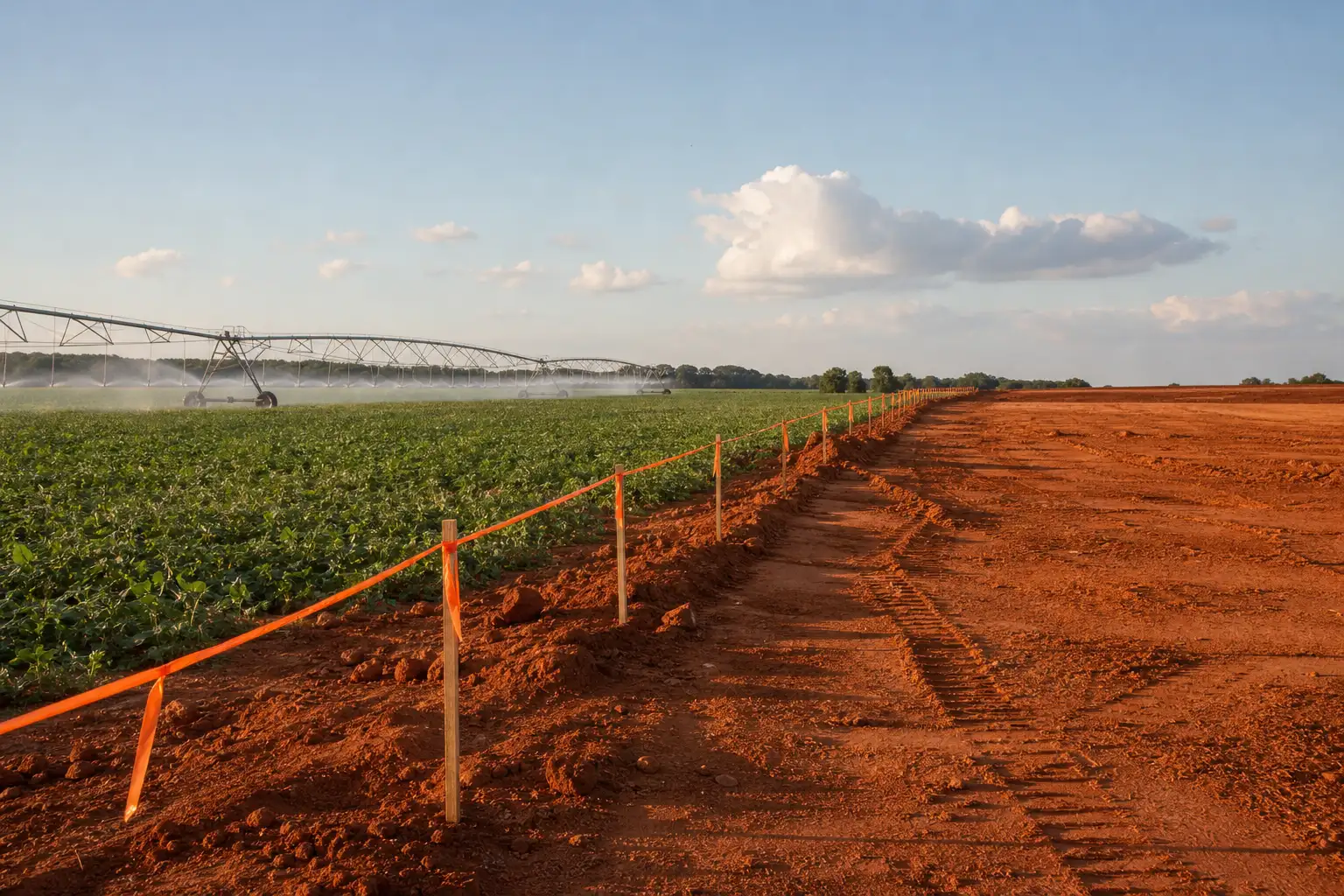
The project driving most of the anxiety in Blakely has a name: Project Blue Hole. QTS Data Centers, a data center operator owned by investment firm Blackstone, filed a Developments of Regional Impact (DRI) application with the Georgia Department of Community Affairs for a campus on undeveloped land off Martha Berry Highway, near the Early County Airport, according to reporting on QTS’s regional filings. The campus could reach up to 12 million square feet at full build-out, targeted for the end of 2035.
On its own project page, QTS describes the plan as a $700 million investment that would generate millions of dollars a year in tax revenue for local schools and services. The company’s Blakely project page also says the design uses closed-loop cooling, with no cooling towers, no ongoing water consumption once the system is running, and no discharge into nearby streams.
That claim has not settled the water question locally. Part of the reason is jurisdictional and a little strange: WDHN reported that the new ordinance is technically unrelated to the QTS proposal, because the county measure covers only unincorporated land outside Blakely’s city limits. County officials told WALB in June that two separate data center proposals were under consideration in the area, one inside the city and one in the unincorporated county, meaning the rules just adopted are aimed at whatever comes next, not necessarily the project everyone showed up to talk about.
Does a Data Center Ordinance Stop at the County Line?
No. Early County’s ordinance only governs projects sited inside Early County. The groundwater beneath it, and the roads leading into it, run straight into Mitchell County, where residents have no vote on what Early County allows and no seat on its commission.
Lauren Dorminey drove about an hour from Mitchell County to speak at the meeting anyway. She told commissioners that a data center’s effects do not stop at the county where it is built, pointing to aquifer use, possible contaminants, and soil and air pollution as regional risks, not local ones, WTVY reported.
The ground under both counties gives her argument some weight. State water planners have identified the Upper Floridan aquifer beneath the Dougherty Plain as one of only two aquifer systems in Georgia’s entire coastal plain already sitting near its sustainable yield, the point where continued pumping measurably lowers water levels and cuts the flow into nearby streams. A federal hydrology study of the same region found that a decade of average irrigation pumping could drop the water table several feet and shrink streamflow by close to a third during dry years.
Irrigation, not industry, is still the biggest draw on that aquifer. A peer-reviewed study of Georgia groundwater found that irrigation totals across Georgia’s coastal plain have climbed roughly 2000% since 1973, with the steepest, most statistically significant declines concentrated in the state’s southern and southwestern counties, exactly where Early and Mitchell sit. A new heavy water user landing on top of that trend, even one built on a closed-loop promise, arrives in a basin state officials already consider stretched thin, and stretched thin water does not recognize a property line.
A Statewide Land Rush Outpaces the Rulebook
Early County is not an outlier. Georgia now hosts more than 200 data center facilities statewide and has become one of the fastest-growing data center markets in the country, according to Georgia Tech’s Energy Policy and Innovation Center.
Local governments are scrambling to keep pace. As of early June, 34 counties and 23 cities across Georgia had adopted moratoriums, passed data center ordinances, or begun drafting them, roughly one in five counties statewide and a threefold increase since last October, the Albany Herald reported in its survey of the wave.
- Bulloch County extended its moratorium through the end of 2026 and has openly discussed a permanent ban.
- Camden County adopted a six-month moratorium in May.
- Terrell County followed with its own moratorium in early July.
- Lee County is weighing an extension of its moratorium into 2027 while it writes a data center ordinance from scratch.
- Troup County and LaGrange passed dueling ordinances within a week of each other in April, one running 17 pages with a 1,500-foot setback, the other just two pages, which one local advocate called a disappointing patchwork of protections.
The pattern repeats a familiar shape: a moratorium buys time, a workshop draws a crowd, and an ordinance follows months later, usually after a specific project has already surfaced.
The Paper Mill Math Behind a Fast Yes
Early County did not arrive at this vote from a position of strength. The county lost its Georgia-Pacific paper mill, along with more than 500 jobs, a hit commissioners said stripped out roughly 10% of the county’s budget, according to WTVY.
Jester was direct about the calculation. He said the county expects the project to generate strong tax revenue over time, revenue he framed as a way to make up ground lost when the mill closed. Commissioner Charlie Sol pointed to the same pressure, telling reporters the board is actively looking for ways to rebuild and grow the county’s tax base.
That backdrop explains why Early County chose regulation over rejection. A county that just lost a tenth of its budget has less appetite for an outright ban than a county with a diversified economy might.
What Early County’s Rules Still Don’t Cover
Davis, the Blakely-area resident skeptical of the ordinance, listed specific gaps. Nothing in the measure caps how many data centers could eventually locate in the county. Nothing requires air quality or water testing once a facility is running. And the 1,000-foot buffer, she noted, is measured to a building’s front door, not to the property line, which shrinks the real-world distance between a resident’s yard and the equipment next door.
She also raised a longer-horizon question: if a data center closes in five years, who uses that much converted land afterward? It is not a hypothetical unique to Georgia, but it is one the ordinance leaves unanswered.
Willis, for her part, was not satisfied just because the vote passed. She said she wants county leaders to tighten the ordinance further before any construction actually begins, and she plans to keep pressing commissioners on it.
The ordinance is now on the books. QTS’s own filing still has to clear state and local review before a single generator gets installed near the airport, and the theatre where residents packed in to argue about it has already emptied out for the night.
Frequently Asked Questions
What Is a Development of Regional Impact Filing?
A Development of Regional Impact, or DRI, is a Georgia state review process for projects large enough to affect more than one local jurisdiction, filed with the Georgia Department of Community Affairs. QTS used this process for its Blakely proposal. Data Center Dynamics has reported that more than a dozen data center campuses statewide have gone through DRI filings in the last couple of years, part of the same land rush reshaping rural Georgia.
Is a Statewide Data Center Moratorium Coming to Georgia?
Not yet. A state bill, House Bill 1012, would have barred Georgia counties and cities from permitting any new data center until March 2027, but it stalled in the legislature, the Albany Herald reported. Similar statewide pause bills stalled in at least a dozen other states this year, even as individual counties keep passing their own local rules.
How Many Jobs Would the Blakely Data Center Create?
QTS has told local officials that full-time positions would include technicians, maintenance workers and security staff, with a high school graduate able to earn more than $50,000 a year, according to a Q&A published by Early County News. The company also said about 30% of its workforce nationally has a military background, and it has discussed partnering with Early County schools on workforce training programs.
How Does Early County’s Setback Compare to Other Georgia Counties?
Early County’s 1,000-foot buffer is stricter than the roughly 100-foot setback common in many Georgia data center ordinances, but it is smaller than Troup County’s 1,500-foot requirement. Jackson County, by comparison, requires 1,000 feet from existing homes but only 150 feet from major roads, showing how much these numbers vary even among neighboring counties.
Have Other Georgia Counties Sued Over Data Center Approvals?
Yes. In Coweta County, a group of residents filed suit in May over the county’s approval of a separate project known as Project Sail, challenging the zoning and environmental review that cleared it, according to a statewide survey of Georgia’s data center ordinances. One activist called Coweta’s experience a cautionary tale for other counties still writing their rules.