Russia banned all diesel exports on July 8, and the shock reached fuel markets an ocean away within 48 hours. U.S. diesel futures jumped 11% to $154 a barrel, an $80 premium over crude, as traders absorbed the loss of one of the world’s largest diesel exporters.
The front line in eastern Ukraine has barely moved in weeks, but the fuel war Kyiv is waging behind it hasn’t stood still at all. Battles still rage around Kostiantynivka and Sloviansk, Russian missiles still find Kyiv, and the Kremlin says there’s no real prospect of peace talks resuming. Ukraine’s campaign against Russian refineries, ports and depots is doing something the trenches haven’t: rattling fuel markets that have nothing to do with the war.
A Third of Russia’s Refining Capacity Is Offline
The Associated Press counted more than 50 Ukrainian strikes on Russian oil refineries, depots and terminals, including sites in occupied Crimea, since late March. Some facilities have been hit repeatedly. The Tuapse refinery on the Black Sea has been struck four times in a little over two weeks.
Russia processed 3.95 million barrels of crude a day in June, down 25% from a year earlier and the lowest level in more than two decades, according to Gary Peach, an oil markets analyst at Energy Intelligence. Gasoline output fell 17% over the same stretch, to 850,000 barrels a day. “About a third of Russia’s oil refining capacity is offline,” said Chris Weafer, chief executive of Macro-Advisory Ltd.
The deepest strike yet hit Omsk in western Siberia, nearly 2,500 kilometers from Ukraine. Ukraine’s military said the refinery, the largest of 11 gasoline producers it has struck, processes more than 21 million metric tons of crude a year. “Today, our long-range sanctions reached the oil refinery in Omsk,” President Volodymyr Zelensky said. Fire Point built the drone that reached it. The Ukrainian company specializes in long-range strike weapons and has become central to Kyiv’s deep-strike campaign. In a separate address, Zelensky said operations against Russia’s oil industry “are very far from stabilization,” despite Kremlin claims otherwise.
Ukraine also hit fuel terminals at Kerch and the port of Kavkaz last week, tightening pressure on supply routes into Crimea, a peninsula where Russian security services say they recently thwarted a bomb plot targeting the Kerch Bridge. Electricity plants there were also struck, prompting a temporary halt to fuel sales on the peninsula.
Five of the hardest-hit sites show the range of the campaign, from Siberia to the Azov coast.
| Facility | Distance / Location | What Happened |
|---|---|---|
| Omsk refinery | About 2,500 km from Ukraine, western Siberia | Russia’s largest hit gasoline producer, capacity over 21 million metric tons a year, set ablaze in July |
| Slavyansk-na-Kubani refinery | About 300 km from the front line, Krasnodar region | Fire broke out; one person killed by falling drone debris; processes close to 4 million tons of crude yearly |
| Yaroslavl refinery | About 700 km from the Ukrainian border | Hit overnight in the same wave as Slavyansk; city exits briefly closed |
| Gazprom Neft refinery, Moscow | Outskirts of Moscow | Struck June 18; had supplied about 40% of fuel for the Moscow region |
| Taganrog port | Sea of Azov, southern Russia | Hit July 10; local authorities declared an emergency and evacuated residents |
The Kremlin and Western analysts read the same drone campaign very differently.
- The Kremlin calls the strikes cosmetic. Putin has described them as an attempt to force a pause in fighting and said they have “absolutely no effect on the situation at the front.”
- Western analysts cited by PBS say the campaign has slowed Moscow’s battlefield operations and added pressure on the Kremlin to negotiate.
- A November 2025 Reuters estimate, cited by the tracking group Russia Matters, found Russia’s oil processing had fallen just 3% for the year despite the drone attacks, far less than the chaos at gas stations would suggest.
Both readings can be true at once. The damage is real, and so is Russia’s ability to keep limping along.
Why a Refinery Fire in Siberia Raises Prices in New York
Russian Deputy Prime Minister Alexander Novak announced the export ban on Wednesday in a televised meeting with President Vladimir Putin, saying it was meant to “increase supplies to the domestic market.” The measure covers producers as well as traders for the first time and runs through July 31. Fuel already committed under existing government deals, including one with Mongolia, is exempt.
The scale of the squeeze shows up in the trading data.
- 11% of global diesel supply came from Russia last year, per data compiled by Bloomberg from analytics firm Vortexa.
- 234,000 barrels a day was Russia’s diesel and gasoil loading rate from July 1 to 10, down from 400,000 in June and an 817,000-barrel average across 2025, according to Kpler data.
- $60.77 a barrel is the record premium European low-sulphur gasoil futures reached over Brent crude this week.
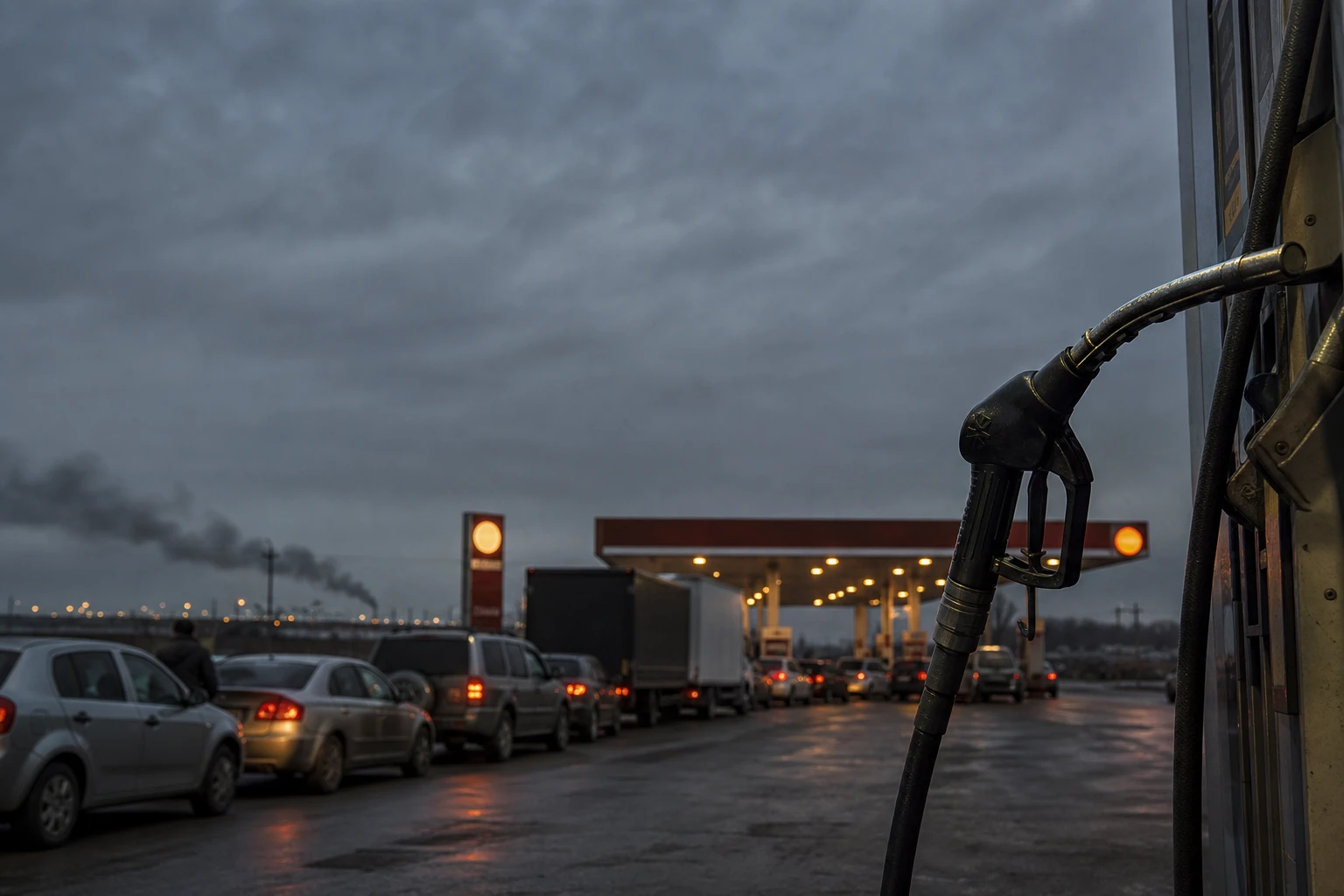
The United States and Europe haven’t imported Russian fuel in years, yet the ban still sent U.S. diesel futures up 11% in a single session. Fewer Russian barrels on the water means Turkey and Brazil, Moscow’s dominant diesel buyers in June, absorbing at least half of available cargoes, now compete with Europe for the same U.S. and Middle Eastern supply.
Kostiantynivka Holds, Barely, as Russia Grinds On
DeepState is a Ukrainian open-source monitoring group. It acknowledged in a July 1 post that “the enemy had successes in the area of Kostyantynivka” during the second half of June. Ukrainian officials describe the Kostiantynivka and Sloviansk sectors as the most active parts of the front, with dozens of clashes a day.
Ukrainian strikes have knocked out nearly 800 Russian logistics vehicles and put supply roads to Crimea and Donbas under constant drone attack, according to the Ukraine Conflict Monitor run by ACLED, the Armed Conflict Location and Event Data Project. Some Russian frontline units could run short of basic supplies by late summer, the monitor found.
Ukraine’s commander-in-chief, Oleksandr Syrsky, said a turning point in the war was “still a long way off,” even while crediting his troops with a string of recent successes. In a midyear post, Syrsky said the number of active offensive fronts had fallen and that Russian assaults were down by half.
Russia answered with barrages of its own, including a night when it sent a record 728 drones at Ukraine, with the western city of Lutsk among the hardest hit.
Why Are Ukraine’s Air Defenses Falling Short?
Ukraine intercepted just 14 of 54 Russian ballistic missiles fired in June, according to CSIS data cited by the tracking group Russia Matters, and missed every one of the 23 missiles that hit the Kyiv region on July 6, the Wall Street Journal reported. Interceptor stocks for the U.S.-made Patriot system are running thin, and the shortfall is showing up in the casualty count.
Russian drones killed two people and seriously wounded an 18-year-old in the Chernihiv region this week. A separate strike killed one person and injured two in Zaporizhzhia, officials said.
At the NATO summit in Ankara, President Donald Trump said Washington would license Ukraine to manufacture its own Patriot systems, praising Zelensky for doing “an amazing job.” The license would help long term. It won’t fix this summer’s shortage.
Europe and Britain Bet on Ukraine’s Factories
European Commission President Ursula von der Leyen signed a new defense industrial partnership with Ukraine in Kyiv on July 15, timed to Ukraine’s Statehood Day. “Ukraine has, in many ways, gone from being a buyer to a net security provider for Europe,” she said, standing alongside Zelensky.
- A further €1 billion released for drone procurement, the second payment under a €6 billion tranche of the EU’s €90 billion Ukraine Support Loan
- A separate €3.2 billion instalment of that same loan disbursed on June 25
- A €10 billion disbursement plan approved for additional drones, missiles and fighter aircraft
- Joint production of anti-ballistic missiles targeted for 2028, alongside continued investment in artillery production
- Total EU support since the war began reaching €216.7 billion in overall wartime support, including €3.8 billion from frozen Russian assets
Britain made its own industrial contribution. BAE Systems delivered Britain’s first artillery barrel forgings in decades to Ukraine, restarting a type of production the UK hadn’t carried out in almost twenty years.
Peace Talks Remain Nowhere in Sight
Kremlin spokesman Dmitry Peskov said Thursday that Moscow sees no immediate path back to the negotiating table, even as he thanked Turkey for offering to host talks.
We are well aware of our Turkish friends’ readiness to continue facilitating a shift toward a peaceful resolution of the situation surrounding Ukraine. At the moment, however, there are no immediate prospects for resuming the negotiation process; we do not see any such signs.
Peskov made the comments to reporters, adding that Russia remains open to the idea of talks in principle.
Putin has said any renewed negotiations would have to build on the 2022 Istanbul talks, which include a Russian demand that Ukraine surrender the Donbas outright. Moscow has also rejected proposals to freeze the fighting along the current line of contact or halt strikes on energy infrastructure as a first step toward de-escalation. Talks broke down in February, when Washington’s attention shifted to its war with Iran.
Russia’s diesel ban is due to expire July 31. Analysts say Moscow is likely to extend it if refinery output hasn’t recovered by then.
Frequently Asked Questions
How long is Russia’s diesel export ban set to last?
The ban took effect July 8 and runs through July 31, covering producers as well as traders for the first time. Fuel already committed under existing government agreements, including a supply deal with Mongolia, is exempt from the restrictions.
How many drones can Ukraine build to keep up the campaign?
Ukraine’s defense industry can now produce as many as 8 million drones a year, Foreign Policy reported, giving Kyiv the volume to keep striking Russian refineries even as Moscow shifts air defenses to protect Moscow and other priority sites.
What is the first concrete milestone in the EU-Ukraine Drone Deal?
The 18 founding members of the Drone Deal are scheduled to hold their first meeting in Brussels in September, when the European Commission and Ukrainian partners begin coordinating joint production timelines with Europe’s drone industry.
Will Ukraine actually get to build its own Patriot missiles?
President Trump has pledged a license, but Serhii Beskrestnov, an adviser to Ukraine’s defense minister, said setting up domestic production could take many months, since a license typically requires training, technical documentation and foreign supplier contacts.