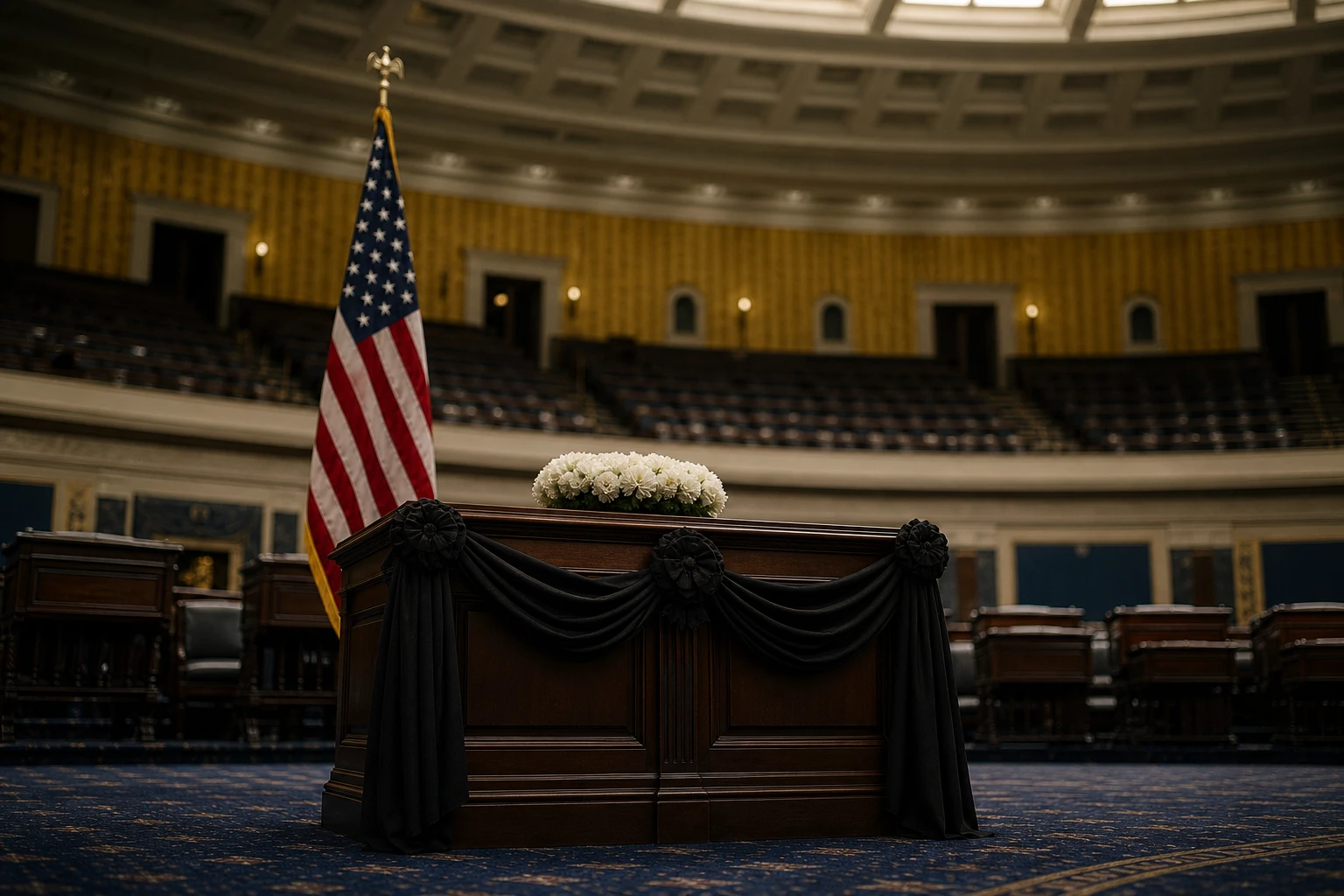
Senate Republicans and Democrats introduced a revised Russia sanctions bill Tuesday that could hit the top five buyers of Russian oil and gas with tariffs up to 100%. The measure arrived three days after the sudden death of Senator Lindsey Graham, the South Carolina Republican who spent nearly two years negotiating it.
Colleagues are rushing to pass it in his name. But the version they unveiled swaps Graham’s automatic penalties for a presidential waiver. House Democrats are already warning that trade-off could become a loophole, even as the bill’s Senate authors call it the only version tough enough to survive.
Congress Revives a Deal Graham Sealed Days Before He Died
Graham spent his final week chasing the finish line. He traveled to Kyiv and met with Ukrainian President Volodymyr Zelensky, then flew to the NATO summit in Ankara, Turkey, where he and Senator Jeanne Shaheen, a New Hampshire Democrat, sat down with Treasury Secretary Scott Bessent to lock in the bill’s language.
On Friday, Graham joined Shaheen, Senator Richard Blumenthal and Senator Roger Wicker, a Mississippi Republican, in announcing they had reached an agreement with the Trump administration to move the measure forward. Graham died late Saturday night, shortly after returning home from Ukraine.
Blumenthal said he spoke with Graham hours before his death.
I’ll start by channeling my inner Lindsey Graham, this is a big effing deal.
Blumenthal, a Connecticut Democrat and Graham’s chief Democratic partner on the legislation, said that at a Tuesday press conference announcing the revised text. Senate Majority Leader John Thune, a South Dakota Republican, fought back tears on the floor Monday as colleagues remembered Graham. Senator Katie Britt, an Alabama Republican, said Graham believed the bill would become the most consequential thing he accomplished in his career.
What the Sanctioning Russia Act of 2026 Would Do
The bill runs more than 60 pages and combines two different tools: mandatory sanctions on Russian leaders and institutions, and a tariff mechanism aimed at countries still buying Russian energy.
Sanctions Take Effect Within 30 Days
The legislation requires the Treasury Department to impose several categories of mandatory sanctions within 30 days of enactment:
- Russian leadership – President Vladimir Putin and senior political and military officials face blocking sanctions.
- Oligarchs and state enterprises – individuals and state-owned firms tied to the Kremlin lose access to U.S. markets.
- Financial institutions – Russian banks and any foreign entity that keeps doing business with them.
- Energy projects – major state-backed ventures that generate export revenue for Moscow.
- The shadow fleet – aging, reflagged oil tankers Russia uses to dodge existing sanctions.
- Defense-industrial enablers – foreign companies that support Russia’s defense industrial base.
Americans would also be blocked from buying Russian sovereign debt or doing business with Russia’s government or energy sector.
Tariffs Fall From 500% to 100%
The tariff piece changed the most since last year’s draft. The original bill authorized a blanket 500% tariff on any country still buying Russian oil or gas, a group Senate aides said could have topped 60 countries. The revised bill narrows that to the five largest buyers of Russian crude and the five largest buyers of Russian natural gas, with the actual rate, up to a 100% ceiling, set by the U.S. Trade Representative.
Senate aides identified the current top five buyers this way:
| Country | Russian Energy Purchases | Tariff Exposure Under the Bill |
|---|---|---|
| China | Top oil buyer and top gas buyer | No exemption identified; faces tariffs on both fronts |
| India | Top oil buyer | Faces the oil tariff; not on the gas list |
| Slovakia | Top oil buyer | Faces the oil tariff; not on the gas list |
| Azerbaijan | Top oil buyer | Faces the oil tariff; not on the gas list |
| Hungary | Top oil buyer and top gas buyer | Oil tariff applies; could seek the gas exemption |
| Japan | Top gas buyer | Could qualify for the 15% exemption |
| France | Top gas buyer | Could qualify for the 15% exemption |
| Belgium | Top gas buyer | Could qualify for the 15% exemption |
Countries get a pass if they buy less than 15% of Russia’s total natural gas exports and can show they are cutting that reliance further. The list resets every 180 days, so the roster of exposed countries can shift as trade flows change.
Four of Five Gas Buyers Could Dodge the Tariff
Read the exemption closely and the top five list stops looking so broad. Reuters reported that Japan, France, Hungary and Belgium could qualify for the exemption, since all four are already cutting their reliance on Russian gas. That leaves China as the one country with no clear path around either tariff.
India, Slovakia and Azerbaijan have no matching exemption on the oil side of the bill. None carries China’s trade weight, though, which is why Blumenthal said the rate should land “at a level appropriate to discourage strongly, China, India, and other major purchasers of Russian oil and gas.”
Why Does the Waiver Clause Worry the Bill’s Own Backers?
The bill lets Trump waive any of its sanctions if he certifies to Congress that doing so serves the national interest. That single clause is why some of the bill’s own Democratic supporters are uneasy even as they vote for it, since discretion in the president’s hands means enforcement becomes optional rather than automatic.
Representative Gregory Meeks of New York, the top House Democrat on foreign policy, called the waiver a loophole big enough to swallow the bill’s intent.
“This is not so much a sanctions bill as it is a massive backdoor authority for President Trump to impose more tariffs, including on our European allies,” Meeks said. He argued for automatic penalties instead, built around the Ukraine Support Act the House already passed.
The Wall Street Journal reported that some Democrats fear the measure hands Trump a trade weapon rather than a blow to Moscow, though Graham’s Senate allies reject that reading. Blumenthal calls the tariffs “targeted, narrowly limited” and says they were built to spare European allies supporting Ukraine.
Trump said Tuesday the bill has “a good chance” of passing but floated adding new sanctions on Iran and Hezbollah. Blumenthal pushed back on reopening a text he said took nearly two years to negotiate. “With all due respect to the President, he has approved this bill, and we should move forward with this bill, rather than opening it,” he told reporters.
Daniel Fried, a former U.S. assistant secretary of state for Europe and Eurasia who served under seven administrations, told RFE/RL that Section 113, the provision aimed at Russian oil and gas exports, is “more practical than the original version, but may prove a challenge to implement.”
- Blumenthal says the tariff authority is confined to five major purchasers, with the 15% exemption and anti-evasion language keeping it from sprawling further.
- Meeks says the same authority is discretionary enough to function as backdoor tariff power over U.S. allies, not a guaranteed penalty on Russia.
- Fried says the bill’s focus on oil and gas exports is sharper than last year’s draft, but implementation will be the real test.
The Senate Tried This Once Before
Graham and Blumenthal first introduced the bill, then called the Sanctioning Russia Act of 2025, in April of last year. It gathered more than 80 co-sponsors within months, a rare showing of Senate unity.
It never got a floor vote. Thune blocked it at the White House’s request while Trump pursued direct talks with Russian President Vladimir Putin. Democrats had their own objections, too. They worried the bill’s tariff authority collided with a pending Supreme Court case, and that a presidential waiver would gut the sanctions before they ever took effect.
Momentum returned briefly in December, then stalled again. It took Graham’s final push, in Kyiv and then in Ankara, to get the White House to sign off in writing.
What Happens Before the Bill Reaches Trump’s Desk?
The bill still needs a Senate floor vote, House action on the same text, and Trump’s signature before any tariff or sanction takes effect. Thune has not committed to a timetable, and the House passed its own, different Ukraine package last month that would still need to be reconciled with whatever the Senate sends over.
Thune called passing the bill “a great tribute to Lindsey” but said Monday that leaders still need to run it past the relevant committees and gauge how many Democrats will actually deliver votes. Schumer wants a floor vote immediately. Blumenthal wants passage “before August.”
Twenty-six senators had signed on as co-sponsors by Tuesday afternoon, evenly split between the two parties. Aides expect that number to climb toward 60 within days, which they said would all but guarantee floor passage.
Thune has not scheduled a vote.
Frequently Asked Questions
What Russian financial institutions and energy projects would face sanctions?
The bill lists Russia’s financial institutions, including the Central Bank of Russia, along with state-backed energy ventures such as Yamal LNG and the Arctic LNG 1, 2 and 3 projects. Those sanctions take effect within 30 days of enactment, alongside the penalties on Putin and senior officials.
How often would the list of targeted countries change?
Every 180 days. The recurring review lets the roster of top five oil and gas buyers shift as trade patterns change, without Congress writing an entirely new bill each time.
Could the bill be renamed after Graham?
Lawmakers are discussing it. Representative Joe Wilson, a South Carolina Republican, said it would be fitting to call the measure the Lindsey Graham Sanctions Act, though it formally carries the title Sanctioning Russia Act of 2026.
Is a House version of the bill coming?
Representative Michael McCaul, a Texas Republican, said on X that he planned to introduce a House companion bill the same week the Senate text was unveiled, urging colleagues to pass it in Graham’s honor.
Does the House need to act too?
Yes, separately. The House already passed a different Ukraine bill last month with more than $1 billion in security and reconstruction aid and another $8 billion available through loans, and that measure still needs to be reconciled with whatever the Senate passes.