Mercedes-Benz India’s customer advisory declaring all its BS6 petrol vehicles compatible with E20 petrol has passed 20,89,908 views, 14,282 likes, 1,666 reposts and 932 replies on X. The July 12 post, titled “Customer Advisory,” states that the vehicles are “materially compatible” with the 20 per cent ethanol blend and “certified accordingly by relevant authorities.” Within hours, owners began posting photographs of their cars’ fuel filler labels and owner manual pages that recommend only E5 or E10 fuel. An X Community Note added context citing official Mercedes-Benz India manuals that warn against higher ethanol content.
The episode lands in a week when the Ministry of Petroleum and Natural Gas has already acknowledged that E20 may cut fuel economy by 3 to 5 per cent in some vehicles. Mercedes-Benz India has not responded to follow-up questions from RushLane on whether earlier owner manuals have been superseded.
The Mercedes-Benz India Advisory That Reached Millions
Mercedes-Benz India published its customer advisory on its official account on the evening of July 12. The full text reads: “At Mercedes-Benz, customer safety, vehicle reliability and performance are of paramount importance to us. All Mercedes-Benz petrol BS VI vehicles are materially compatible with E20 fuel and certified accordingly by relevant authorities. We are happy to support customers for any technical queries. Mercedes-Benz remains committed to sustainable mobility.” The statement did not name any model, year, production date, or VIN range.
By the time this article was published, the post had drawn 20,89,908 views, 14,282 likes, 1,666 reposts and 932 replies on X, according to data on the post’s page. Most of those replies turn on what is printed on Mercedes-Benz India’s own cars and manuals, not on ethanol policy.
The post has remained at the top of X discussion since July 12, fed by a steady stream of owner photos that re-raise the contradiction. Owners have used the reply section to attach side-by-side photographs of those documents. Mercedes-Benz India has not addressed the contradiction in the replies.
Where the Owner’s Manual Says Otherwise
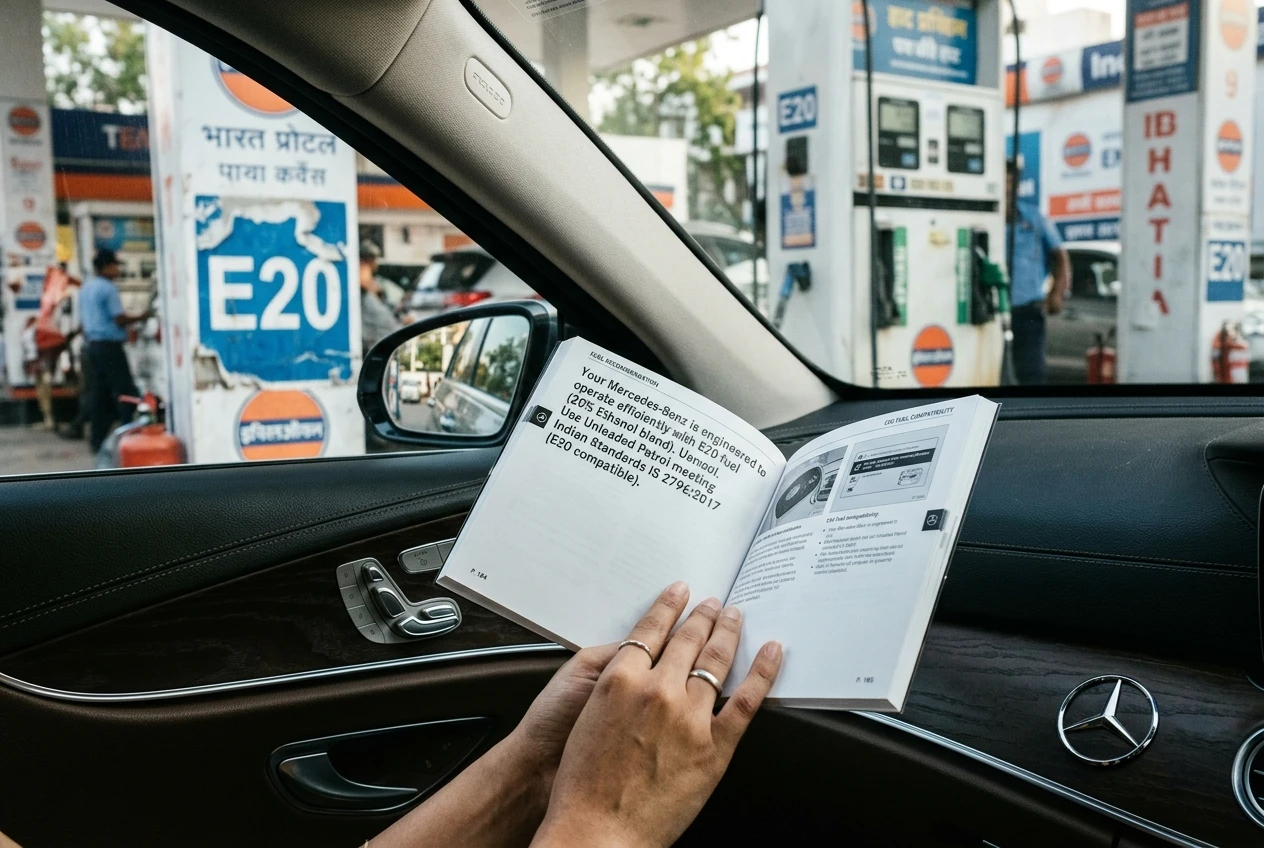
Several owners responding to the advisory have highlighted that their fuel filler caps list only E5 and E10 compatibility. Owner manuals and fuel filler labels contradicting the advisory were also flagged by RushLane, which reported that the corresponding manuals hosted on Mercedes-Benz India’s own website recommend fuels containing up to 10 per cent ethanol.
X’s Community Notes system attached a note to the advisory post that pulls supporting references directly from official Mercedes-Benz India owner manual pages. The note states that multiple BS6 manuals recommend a maximum ethanol content of E10 and warn against higher blends. The result is an apparent contradiction between the company’s July 12 statement and the printed guidance shipped with the same vehicles.
| Source | Ethanol tolerance | Certification claimed | Scope |
|---|---|---|---|
| Mercedes-Benz India X advisory (July 12) | E20 (“materially compatible”) | “Certified accordingly by relevant authorities” | “All Mercedes-Benz petrol BS VI vehicles” with no model years, dates, or VIN ranges listed |
| Mercedes-Benz India owner manuals cited by Community Notes | E5 to E10 recommended | Manual pages warn against higher ethanol blends | Tied to specific models, production dates, and model years |
| Vehicle fuel filler labels posted by owners | E5 and E10 listed | No E20 marking on the car itself | Applies to the specific car photographed |
The Vlogger Who Lit the Match
The advisory followed a viral YouTube video from Sourav Joshi, India’s most-followed daily vlogger, who claimed the fuel efficiency of his Mercedes-Benz GLC 300 had dropped sharply after refuelling with ethanol-blended petrol. In a clip posted to YouTube, Joshi told his audience: “Yesterday I showed you our car’s mileage had gone from 17 straight down to 9. And do you know what it has become today? Today it has reached five… look at this, it’s showing a mileage of five.” He attributed the drop to ethanol blending at his local petrol pump.
I don’t know when this car will break down. Nowadays I’m so scared of refilling petrol.
The quote comes from Sourav Joshi, India’s most-followed daily vlogger, speaking in a YouTube video uploaded in mid-July 2026. Mercedes-Benz India’s advisory did not name Joshi but addressed the same ethanol question. The company’s statement landed within hours of his video spreading on X and YouTube.
Joshi said a full tank that once gave him roughly 800 km of range now shows only about 480 km after refuelling. NDTV Profit noted that the advisory reiterates an existing instruction: E20 petrol should only be used in vehicles certified for it.
Government’s Own Admission on Mileage
The Federal reported that the Ministry of Petroleum and Natural Gas, in a July 10 FAQ, acknowledged that some vehicles may experience a 3 to 5 per cent reduction in fuel economy with E20. The ministry argued that mileage is influenced by other factors: driving habits, tyre pressure, servicing and air conditioner use. It also said E20 offers a higher effective octane rating, “superior anti-knock characteristics,” faster combustion, smoother acceleration and cleaner engine operation. The ministry further claimed E20 can reduce lifecycle carbon emissions by nearly 40 per cent.
India brought forward its target of achieving 20 per cent ethanol blending in petrol from 2030 to the 2025-26 ethanol supply year, making E20 the standard fuel being rolled out across the country. Mercedes-Benz India has publicly urged the government to adopt a phased approach before increasing ethanol blending beyond 20 per cent. That stance has put the luxury carmaker in the unusual position of certifying its cars for E20 while advising caution about higher blends.
Mercedes-Benz India’s Broader Ethanol Playbook
The customer advisory is consistent with Mercedes-Benz India’s long-standing public position on E20 fuel. The carmaker’s managing director and CEO, Santosh Iyer, has previously said the company’s newer petrol vehicles are fully compatible with E20.
Iyer said during the company’s half-yearly sales call that the brand was among the first to secure materially compliant and emission-compliant E20 vehicles. He added that the latest S-Class Hybrid, including the new S 450e plug-in hybrid launched in India, is already E25 compliant, meaning it can run on a higher ethanol blend than the current standard. Firstpost reported that Iyer had said Mercedes-Benz has not encountered significant technical issues related to E20 fuel, although dealerships have received more customer queries during the mileage debate. He also flagged fuel adulteration as a separate concern being masked as an E20 issue.
Autocar India quoted Santosh Iyer on fuel adulteration and E20, saying the company has “seen increased fuel adulteration happening under the garb of E20,” with fuel-quality issues being mistaken for ethanol-related concerns. Mercedes-Benz India has recommended that multiple petrol grades remain available at fuel stations during the transition. That would allow owners of older or non-certified vehicles to choose a fuel suited to their car.
What Mercedes-Benz India Has Not Clarified
Three questions are still open from the July 12 advisory. First, does the E20 compatibility claim cover every BS6 petrol Mercedes-Benz sold since BS6 norms took effect, or only newer production models? Second, have the owner manuals and fuel filler labels that list only E5 or E10 compatibility been formally superseded? Third, what specific evidence underwrites the term “materially compatible,” and which “relevant authorities” issued the certification? RushLane said Mercedes-Benz India had not responded to those questions at the time of its report.
For now, owners reading the advisory against their own glovebox paperwork have no document from the company reconciling the two. The phrase “materially compatible” sits between them.
Frequently Asked Questions
What did Mercedes-Benz India say about E20 fuel?
Mercedes-Benz India posted a customer advisory on X on July 12, 2026, stating that all its BS6 petrol vehicles are “materially compatible with E20 fuel and certified accordingly by relevant authorities.” The post also offered technical support and reiterated the brand’s commitment to sustainable mobility.
Is my Mercedes-Benz compatible with E20 petrol?
Mercedes-Benz India’s July 12 advisory covers all BS6 petrol vehicles. However, the company has not specified which model years or VIN ranges are included, and RushLane reported that many owner manuals on Mercedes-Benz India’s website still recommend a maximum of E10. Owners should check their manual until Mercedes-Benz clarifies the scope.
Why are owners questioning the E20 advisory?
Owners responding on X have posted photos of fuel filler labels and owner manual pages that list only E5 or E10 compatibility. X’s Community Notes system added a note citing official Mercedes-Benz India owner manual pages that warn against higher ethanol blends. The advisory itself does not reconcile those documents with its blanket E20 statement.
Did the Indian government admit E20 reduces mileage?
The Ministry of Petroleum and Natural Gas said in a July 10, 2026 FAQ that “some vehicles may experience a 3 to 5 per cent reduction in fuel economy” with E20. The ministry said mileage also depends on driving habits, tyre pressure, servicing, and air conditioner use, and argued that E20 offers cleaner combustion and a higher octane rating.
What did Sourav Joshi claim about his Mercedes?
Popular YouTuber Sourav Joshi said his Mercedes-Benz GLC 300’s mileage fell from about 17 kmpl to 5 kmpl between successive days of driving after refuelling with what he described as ethanol-blended petrol. He also said his full-tank range dropped from around 800 km to about 480 km. Mercedes-Benz India’s July 12 advisory did not name him but addressed ethanol compatibility.