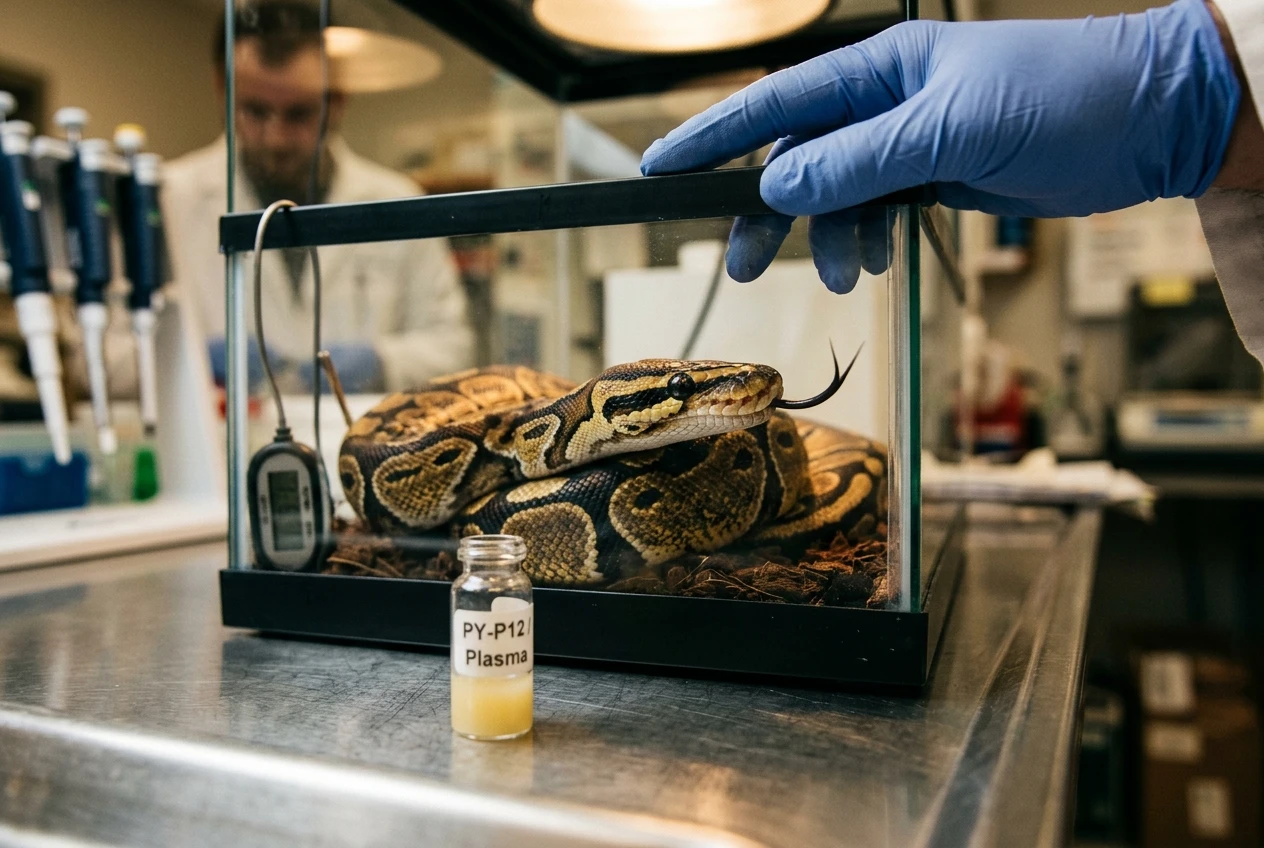
A team at the University of Colorado Boulder has identified a single molecule in python blood that surges a thousand-fold after the snakes feed and points toward a new class of weight loss drugs without the nausea and muscle loss common to current treatments. The discovery, published March 19, 2026 in Nature Metabolism, follows a research program that has run in Leslie Leinwand’s lab for more than two decades.
The molecule, called para-tyramine-O-sulphate or pTOS, climbs from barely detectable levels in fasting snakes to concentrations thousands of times higher after a meal large enough to boggle a mammal’s metabolism. When the team gave it to obese mice, the animals ate less and lost weight without the gastrointestinal problems or muscle wasting tied to GLP-1 drugs like Ozempic and Wegovy.
A Molecule That Surges a Thousand-Fold
In the new paper, a collaboration between CU Boulder’s BioFrontiers Institute, Stanford Medicine and Baylor University, the researchers ran untargeted metabolomics on plasma from Burmese pythons and ball pythons fed once every 28 days on meals weighing 25 percent of their body weight. Out of 208 metabolites that rose significantly after feeding, pTOS stood out, climbing more than 1,000-fold. The molecule is made by gut bacteria in the snakes and is not naturally present in mice. It is present in human urine at low levels and rises modestly after a meal. Because most research runs in mice or rats, pTOS has been quietly overlooked, the team wrote.
“If I were a betting person, I’d bet that something that changes a thousand-fold is probably doing something important,” said Leinwand, the CU Boulder distinguished professor of molecular, cellular and developmental biology who has run the python lab for more than two decades. That bet is now paying off in a measured, early-stage way. The team’s mouse studies show pTOS works through the hypothalamus, the brain’s appetite headquarters, and does so without causing the gastrointestinal problems, muscle loss or energy declines seen with current drugs. Other metabolites identified in the python plasma surge by 500 to 800 percent. Leinwand said the team hopes to study them next, and the full findings are laid out in the paper describing pTOS and its 1,000-fold surge.
The python work began with a simple observation: these snakes can fast for twelve to eighteen months and then swallow a meal equal to their own body weight, surviving a metabolic jolt that would kill most mammals. The Nature Metabolism paper frames pythons and a few of their relatives as extreme outliers in vertebrate digestion, a sit-and-wait lifestyle no mammal comes close to matching. Humans and rodents, the paper notes, are built for small, frequent meals, one to two percent of body weight, one to three times a day. That puts a hard ceiling on how loud any post-meal molecular signal can get.
By the Numbers
- pTOS surge in python plasma: more than 1,000-fold after a meal
- Metabolite features that rose significantly after a python fed: 208
- Pythons’ feeding schedule in the study: once every 28 days, meal equal to 25% of body weight
- Leinwand’s tenure running the python lab: more than two decades
- Other metabolites that rose after a python meal: 500% to 800%
Pythons as Metabolic Extremes
Burmese pythons have been documented displaying a forty-fold spike in energy expenditure after feeding, a sustained rise in tissue protein synthesis, and an organ-wide growth spurt in which most organs swell more than 50 percent before shrinking back over the following weeks. Few other vertebrates come close. The Nature Metabolism paper notes that Burmese pythons can consume prey equal to their own body weight in a single meal and fast for twelve to eighteen months between them. The same paper extends the pattern to ball pythons, a species that diverged from Burmese pythons about twenty-one million years ago but shows the same post-feeding pTOS rise. Mammals, the paper argues, were built for the opposite lifestyle.
The postprandial response in pythons reads less like digestion and more like a controlled renovation of the body. Heart rate can double in the first 24 hours after a meal. Cardiac muscle softens dramatically while contracting with about 50 percent greater force, work published in 2024 in the Proceedings of the National Academy of Sciences. Tissue protein synthesis stays elevated for days. Bloodstream turns milky white with circulating fats that, in mammals, would be a warning sign but in pythons serve as fuel. Organ size climbs. Then, over the following weeks, almost everything returns to baseline.
Several python species share the sit-and-wait pattern the Leinwand lab has spent years mapping, and the new study underscores how unusual the family is among vertebrates. Burmese pythons and ball pythons provided the bulk of the pTOS data. Their relatives African rock pythons and reticulated pythons share the lifestyle but were not directly measured for pTOS in the new paper.
Python Species Studied for Extreme Feeding
- Burmese python (Python molurus bivittatus): the original study species, can consume prey equal to its own body weight
- Ball python (Python regius): confirmed postprandial pTOS surge, diverged from Burmese pythons about 21 million years ago
- African rock python (Python sebae): large-bodied ambush predator sharing the sit-and-wait lifestyle
- Reticulated python (Malayopython reticulatus): the longest snake, an extreme feeder
A Heart That Grows, Then Shrinks, Then Grows Again
The most striking chapter of the python playbook is the heart. In the first twenty-four hours after a python devours a meal, its heart grows twenty-five percent, its cardiac muscle softens, and it contracts with roughly 50 percent greater force as the animal’s metabolism climbs to forty times its resting rate. Two weeks later, after digestion is done, the heart returns almost to its starting size, slightly larger and slightly stronger than before. The pattern was first laid out in a 2024 PNAS paper by Leinwand’s group, and the full numbers appear in the original PNAS cardiac remodeling study in pythons.
That story grew more complicated in 2025. A team led by CU Boulder postdoctoral researcher Yuxiao Tan assigned 24 Burmese pythons to one of four feeding regimens: Fasted, Normal Fed, Frequent Fed, and Frequent Fed/Fasted, then tracked what happened to their hearts. The Frequent Fed pythons, fed every four days instead of every 28, did not just build bigger heart cells. Their heart cells actually divided. The team called the result a hybrid model, with hypertrophy coming first, then hyperplasia. The full breakdown is covered in the heart growth and hyperplasia study in frequently-fed pythons.
Hypertrophy means existing cells grow larger; hyperplasia means new cells form. Human hearts hypertrophy after a heart attack in a way that stiffens the muscle and can lead to failure. Tan noted that in frequently-fed pythons, hearts that had been pushed past hypertrophy briefly switched gene expression back on, de-differentiated and divided, leaving total heart mass elevated even after food was withheld.
The implication for human medicine is real but unfinished. Plasma from fed Burmese pythons, an earlier study had shown, could promote healthy cardiac growth when administered to mammal cells, and the 2025 follow-up extended that finding to hyperplasia. Tan suspects a circulating factor in python blood is the trigger, but the molecule has not yet been isolated. No injured python hearts have been tested in this work, which means the regenerative ceiling in these animals remains unknown. “You can translate the snake biology to mammals, because the protein activated mammal cells,” Tan said. “It’s hard to say if we could use this for drug development, but that’s provisioned here.”
From Snake to Mouse to Human
The mechanism behind pTOS runs through the brain. In both pythons and mice, the molecule activates a specific neural population in the ventromedial hypothalamus, a brain region long associated with hunger cues. In mice, those neurons are required for pTOS’s appetite-suppressing effect. When the researchers gave high doses of para-tyramine-O-sulphate to diet-induced obese male mice, the animals ate less and lost weight without the gastrointestinal problems, muscle loss or energy declines seen with GLP-1 drugs. The mechanism is laid out in how pTOS acts on the brain’s hunger center.
The dose-to-response math is striking. In Burmese pythons, plasma pTOS rose from 20 nanomolar in the fasted state to 1.0 micromolar one day after a meal and peaked at 4.5 micromolar three days after feeding, a more than 200-fold climb in absolute concentration. Ball pythons showed a similar curve, with fasting plasma pTOS at about 1.2 nanomolar, peaking at 4.1 micromolar three days after the meal. Other metabolites in the study also surged post-feeding, though none matched the spike of pTOS. Together, the data suggest pythons evolved a molecule that doubles as a built-in appetite brake.
The team also tracked pTOS in humans. Public metabolomic datasets from three separate human meal studies show circulating pTOS does rise after eating, though at lower absolute levels than in pythons. The implication, the researchers argue, is that the gut-to-brain appetite signal pythons use at full volume is the same one humans use at a whisper. The molecule is also produced, in snakes, by gut bacteria, raising the question of whether a person’s microbiome could be coaxed to make more of it. That question has not yet been answered.
| Time point | Burmese python plasma pTOS | Ball python plasma pTOS |
|---|---|---|
| Fasted state | 20 ± 5 nM | 1.2 ± 0.6 nM |
| 1 day after feeding | 1.0 ± 0.1 µM | 1.5 ± 0.4 µM |
| 3 days after feeding (peak) | 4.5 ± 0.6 µM | 4.1 ± 1.2 µM |
Arkana Therapeutics and the Animal-Drug Pipeline
To turn the discovery into a therapy, Leslie Leinwand, Stanford’s Jonathan Long, Jack Gugel, and Tommy Martin, all of whom have worked on the python biology in Leinwand’s lab, have formed a startup called Arkana Therapeutics. The plan, Leinwand said in the university’s overview of the appetite-suppressing discovery, is to start with chemically synthesized versions of the rare metabolites found in python blood and test them as candidates for obesity, sarcopenia, and other conditions where the current drug toolkit is thin. “We believe there is still room for therapeutic growth in this market,” Leinwand said. Sarcopenia, the age-related loss of muscle mass and strength, is on the early list.
The reference point is hard to miss. Today’s blockbuster weight loss drugs trace back to a hormone in Gila monster venom that resembles human GLP-1. Ozempic and Wegovy, the team’s announcement notes, are now used by millions, but studies cited by the Leinwand team show as many as half of users stop within a year, often because of side effects. Leinwand argues the python pipeline may surface molecules with a cleaner profile. “We’ve basically discovered an appetite suppressant that works in mice without some of the side-effects that GLP-1 drugs have,” she said. Whether that translates to humans is the open question.
This is a perfect example of nature-inspired biology. You look at extraordinary animals that can do things that you and I and other mammals can’t do, and you try to harness that for therapeutic interventions.
That quote is from Leslie Leinwand, a distinguished professor of molecular, cellular and developmental biology at CU Boulder and senior author of the Nature Metabolism study. Skip Maas, a molecular biologist in her lab, keeps a pet ball python named Agrapina that fasted for fourteen months and still constricted a rat with full force when offered one. The snake’s preserved muscle tone during long fasts is one of the metabolic puzzles the team is now chasing.
Sarcopenia affects nearly everyone to some degree as they age, the team’s announcement notes, and people whose health limits their exercise are hit hardest. There are no approved therapies that halt or reverse sarcopenia. Arkana Therapeutics’ first targets are obesity and sarcopenia, with other metabolites on the discovery queue. Long’s Stanford lab, which studies metabolic byproducts in blood, will run chemistry on the python compounds. The longer play is a pipeline, not a single pill.
A Wider Hunt for Nature-Inspired Cures
Pythons are not the only extreme animals attracting drug hunters. Jonathan Long’s lab at Stanford has previously looked at racehorse blood for clues to endurance metabolism. Ashley Zehnder, chief executive of Fauna Bio, searches for disease-resistance genes in mammals with unusual adaptations. At the Stowers Institute for Medical Research, evolutionary biologist Jasmin Camacho studies bats that can drink large amounts of nectar without developing diabetes. Similar work on other unusual species is already underway, from the invasive tegu problem across two Georgia counties to broader animal biology programs like what classroom elephants reveal about animal biology.
The pattern is not new. The Gila monster’s venom gave the world GLP-1 drugs. The python work, the researchers argue, shows that even larger extremes are worth probing, because the bigger the metabolic swing, the louder the molecular signal. “By going to this extreme animal, that molecule was expressed at a higher level in a way that it just stood out,” Camacho said of pTOS. “Evolution’s been running natural experiments for hundreds of millions of years,” she added. Other researchers see the python result as one entry in a broader animal-drug pipeline that is still being built.
The challenges, Zehnder notes, are practical as much as scientific. Researchers have to learn how to keep these animals healthy in a laboratory, then map their basic biology from scratch. Pythons, for instance, are not standard lab models, and the team’s python facility at CU Boulder required years of husbandry work. That groundwork is now paying off. Leinwand’s team has begun cataloguing the function of the 207 other metabolites that surged in the snake’s plasma after a meal, each a candidate to join pTOS on the path from snake biology to bedside.
Frequently Asked Questions
What is pTOS?
Para-tyramine-O-sulphate (pTOS) is a metabolite produced by gut bacteria in Burmese and ball pythons. Its concentration in the snakes’ blood climbs more than 1,000-fold after a meal and it suppresses appetite by activating neurons in the brain’s ventromedial hypothalamus.
What did the March 2026 Nature Metabolism paper find?
The paper, a collaboration between CU Boulder, Stanford Medicine and Baylor University, reported that pTOS is conserved across pythons and mice, rises modestly in humans after meals, and reduces food intake and body weight in obese mice without the gastrointestinal problems or muscle loss seen with GLP-1 drugs.
How do pythons grow and shrink their hearts?
After a python eats, its heart enlarges by about 25 percent within 24 hours through hypertrophy, the enlargement of existing cells, then shrinks back once digestion ends. In frequently fed snakes, the heart can also undergo hyperplasia, in which heart muscle cells themselves divide, leaving the organ permanently enlarged.
Are any python-derived drugs in human trials?
No. The Leinwand team has founded Arkana Therapeutics to develop chemically synthesized versions of python metabolites, but the work remains preclinical. No human trials have been announced.
What is Arkana Therapeutics?
Arkana Therapeutics is a startup co-founded by Leslie Leinwand of CU Boulder, Jonathan Long of Stanford, Jack Gugel and Tommy Martin, with the goal of turning python-derived metabolites into drugs for obesity, sarcopenia and related conditions.
What other animals are being studied for drug discovery?
Bats that drink large amounts of nectar without developing diabetes, studied at the Stowers Institute, racehorses for endurance metabolism at Stanford, and mammals with unusual disease resistance catalogued by Fauna Bio are among the species under active study.
Disclaimer: This article is for informational purposes only. The findings discussed are preclinical and have not been tested in human clinical trials. Consult a qualified healthcare professional before making any decisions based on this research. Figures are accurate as of the publication date.