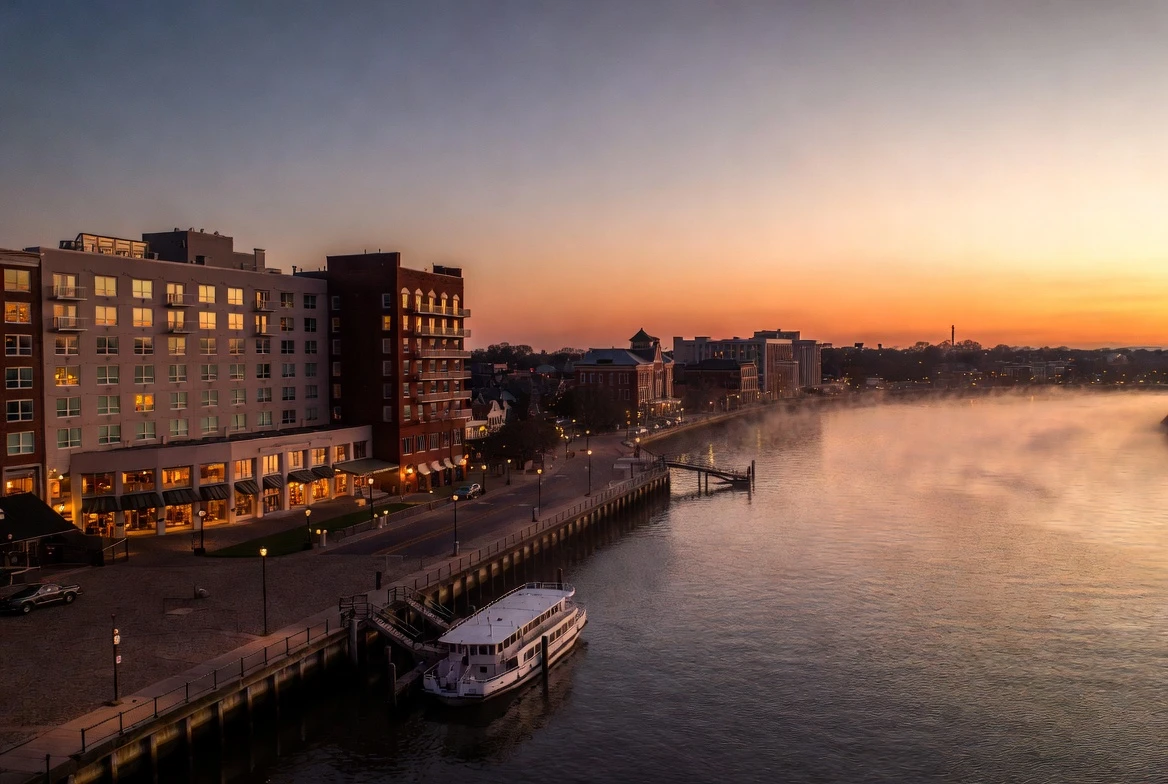
Certares Real Estate Management, alongside Clearview Hotel Capital, acquired the 351-room Hyatt Regency Savannah in Savannah, Georgia, per the announcement of the Hyatt Regency Savannah acquisition on July 1. The sales price and seller were undisclosed. The property sits along River Street on the Savannah River, with direct access to the city’s Historic District.
The deal extends a year that has concentrated hospitality deal flow in upscale, upper-upscale and luxury assets. In the first half of 2026, those tiers accounted for 73% of hotel transactions, the highest concentration in two years, according to PwC’s midyear US hospitality and leisure deals outlook. The Hyatt Regency Savannah buy fits inside that pattern, alongside marquee trades that have defined the year’s deal list.
A Riverfront Anchor in Savannah’s Historic District
The Hyatt Regency Savannah opened in 1981 and runs 351 keys, including 31 suites, along River Street on the Savannah River. The property carries more than 40,000 square feet of meetings and event space, multiple food and beverage outlets and a parking garage that can accommodate more than 300 cars. It sits steps from cobblestoned River Street and borders Savannah’s Historic District, described in the buyer’s announcement as one of the country’s most visited leisure destinations. Certares and Clearview plan to invest in guestroom and guest-facing improvements designed to elevate the property’s competitive positioning.
Savannah has emerged as one of the fastest-growing hospitality markets in the country, per the buyer’s announcement, supported by leisure travel, expanding group business demand after the recent Savannah Convention Center expansion and economic growth driven by the Port of Savannah. The hotel’s location puts it within walking distance of City Hall and the riverfront entertainment strip, a positioning the deal partners framed as a multi-segment play. The 351 keys sit in a building that physically bridges River Street, a remnant of an earlier structure on the site, with pedestrian and vehicle access routed through a tunnel below. Clearview founder and CEO Jon Kline said the deal aims to strengthen the property’s position as one of the leading hotels in the Southeast. The upper-upscale tier, which is where the Hyatt Regency Savannah sits, has been one of the focal points for hotel M&A in the first half of 2026.
The Hyatt Regency Savannah sits in the upper-upscale tier that PwC’s midyear deals outlook identifies as one of three tiers absorbing the bulk of 2026 transaction volume. The buyer’s release frames the acquisition as a reflection of Certares’ continued focus on investing in high-quality hospitality assets in markets with strong long-term demand fundamentals. Brand and operations remain with Hyatt under the existing flag.
The Buyer Pair Behind the Deal
Certares Real Estate Management was established in 2012 and runs an investment platform focused exclusively on travel and hospitality, with approximately $6.4 billion of regulatory assets under management as of December 31, 2025, per the buyer’s announcement. The firm launched its real estate platform in early 2021 and has since accumulated more than 4,000 hotel keys across premier US destinations, according to the announcement. The Savannah acquisition is its 17th hotel deal since that platform launch, following last August’s purchase of the Hyatt Regency Greenwich in Connecticut and an April 2024 buy of the Hilton Boston Back Bay. Nolan Hecht is the senior managing director and head of real estate at Certares. Clearview Hotel Capital, the co-buyer, was founded in 2007 and operates Clearview Hospitality Fund I, the commingled closed-end fund through which the Savannah investment was made.
- April 2024: Certares acquires the Hilton Boston Back Bay hotel.
- August 2025: Certares acquires the Hyatt Regency Greenwich in Connecticut.
- July 2026: Certares and Clearview acquire the Hyatt Regency Savannah in Georgia, the 17th hotel acquisition since 2021.
“The Hyatt Regency Savannah exemplifies our strategy of investing in strong, well-located hotels in growing markets. We specifically seek out markets where there are diverse demand drivers in both leisure and business, and there is no better example of this than Savannah, which has significantly built out its business infrastructure while doubling down on leisure destinations like the Historic District that make it so unique. Partnering with Clearview, an experienced Savannah hotel owner, will help us capitalize on the property’s full potential.”
Hecht made the comments in the deal’s announcement on July 1. Since inception, Clearview has invested in 71 hotels, aggregating more than $2 billion and 18,000 rooms, per the announcement. Kline said his firm has owned and operated hotels in the Savannah market for many years, an on-the-ground presence that fits the upper-upscale, high-barrier-to-entry strategy both firms share. The deal pairs Certares’ capital and platform scale with Clearview’s local market presence in Savannah, a market Hecht described as having built out its business infrastructure while doubling down on leisure destinations.
The 73% Concentration Signal
The Hyatt Regency Savannah buy is one of many 2026 transactions that have clustered at the top of the hospitality stack. In the first half of 2026, upscale, upper-upscale and luxury assets accounted for 73% of hotel deals, the highest concentration in two years, per the midyear US hospitality deals outlook. That share landed despite overall deal volume slipping roughly 2.5% from the prior six-month period, with capital that is still in the market choosing premium assets over the middle. The tilt has been visible across multiple marquee transactions in the first six months of the year. Buyers with capital to deploy have not needed to stretch as far down the chain to find scale.
Notable 2026 hotel transactions include Sunstone Hotel Investors’ sale of the Hyatt Regency San Francisco, Braemar Hotels & Resorts’ sale of the Park Hyatt Beaver Creek Resort & Spa and the JW Marriott Marco Island Beach Resort, per Hotel Dive. Gencom acquired The Ritz-Carlton New York, Central Park in Midtown Manhattan in H1, per Hotel Dive and JLL. Host Hotels & Resorts sold two Four Seasons resorts, in Orlando, Florida and Jackson Hole, Wyoming, in a combined transaction, per Hotel Dive. The buyers in most of those marquee trades have not been named publicly.
| Asset | Buyer / Acquirer | Seller | Reported Price |
|---|---|---|---|
| Hyatt Regency San Francisco | undisclosed | Sunstone Hotel Investors | $279 million |
| Park Hyatt Beaver Creek Resort & Spa | undisclosed | Braemar Hotels & Resorts | $176 million |
| JW Marriott Marco Island Beach Resort | undisclosed | undisclosed | $835 million |
| The Ritz-Carlton New York, Central Park | Gencom | undisclosed | $320 million (per JLL) |
| Four Seasons Resort Orlando + Four Seasons Resort Jackson Hole | undisclosed | Host Hotels & Resorts | $1.1 billion (combined) |
The table shows what clearing at the top looks like in 2026: marquee deals, marquee prices, and a thin slice of the seller universe. Midscale and select-service transactions do not appear on marquee lists the way they did in earlier periods, per the pattern in the PwC data. Investors with capital to deploy are picking trophy assets over volume plays.
PwC’s midyear outlook frames it as the moment the market stopped treating hospitality as a single asset class, with mid-tier operating performance still robust but deal conviction concentrated at the premium end. That is the picture the 2026 transaction list paints, and the Savannah deal lands inside it.
Why Capital Is Climbing the Tier Stack
JLL’s 2026 hotel investment outlook calls this year “the deepening of a new investment cycle with compelling fundamentals across key markets,” supported by strong debt markets, near-record dry powder and rising investor demand for yield. JLL’s June US Hotel Investment Market Update frames luxury hotels as a “compelling opportunity for investment,” with ultra-luxury RevPAR reaching 148% of pre-pandemic levels year-to-date through April, ahead of broader luxury at 133% and the overall US market recovery at 120%. Global wealth creation grew at a 9.6% compound annual growth rate from 2015 to 2025, outpacing ultra-luxury supply growth of 2.3% over the same period, JLL’s report says. The supply-demand gap is the structural argument, with trophy assets scarce and converting premium assets the preferred path to scale.
PwC writes that the concentration of deals in upscale, upper-upscale and luxury has reached its highest level in two years. Speakers at NYU’s International Hospitality Investment Forum last month pointed to a favorable debt market, secular tailwinds and rising foreign investment as additional support for the rest of the year, per Hotel Dive. The capital markets alignment shows up in the buyer mix, with private equity now accounting for nearly 30% of luxury transactions since 2015, per JLL, and REITs at 24.8% and institutional investors at 11.1%. Each of those pools holds a meaningful share of upper-tier luxury deal flow. JLL expects 2026 to mark the beginning of the next active trading cycle for premium assets.
The Savannah deal is part of that backdrop, on a riverfront site with both leisure and group demand drivers. The capital that funds it sits inside the broader 2026 inflection JLL flagged at the top of the market.
What Thins Out in the Middle
The flip side of capital concentrating at the top is the middle of the market. PwC’s midyear outlook flags that mid-tier RevPAR remains healthy, but deal conviction has moved up the tier stack, with trophy assets scarce and new-build economics hard to underwrite against current financing and entitlement costs. The pattern in the PwC data lines up with the deals list, with premium assets clearing and mid-tier assets underwritten for yield but not for trade. Operating performance in the middle is still solid, but the capital going into new deals isn’t flowing there.
Speakers at NYU’s forum also called out a “growing wealth bifurcation” in the hospitality industry, per Hotel Dive’s coverage of the JLL outlook. JLL says the luxury market has reached an inflection point and is “gearing up for its next ‘active trading cycle,'” with transaction activity up 115% year over year in Q1 2026, and historically those cycles run 18 to 36 months. JLL expects 2026 to mark the beginning of that next active trading cycle for premium assets.
Frequently Asked Questions
How large is the Hyatt Regency Savannah property?
The property runs 351 guestrooms, including 31 suites, with more than 40,000 square feet of meetings and event space, multiple food and beverage outlets and a parking garage that can accommodate more than 300 cars. It sits along River Street on the Savannah River and borders the city’s Historic District, per the buyer’s announcement.
What was the sale price for the Hyatt Regency Savannah?
The sales price and the seller were not disclosed in the buyer’s announcement on July 1, 2026. Certares Real Estate Management and Clearview Hotel Capital are the buyers, and the partnership plans to invest in guestroom and guest-facing improvements without naming the dollar amount.
How does the deal fit Certares’ broader portfolio?
The transaction is Certares’ 17th hotel acquisition since the firm launched its real estate platform in early 2021. Across its real estate portfolio, Certares has acquired more than 4,000 hotel keys in premier US destinations. Earlier Certares hotel deals include last August’s purchase of the Hyatt Regency Greenwich in Connecticut and an April 2024 acquisition of the Hilton Boston Back Bay.
Which other marquee hotel deals have closed in 2026?
Notable 2026 transactions include Sunstone Hotel Investors’ $279 million sale of the Hyatt Regency San Francisco, Braemar Hotels & Resorts’ $176 million sale of the Park Hyatt Beaver Creek Resort & Spa, the $835 million sale of the JW Marriott Marco Island Beach Resort, Gencom’s $320 million acquisition of The Ritz-Carlton New York, Central Park and Host Hotels & Resorts’ combined $1.1 billion sale of two Four Seasons resorts in Orlando and Jackson Hole.
What is the outlook for hotel investment through the rest of 2026?
JLL’s 2026 Global Hotel Investment Outlook calls the year “the deepening of a new investment cycle with compelling fundamentals across key markets.” The firm reports luxury hotel transaction activity up 115% year over year in Q1 2026, and flags a typical luxury trade window of 18 to 36 months. Speakers at NYU’s International Hospitality Investment Forum pointed to a favorable debt market, secular tailwinds and rising foreign investment as additional support.