Georgia’s first national park bill cleared its first congressional step on Wednesday, July 1, 2026, when the House Subcommittee on Federal Lands held a hearing on H.R. 9416, the Ocmulgee Mounds National Park Redesignation Act. The seven-page bill would strip one word, “historical,” from the name of Ocmulgee Mounds National Historical Park in Macon-Bibb County and put the site on the federal map as Ocmulgee Mounds National Park. If it becomes law, Georgia joins a list of states with at least one unit of the national park system for the first time.
The legislation was introduced on June 24, 2026 by Rep. Austin Scott, a Georgia Republican, with 11 bipartisan cosponsors from the state’s House delegation, including Rep. Sanford Bishop, a Democrat. On Wednesday, Scott and Bishop testified together in the subcommittee. The official bill record on Govinfo lists the cosponsors as Sanford Bishop, Buddy Carter, Brian Jack, Hank Johnson, Nikema Williams, Richard McCormick, Mike Collins, Rick Allen, Clay Fuller, Barry Loudermilk, and Lucy McBath. The subcommittee heard testimony; a committee vote has not yet been scheduled.
What’s Actually in the Seven-Page Bill
H.R. 9416 reads less like a sweeping land designation and more like a focused rewrite of one park’s existing authority. The text keeps Ocmulgee inside the National Park System, allows fishing in park waters under existing federal and state law, and orders the Interior Secretary to seek out tribal members for park employment. It also gives the Secretary authority to make technical corrections to the official park map numbered 363/193026, dated May 2026.
The provisions that draw the most attention, however, are the ones that redraw the relationship between the federal government and the Muscogee (Creek) Nation:
- Trust transfer of approximately 133.88 acres owned by the Muscogee (Creek) Nation, to be completed within 180 days of the Nation’s request.
- An explicit ban on class II and class III gaming on the trust parcel, meaning no casino-style or bingo-style gambling on the land.
- Authority for cooperative agreements between the National Park Service and the Muscogee Nation, replacing a stronger co-management clause that appeared in earlier drafts.
- Continued tribal consultation and protection of sacred cultural sites within the broader Ocmulgee corridor.
For a fuller walk-through, a plain-English summary of H.R. 9416’s provisions lays out each section in order.
Why the Bill Is Smaller Than the Last One
H.R. 9416 is a noticeably trimmed version of what Georgia’s delegation has been pushing for years. The earlier Ocmulgee Mounds National Park and Preserve Establishment Act, filed in both chambers as H.R. 2345 and S. 1131, would have created an adjoining national preserve, authorized willing-seller land purchases to enlarge the park, and directed the Interior Secretary to enter a formal co-management agreement with the Muscogee Nation. None of those three pieces survive in the new text.
The shift reflects what the National Park Service told a Senate subcommittee on December 9: it did not want to take on the additional land along the Ocmulgee River that the larger bill contemplated, much of which is already overseen by U.S. Fish and Wildlife or the Georgia Department of Natural Resources. With the agency’s position on record, the Georgia delegation narrowed the ask to the parts that don’t hinge on buying or managing new ground. Under H.R. 9416, the park would still rank as the second-smallest national park in the country behind the National Park Service page for Gateway Arch National Park in St. Louis, which sits on 91 acres.
The Muscogee Stake: What the Tribe Gains and Loses
The part of the story that gets the least attention in fast coverage is the one that matters most to the Muscogee (Creek) Nation. The older bill carried a co-management clause that would have put the tribe on equal administrative footing with the Park Service at Ocmulgee, a precedent-setting arrangement for a unit of the national park system. That provision is gone from H.R. 9416. In its place is the cooperative-agreement authority, which gives the Secretary discretion rather than direction.
What the tribe gains is land status. The 133.88 acres the Muscogee Nation already owns near the park would be taken into federal trust for the Nation within 180 days of a request, formally placing it inside the Muscogee Creek Indian Reservation. The bill also bars class II and class III gaming on that parcel, foreclosing one potential use of the land and answering a recurring question about sovereign land in Middle Georgia.
Our bill today represents a small, albeit meaningful, step forward that will strengthen Ocmulgee and ensure that its cultural and religious sites are protected now and into the future.
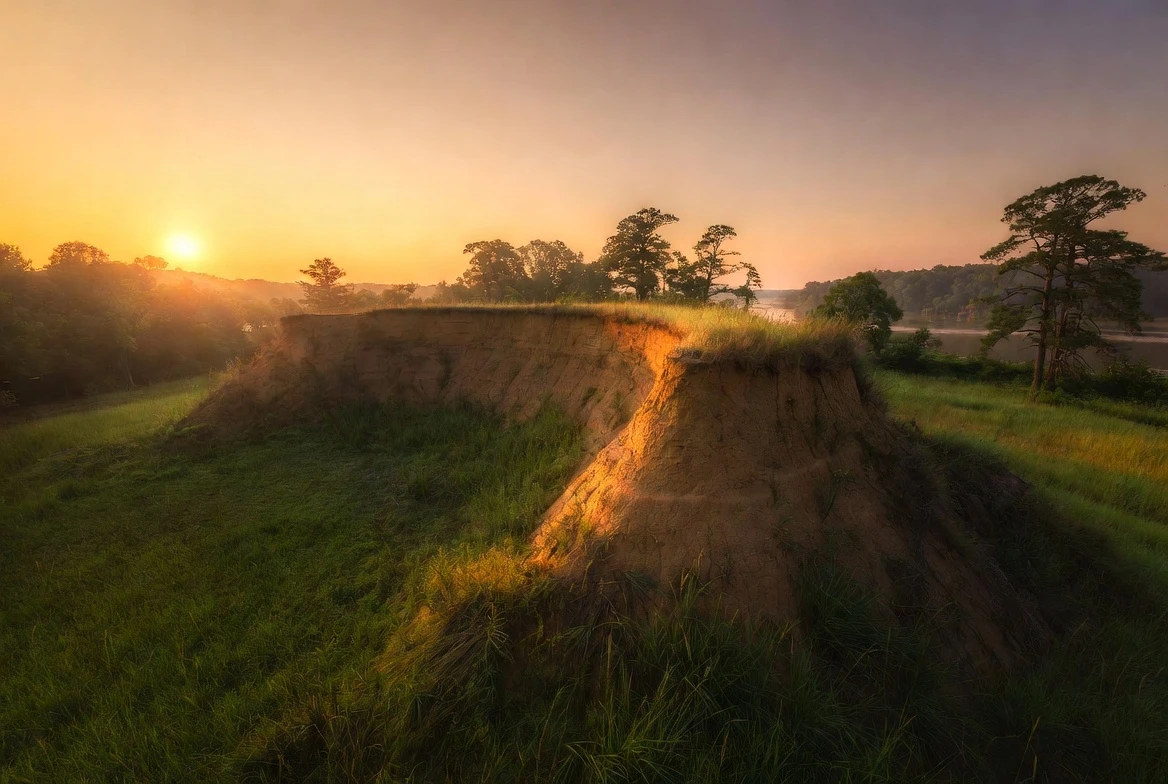
That framing came from Bishop in the bipartisan statement Bishop and Scott issued after the hearing, where he placed the redesignation inside a longer story about the site’s Indigenous history. Bishop’s office said the area is the ancestral home of the Muscogee (Creek) Nation and has been inhabited continuously for over 12,000 years, with Muskogean people of the Mississippian period beginning to construct the surviving mounds around 900 CE.
Scott, in his own remarks, cast the redesignation in national terms, comparing the Ocmulgee River corridor to “the Grand Canyon, Yosemite, and Yellowstone” as a regional heritage landmark. The Muscogee Nation’s formal position on the new bill was not in the materials released after the hearing. The change from co-management to cooperative agreement, paired with the trust transfer and gaming ban, is the kind of trade the easy “Georgia gets a national park” narrative flattens into a straight win for everyone.
What Macon Expects: 3,000 Jobs, 1.3 Million Visitors
The economic case for the redesignation came from Gary Wheat, CEO of Visit Macon, who told members of the House Natural Resources Committee that the name change would still transform the east side of Macon even without the larger land base. Wheat cited studies projecting 3,000 new jobs, 1.3 million visitors a year, and $206 million in annual economic activity, a figure he said could ultimately help roll back property taxes for residents of Bibb County.
For Middle Georgia, those numbers translate into careers, expanded tax revenue, stronger entrepreneurship and a higher quality of life.
Wheat also pointed to the project’s cultural dimension, telling legislators that the economic development rides alongside renewed efforts in recent years to welcome citizens of the Muscogee Nation in Oklahoma back to their traditional homelands.
The projections, drawn from studies Visit Macon has commissioned:
- 3,000 new jobs tied to the redesigned park
- 1.3 million visitors a year once national-park status takes effect
- $206 million in projected annual economic activity
- 133.88 acres of Muscogee (Creek) Nation land moving into federal trust
Local governments are putting money down on the bet. In the days before the hearing, the Macon-Bibb County development authority voted to buy the downtown Marriott for $13 million, a move framed as preparation for the tourism the redesignation is expected to draw.
Where the Bill Goes From Here
Wednesday’s hearing was a subcommittee step, not a final vote. The latest action on the bill is recorded as “Subcommittee Hearings Held” on July 1, 2026. If the subcommittee approves, the bill advances to the full House Natural Resources Committee and then to the floor of the House. A Senate companion would also be required before any redesignation could reach the president’s desk.
If H.R. 9416 stalls in committee, the proposal is not necessarily dead. Supporters could revise the text or try again later in the 119th Congress. Either path keeps the larger Preserve and co-management plan within reach for a future Congress, even if H.R. 9416 passes first on its own terms.
Frequently Asked Questions
What would H.R. 9416 actually do?
It would redesignate Ocmulgee Mounds National Historical Park as Ocmulgee Mounds National Park, removing the word “historical” from the federal name, and keep the site under the National Park System with the same general authorities. The bill also includes targeted provisions on fishing access, tribal employment, sacred-site protection, and a trust transfer for Muscogee (Creek) Nation land.
How is H.R. 9416 different from the earlier Ocmulgee park bill?
The earlier Ocmulgee Mounds National Park and Preserve Establishment Act (H.R. 2345 and S. 1131) would have added a national preserve, allowed willing-seller land purchases to expand the park, and directed the Interior Secretary to enter a co-management agreement with the Muscogee Nation. H.R. 9416 drops all three of those elements and keeps the redesignation plus the trust transfer.
What does the bill do for the Muscogee (Creek) Nation?
H.R. 9416 moves approximately 133.88 acres owned by the Muscogee Nation into federal trust within 180 days of a request, placing the land inside the Muscogee Creek Indian Reservation. It bars class II and class III gaming on that parcel and authorizes cooperative agreements with the Park Service, though the directed co-management clause from the earlier bill is no longer in the text.
When could Ocmulgee officially become a National Park?
The earliest path is for H.R. 9416 to advance out of the House Subcommittee on Federal Lands, through the full House Natural Resources Committee, through the House, and then through a Senate companion before the president could sign it. The subcommittee hearing on July 1, 2026 was the first of those steps.