Tata Motors has put the Sierra EV on sale in India at an introductory price of Rs 18.79 lakh, putting the new compact electric SUV directly across from the Hyundai Creta Electric, which has been selling at Rs 18.03 lakh to Rs 24.70 lakh (ex-showroom, pan-India). On paper, Tata brings the bigger numbers: a 2,730 mm wheelbase that is 120 mm longer than the Hyundai’s, three powertrain options including a dual-motor all-wheel-drive variant, and a top claimed MIDC range of 665 km against the Creta Electric’s 510 km. Hyundai’s counter is structural, not spec-sheet: a battery-as-a-service plan that pulls the Creta Electric’s starting price down to Rs 10.99 lakh, a wider colour palette, and an 11 kW AC charger that fills the smaller battery faster than the Sierra’s 7.2 kW wall-box unit.
Deliveries of the Sierra EV are scheduled to begin on 15 July, per Tata’s launch announcement. The comparison below pulls together specifications from Tata Sierra EV vs Hyundai Creta Electric specifications comparison on CarDekho, the launch report on the same site, and Tata’s own Sierra.ev product page.
The Price Gap, and How the BaaS Shortcut Narrows It
Tata’s introductory price band for the Sierra EV runs from Rs 18.79 lakh to Rs 25.99 lakh (ex-showroom, pan-India). The Hyundai Creta Electric’s range is Rs 18.03 lakh to Rs 24.70 lakh on the same basis. At the top of each line-up, the gap is around Rs 1.3 lakh in Hyundai’s favour, per the CarDekho comparison. That paper gap opens into a far bigger one once Hyundai’s battery-as-a-service programme is counted in: a BaaS Creta Electric starts at Rs 10.99 lakh, with a separate battery rental of Rs 3.9 per km.
The Sierra EV, by contrast, has to be bought outright. Tata does not offer a BaaS scheme on the new model, and the 7.2 kW AC home charger is a Rs 49,000 accessory added on top of the variant price. At the bottom of the price band, the entry Sierra EV is Rs 18.79 lakh and a BaaS Creta Electric is Rs 10.99 lakh, before the per-km battery rental starts to accrue. The Rs 1.3 lakh figure refers to the fully loaded variants compared like for like, CarDekho notes.
- Sierra EV price band: Rs 18.79 lakh to Rs 25.99 lakh (introductory)
- Creta Electric price band: Rs 18.03 lakh to Rs 24.70 lakh
- Creta Electric with BaaS: from Rs 10.99 lakh + Rs 3.9 per km battery rental
- Sierra EV 7.2 kW AC wall-box: Rs 49,000 accessory
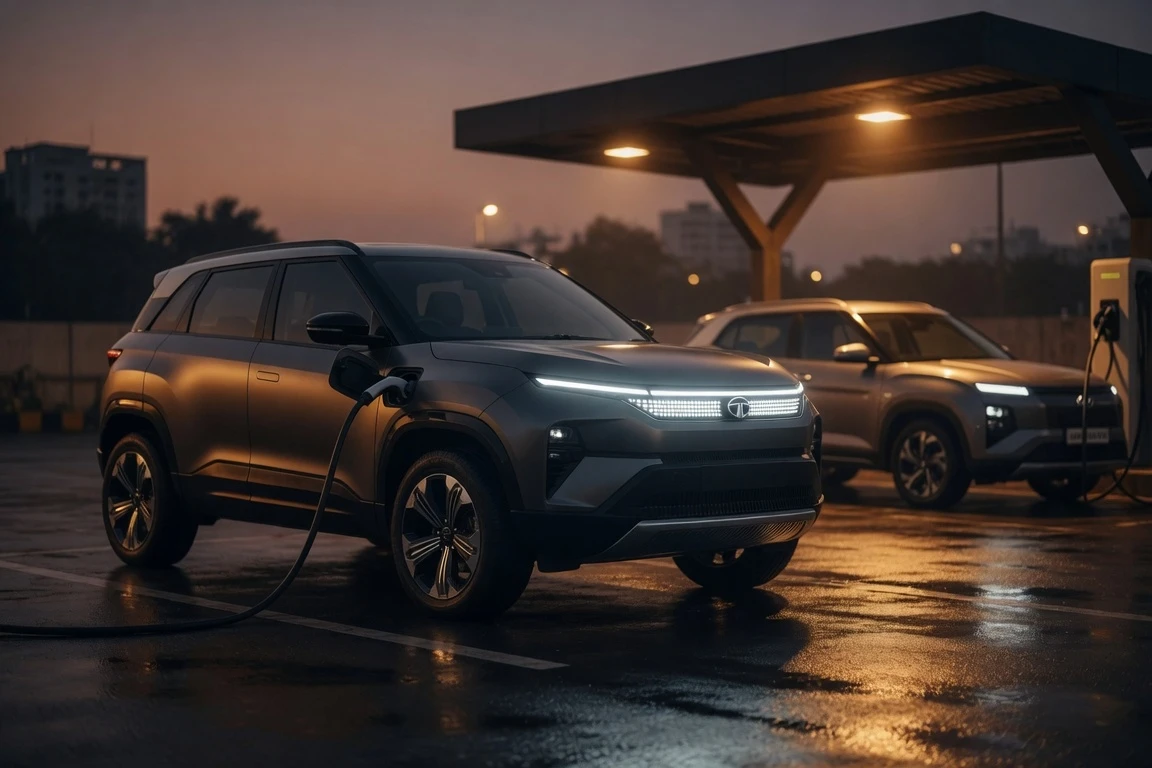
The Sierra Stretches Wider, and Sits on a Longer Wheelbase
On footprint, the two SUVs are exactly the same length at 4,340 mm, but the Sierra EV measures wider (1,841 mm versus 1,790 mm), taller (1,750 mm with roof rails versus 1,655 mm) and rides on a 120 mm longer wheelbase of 2,730 mm against the Creta Electric’s 2,610 mm. Those extra 120 mm, on paper, translate into a more spacious cabin for the Sierra, with a flatter floor possible thanks to the longer platform. Ground clearance is similar across the two, with both sitting around 200 mm to 205 mm unladen.
The wider track and longer wheelbase also shape the way each car sits on the road. CarDekho’s comparison notes that the Sierra’s proportions should give it a more spacious cabin and better road presence than the Hyundai. The Creta Electric keeps the compact, urban-friendly footprint that made the ICE Creta a segment leader, with dimensions that slot into a standard parking space more easily.
| Parameter | Tata Sierra EV | Hyundai Creta Electric | Difference |
|---|---|---|---|
| Length | 4,340 mm | 4,340 mm | No difference |
| Width | 1,841 mm | 1,790 mm | +51 mm (Sierra) |
| Height | 1,750 mm (with roof rails) | 1,655 mm (with roof rails) | +95 mm (Sierra) |
| Wheelbase | 2,730 mm | 2,610 mm | +120 mm (Sierra) |
More Shades on the Creta, and Three of Them Matte
The Creta Electric offers more colourways than the Sierra EV, with nine names on the list compared to Tata’s seven. Two of the Hyundai’s shades (Ocean Blue and Atlas White) are also available with a contrasting black roof, and four of them come in a matte finish. The Sierra EV’s colour palette is all monotone, with one shade reserved for the fully loaded QWD dual-motor variant.
Tata’s seven shades are Rishikesh Rapids, Nainital Nocturne, Pristine White, Pure Grey, Bengal Rouge, Coorg Cloud and Andaman Adventure. The Creta Electric’s nine are Ocean Blue, Starry Night, Atlas White, Titan Grey Matte, Fiery Red, Black Matte, Abyss Black, Ocean Blue Matte and Robust Emerald Green Matte. Buyers who want a matte finish or a dual-tone roof have one choice in this comparison, and it is the Hyundai.
Where the Cabin Tech Tips
Both SUVs run the expected compact-SUV tech stack: panoramic sunroof, ventilated front seats, dual-zone climate control, a 360-degree camera, six airbags, electronic stability control and Level-2 ADAS. On the touchscreen, the Sierra EV pulls ahead: a 12.3-inch main display, a 12.3-inch co-passenger entertainment screen and a 10.25-inch digital driver’s display. The Creta Electric uses a 10.25-inch main touchscreen and a 10.25-inch driver’s display, with no passenger-side screen.
On the audio side, the Sierra EV runs a 12-speaker JBL Black system, while the Creta Electric uses an 8-speaker Bose set-up that includes a sub-woofer and two tweeters. The Sierra EV adds a PM2.5 cabin air filter and front LED fog lamps, both of which the Creta Electric skips. The Creta Electric counters with greater seat adjustability: 8-way powered driver and 6-way co-driver seats, against the Sierra’s 6-way driver and 4-way co-driver.
On the smaller print, both SUVs offer wireless Apple CarPlay and Android Auto (the Creta Electric via adapter), wireless smartphone charging, ambient lighting, an electronic parking brake and all-four disc brakes. The Sierra EV adds corner stability control, a feature the Creta Electric does not list. Both charge via Type-C USB ports: the Sierra EV provides two front and two rear; the Creta Electric one front and two rear.
- Sierra EV only: front LED fog lamps
- Sierra EV only: 12.3-inch co-passenger entertainment screen
- Sierra EV only: 12-speaker JBL Black sound system
- Sierra EV only: PM2.5 cabin air filter
- Sierra EV only: corner stability control
- Creta Electric only: 8-way driver, 6-way co-driver powered seat adjustment
Power, Range, and the AWD Card
The Sierra EV ships with two battery packs, a 63 kWh and a 75 kWh unit, and three powertrain options: a single-motor RWD 63 kWh, a single-motor RWD 75 kWh, and a dual-motor AWD 75 kWh. The Creta Electric ships with two battery packs (42 kWh and 51.4 kWh) and a single front-mounted motor in each. Both cars use single-speed automatic transmissions.
Power output on the top Tata is 209 PS from the rear motor and 140 PS from the front motor in the AWD variant, with combined torque of 504 Nm and a Tata-claimed 0-100 kmph time of 5.8 seconds. The 63 kWh RWD Sierra EV produces 238 PS and 315 Nm, and the 75 kWh RWD produces 209 PS and 315 Nm. Hyundai’s two Creta Electric variants produce 135 PS (42 kWh) and 171 PS (51.4 kWh), both with 200 Nm of torque.
On claimed range (MIDC Part 1 + Part 2), the Sierra EV runs 565 km (63 kWh RWD), 665 km (75 kWh RWD) and 624 km (75 kWh AWD). The Creta Electric runs 420 km (42 kWh) and 510 km (51.4 kWh). Tata’s headline MIDC figure of 665 km tops the Hyundai’s 510 km ceiling on paper.
Drivetrain is the cleanest split in the comparison: rear-wheel drive on every Sierra EV, with all-wheel drive available on the top variant; front-wheel drive on every Creta Electric. A buyer who wants AWD in this segment has one choice, and it is the Tata. The QWD dual-motor configuration is available only on the top Empowered A trim, at a Rs 1.20 lakh premium over the 75 kWh RWD Empowered A price.
| Specification | Sierra 63 kWh RWD | Sierra 75 kWh RWD | Sierra 75 kWh AWD | Creta 42 kWh | Creta 51.4 kWh |
|---|---|---|---|---|---|
| Power | 238 PS | 209 PS | 209 PS (rear) + 140 PS (front) | 135 PS | 171 PS |
| Torque | 315 Nm | 315 Nm | 504 Nm | 200 Nm | 200 Nm |
| Claimed range (MIDC) | 565 km | 665 km | 624 km | 420 km | 510 km |
| Drivetrain | RWD | RWD | AWD | FWD | FWD |
AC Fast Charging Speed, DC Speed, and the Tradeoff
Charging is where the comparison flips. Hyundai fits an 11 kW AC fast charger on the Creta Electric, against the 7.2 kW AC unit available as a Rs 49,000 accessory on the Sierra EV. With the smaller 42 kWh pack, the Creta Electric goes from 10 to 100 percent in 4 hours on AC, and the 51.4 kWh pack in 4 hours 50 minutes. The Sierra EV’s 63 kWh pack takes 8.9 hours and the 75 kWh pack 10.5 hours on the same duty cycle, per CarDekho.
On DC fast charging, the Sierra EV pulls ahead. With a 110 kW unit, the 63 kWh pack goes from 10 to 80 percent in 25 minutes; with a 120 kW unit, the 75 kWh pack takes 26 minutes. The Creta Electric, with a > 100 kW DC unit, takes 39 minutes for the 42 kWh pack and 58 minutes for the 51.4 kWh pack. Both are within typical highway-stop tolerances, but the Sierra is the quicker fill on the bigger pack.
| Charging spec | Tata Sierra EV | Hyundai Creta Electric |
|---|---|---|
| AC fast charger | 7.2 kW (Rs 49,000 accessory) | 11 kW (standard) |
| AC 10 to 100% (top pack) | 10.5 hours (75 kWh) | 4 hours 50 mins (51.4 kWh) |
| DC fast charger | Up to 120 kW | > 100 kW |
| DC 10 to 80% (top pack) | 26 minutes (75 kWh) | 58 minutes (51.4 kWh) |
Who the Two EVs Are For
The Sierra EV is the longer-distance, larger-cabin, AWD-capable option in this comparison. Its on-paper edge on range, wheelbase and powertrain count translates into a more SUV-shaped product aimed at buyers who want the higher seating position and the extra space. The launch itself, per CarDekho, was preceded by a Tal Moreeb sand dune climb in the UAE, a sign of the AWD version’s off-pavement brief.
The Creta Electric is the lower-entry, faster-filling, more-colourful option. The BaaS programme pulls the entry price to Rs 10.99 lakh, the 11 kW AC charger is standard, and the matte and dual-tone options give buyers a wider design palette. Buyers who want a smaller urban footprint, a price point under Rs 11 lakh or a quicker AC fill have one choice in this comparison, and it is the Hyundai. For more on the Creta Electric’s place in Hyundai’s wider India plan, see Hyundai’s 2030 product and EV roadmap, and for the Sierra EV’s full launch context, see Sierra EV launch announcement and variant pricing on the same site. Tata’s own listing of the model sits at Tata Motors’ official Sierra.ev product page.
Frequently Asked Questions
Which is cheaper, the Tata Sierra EV or the Hyundai Creta Electric?
The Hyundai Creta Electric’s entry price of Rs 18.03 lakh undercuts the Tata Sierra EV’s starting price of Rs 18.79 lakh. With Hyundai’s battery-as-a-service plan, a Creta Electric starts at Rs 10.99 lakh, with a separate battery rental of Rs 3.9 per km. The Sierra EV is sold outright only.
Which one has more claimed range?
The Sierra EV’s top claimed MIDC range is 665 km on the 75 kWh RWD, with 565 km on the 63 kWh and 624 km on the 75 kWh AWD. The Creta Electric’s top claimed MIDC range is 510 km on the 51.4 kWh and 420 km on the 42 kWh. Tata’s MIDC figures sit above Hyundai’s on every like-for-like spec.
Does the Tata Sierra EV have AWD?
Yes, but only on the top Empowered A variant, at a Rs 1.20 lakh premium over the 75 kWh RWD Empowered A. The dual-motor AWD setup pairs a 209 PS rear motor with a 140 PS front motor, producing 504 Nm of combined torque and a Tata-claimed 0 to 100 kmph time of 5.8 seconds. The Creta Electric is offered in FWD only.
What is the Hyundai Creta Electric BaaS scheme?
Hyundai’s battery-as-a-service plan drops the entry price of the Creta Electric to Rs 10.99 lakh (ex-showroom, pan-India), with the battery rented separately at Rs 3.9 per km. The Sierra EV does not offer a BaaS option, and the 7.2 kW AC home charger is a Rs 49,000 accessory on the Tata.
Which charges faster, the Sierra EV or the Creta Electric?
On AC, the Creta Electric fills faster because of its 11 kW onboard charger and smaller 51.4 kWh pack, taking 4 hours 50 minutes from 10 to 100 percent, against the Sierra EV’s 10.5 hours for the 75 kWh pack on a 7.2 kW wall-box. On DC, the Sierra EV is quicker per the spec sheet: 26 minutes from 10 to 80 percent on a 120 kW unit for the 75 kWh pack, against 58 minutes on the Creta Electric’s 51.4 kWh pack.