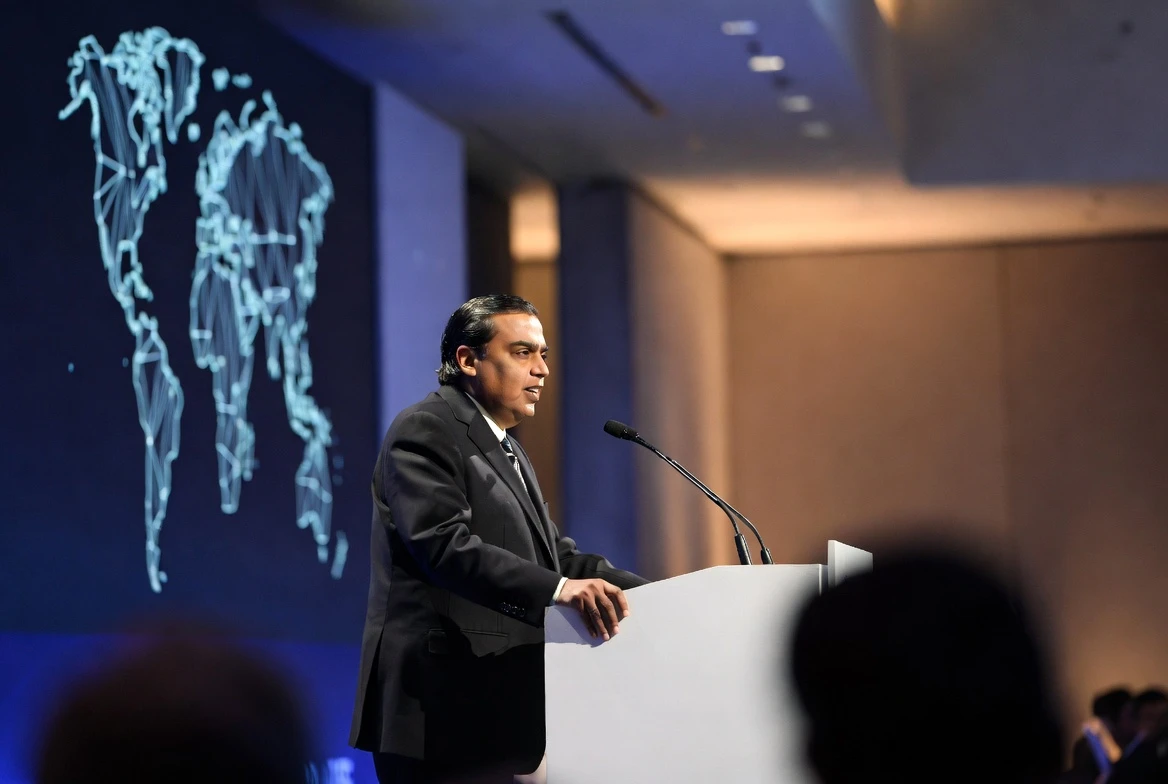
Mukesh Ambani, chairman of Reliance Industries, and Sunil Mittal, founder of Bharti Enterprises, will sit on a new United Nations-backed body called the AI for Good Global Commission, alongside the chief executives of Amazon, Microsoft, Nvidia, Anthropic, Google and Cohere. Rwanda’s Paul Kagame and Salesforce’s Marc Benioff will co-chair the panel, with International Telecommunication Union Secretary-General Doreen Bogdan-Martin as vice-chair, per the ITU’s announcement of the body. The 40-plus founding members, drawn from heads of state, tech CEOs and multilateral agencies, will gather first in Geneva on July 8, the inaugural meeting of a body whose stated brief is to strengthen AI trust, expand access and “unlock AI’s potential to solve real-world challenges at the speed the technology demands.”
The story behind those seats is more specific than the mandate statement suggests. Both chairmen run the parent groups of India’s two major private mobile carriers, Reliance Jio and Bharti Airtel, whose networks carry a large share of the country’s mobile traffic. Anthropic, the AI lab behind Claude, plans a Bengaluru office and a Reliance partnership to grow in India. With Ambani and Mittal now on the same panel as Amazon’s Andy Jassy, Nvidia’s Jensen Huang and Microsoft’s Brad Smith, the operators that route most of the global south’s mobile data will help set the AI trust and access conversation. Both chairmen now sit on a body whose stated mandate names access as one of three priorities.
Forty-Four Names at the Same Table
The founding members of the AI for Good Global Commission run from the President of Rwanda to the CEO of Pfizer, the Director-General of WIPO, the CEO of Vodafone and the founder of ZTE. The founding-member roster for the AI for Good Global Commission, published by the ITU ahead of Geneva Digital Week, splits roughly into three buckets: heads of state and AI ministers, chief executives of the labs and platforms building AI, and the operators and regulators of the networks through which AI will reach users. Kagame and Benioff co-chair, with Bogdan-Martin vice-chair. The body is a convening panel with no rule-making power.
Indian industry sits in the second bucket twice over. Ambani is listed as Chairman and Managing Director of Reliance Industries Limited, and Mittal as Founder and Chairman of Bharti Enterprises.
Big Tech dominates the tech half: Amazon’s Andy Jassy, Anthropic’s Jack Clark, Cohere’s Aidan Gomez, Google’s James Manyika, Microsoft’s Brad Smith, Nvidia’s Jensen Huang, Qualcomm’s Cristiano Amon and Salesforce’s Benioff himself. Telecommunications is the deepest industry bench, with Vodafone’s Margherita Della Valle, Orange’s Christel Heydemann, MTN Group’s Ralph Mupita and GSMA Director-General Vivek Badrinath joining Ambani and Mittal. Multilateral leadership pulls in WTO Director-General Ngozi Okonjo-Iweala, WIPO’s Daren Tang, UNESCO’s Khaled El-Enany, UNDP Administrator Alexander De Croo and African Union Commissioner Lerato Dorothy Mataboge. Health, pharma, finance and consumer goods add Pfizer’s Albert Bourla, Roche’s André Hoffmann, Accenture’s Julie Sweet, Bel Group’s Cécile Béliot, LSEG Chief Executive David Schwimmer and will.i.am of FYI.AI. The political counterweight to the Bay Area comes from Estonian President Alar Karis, Iceland’s Halla Tómasdóttir and ministers from Kazakhstan, Singapore, Nigeria, Namibia and Togo.
Why the Telecom Chiefs Made the List
Ambani and Mittal are not honorary additions to a roster dominated by AI builders. Both chair parent groups whose mobile networks shape the Indian market and increasingly define how the world’s most populous country first meets AI. Reliance Jio and Bharti Airtel are the two major private carriers in India, and both chairmen have made AI infrastructure a boardroom priority: Reliance through partnerships with US AI vendors and data-centre build-outs, Airtel through AI-driven customer support and network operations.
Anthropic, the AI lab behind Claude, recently said it was planning a Bengaluru office and a Reliance tie-up to grow in India. Airtel has rolled out AI-driven customer support, and Reliance has built out data-centre capacity. Per the ITU, the 2.2 billion people who remain offline are cut off from AI advancements, the panel’s north-star figure.
The telecom block on the new commission is broad enough to act in concert. Vodafone’s Della Valle, Orange’s Heydemann and MTN’s Mupita join Ambani and Mittal from the operator side, with GSMA Director-General Badrinath speaking for the industry association. Several big Asian digital platforms, including Tencent, Alibaba, ByteDance and Samsung, do not appear on the founding list as published by ITU. The list pulls in parts of the AI value chain beyond the model labs, from chipmakers like Qualcomm to standards bodies like WIPO and UNESCO to enterprise-risk groups like LSE and Roche.
That framing ties AI’s economic upside to the same foundation as AI’s public-trust imperative. With operators like Reliance and Airtel on the founding roster, both halves land on the same group of decision makers. The body’s working outputs have not yet been published.
The promise of AI is built on not only incredible opportunities for the growth of our economy, but on the foundation of trust that is required for our shared success.
Marc Benioff, Co-Chair of the AI for Good Global Commission, made that case in the body’s announcement issued via the ITU.
What the Commission Says It Will Do
The commission’s stated mandate, per the ITU release, is to strengthen trust, expand access and unlock AI’s potential to solve real-world challenges at the speed the technology demands. Bogdan-Martin, the vice-chair, said the panel must ensure AI benefits all people, everywhere. Kagame, the co-chair, framed the body as a direct response to inequality of access, saying “technology is supposed to be a force for good, and we have a responsibility to use it accordingly.” He added: “Let us work together to reduce inequality, and allow more and more of our citizens to benefit from the good AI can deliver to all of us.”
The substantive working areas, as laid out in the announcement, are three. “No organization can single-handedly put AI at the service of all humanity,” Bogdan-Martin, the vice-chair, said. “Collective leadership and the combined expertise of partners from across sectors” is the explicit operating principle.
The body’s value will not be regulatory. The panel has no rule-making power, and Axios reported on the eve of the launch that “it will be a challenge for this group to reach cohesive, concrete goals that manage to transcend politics and calls for digital sovereignty.” The commission’s working lever is convening authority, the soft power that ITU and UNESCO have historically used to nudge norms into standards. The commission’s work plans and meeting calendar have not yet been published.
- Strengthening AI infrastructure
- Accelerating AI’s impact on health, education, food security and disaster response
- Ensuring trust and safety
A Geneva Week Built Around a First Meeting
The commission will hold its inaugural meeting on July 8 in Geneva, in the middle of the AI for Good Global Summit 2026 at Geneva’s Palexpo, an ITU summit running from July 7 through July 10. The launch lands inside Geneva Digital Week, a five-day block of overlapping digital-policy events. Three of those events shape the body’s first public acts.
The first UN-mandated Global Dialogue on AI Governance runs July 6 and 7, days before the commission’s first session. The WSIS Forum 2026, the World Summit on the Information Society, runs from July 6 through July 10, sharing Geneva’s calendar with both events. The commission’s website at commission.aiforgood.itu.int went live ahead of the summit, listing the body’s purpose as helping identify “practical pathways to strengthen trust, support responsible innovation, and deliver broad-based economic and social benefits.” The inaugural meeting will set the work plan, the meeting calendar and any working-group structure, all of which the body has not yet published.
Inside the summit, working sessions will mix government delegations, multilateral agencies and AI lab executives side by side. Geneva Digital Week is structured to put the commission’s founders in dialogue with national negotiators at the same venues on the same days. The summit’s programme, hosted at aiforgood.itu.int, runs alongside the body of work the inaugural meeting will kick off.
ITU’s announcement pointed to commission.aiforgood.itu.int as the live hub for updates and work-plan outputs. Geneva Digital Week closes July 10, per the ITU release.
- July 6: first UN-mandated Global Dialogue on AI Governance begins
- July 6-10: WSIS Forum 2026 runs in parallel
- July 7: AI for Good Global Summit 2026 opens at Geneva’s Palexpo
- July 8: AI for Good Global Commission holds its inaugural meeting
- July 10: Geneva Digital Week closes
What the New Body Stands On
The AI for Good Global Commission is not built from a blank page. It sits on top of the multi-stakeholder ITU/UNESCO Broadband Commission for Sustainable Development, a body whose remit has spanned connectivity, digital inclusion and economic development. The new body shares Geneva Digital Week with the AI for Good Global Summit, an ITU-led Geneva programme. Bogdan-Martin, vice-chair of the new commission, is also ITU Secretary-General. Geneva Digital Week is the umbrella the body’s launch now sits inside.
Both bodies bring ITU, multilateral agencies and industry CEOs into the same room. The new body’s lever, per the same ITU framing, is the same remit turned to AI’s trust and access brief. The ITU’s announcement says the new panel builds on the Broadband Commission’s foundation.
Frequently Asked Questions
What is the AI for Good Global Commission?
A UN-backed convening panel of more than 40 founding members, announced on July 3, 2026, by Rwandan President Paul Kagame, Salesforce CEO Marc Benioff and ITU Secretary-General Doreen Bogdan-Martin, designed to bring heads of state, industry CEOs and heads of UN agencies together around AI governance, trust and access.
Who leads the commission?
Kagame and Benioff serve as co-chairs and Bogdan-Martin is vice-chair. The roster also names Estonian President Alar Karis, Iceland’s President Halla Tómasdóttir, Amazon’s Andy Jassy, Nvidia’s Jensen Huang, Microsoft’s Brad Smith, Reliance Industries’ Mukesh Ambani and Bharti Enterprises’ Sunil Bharti Mittal among its 40-plus founding members.
Why are the two Indian telecom chairmen on the panel?
Ambani chairs Reliance Industries, parent of the Reliance Jio mobile network. Mittal heads Bharti Enterprises, parent of Bharti Airtel. Both chairmen run major private mobile carriers in India, giving the commission’s access brief a roster line that includes the operators carrying that country’s mobile traffic.
When and where does the commission first meet?
The commission’s inaugural meeting is scheduled for July 8 in Geneva, running inside Geneva Digital Week and during the AI for Good Global Summit 2026 (July 7-10). The first UN-mandated Global Dialogue on AI Governance opens July 6 and ends July 7.
Does the commission have regulatory power?
No. The body is a convening and advisory panel without rule-making authority. Its value is the convening power that the ITU and UNESCO have historically used to nudge technical norms into standards across connectivity, spectrum and digital inclusion.