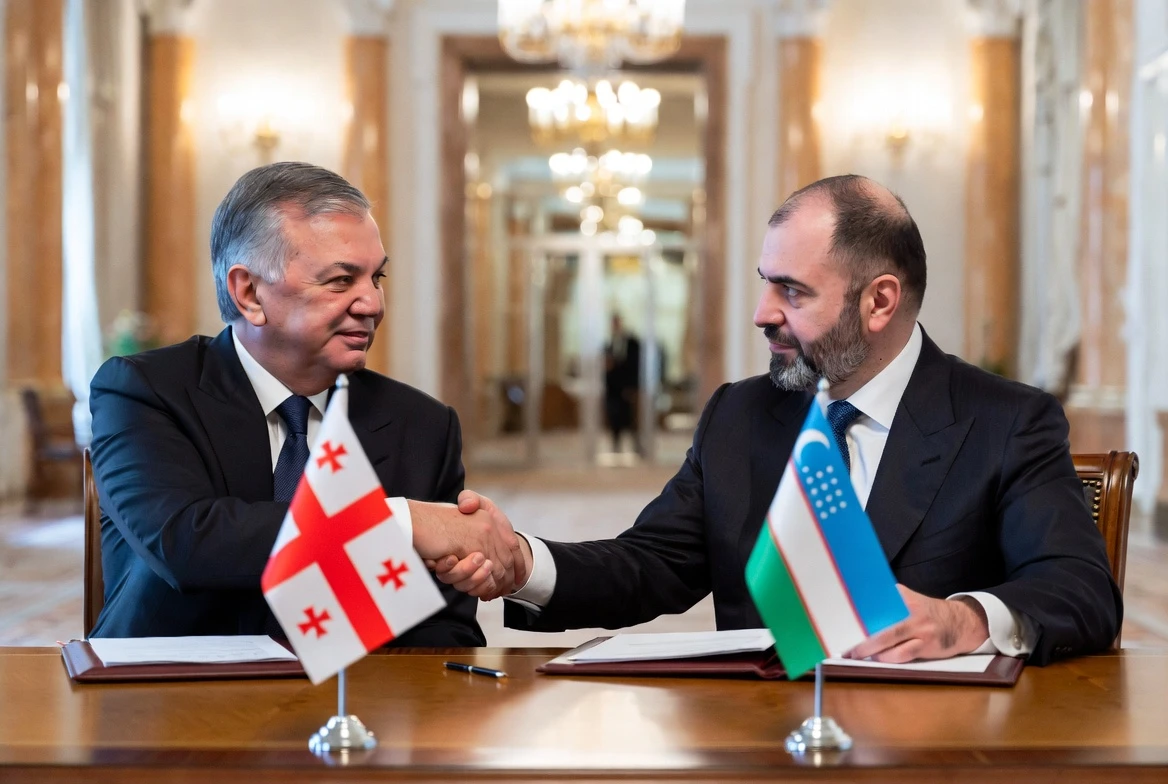
Uzbek President Shavkat Mirziyoyev and Georgian Prime Minister Irakli Kobakhidze signed a strategic partnership declaration in Tbilisi on Friday, the first Uzbek presidential visit to Georgia in 23 years. The visit, which began with talks between Mirziyoyev and Georgian President Mikheil Kavelashvili on July 2, produced 14 bilateral documents covering customs, education, and a 2026 to 2027 cooperation program between the two governments. Uzbekistan also announced it will open an embassy in Georgia, where it has no embassy today, instead covering the country through a diplomatic mission in Baku. The two governments set a target to raise bilateral trade to $1 billion, up from $270 million in 2025.
Ports and railways carry more weight than the diplomatic language. The declaration was paired with plans to route more Uzbek cargo through Poti and Batumi and to integrate the Baku-Tbilisi-Kars railway with the China-Kyrgyzstan-Uzbekistan railway now under development. For Tashkent, Georgia functions as much a corridor as a customer.
What Was Signed in Tbilisi
The strategic partnership declaration came after Mirziyoyev’s two days of meetings in the Georgian capital. On July 2 he sat down with Kavelashvili; on July 3 he held talks with Kobakhidze before the signing. The visit was the first by an Uzbek president to Georgia in 23 years. Uzbekistan and Georgia established diplomatic relations in August 1994, yet Tashkent has never operated an embassy in Georgia and currently covers the country through its diplomatic mission in Baku. That changes now: Uzbekistan announced during the visit that it will open a resident embassy in Tbilisi.
The two sides exchanged 14 bilateral documents at the signing. The package covers customs cooperation and administrative assistance, ICT and digitalization, vocational and higher education, the 2026 to 2027 intergovernmental cooperation program, a 2027 to 2030 culture ministry cooperation program, an E-Permit electronic permit exchange system, agriculture, environmental protection, healthcare, radiation protection and nuclear safety, labor migration, tourism, and enforcement cooperation between the Uzbek Bureau of Compulsory Enforcement under the General Prosecutor’s Office and the National Bureau of Enforcement of the Georgian Ministry of Justice. Every document, with its full title, is recorded on the Uzbek presidential tally of all 14 Tbilisi documents.
In his remarks after the signing, the Uzbek president framed the elevation to strategic partnership as a significant achievement and pointed to Georgia’s economic record. He called the new arrangement a foundation for trade, investment, and cultural cooperation, and pointed to the trust between the two governments. Mirziyoyev went on to place the South Caucasus in the same breath as Tashkent’s other regional partners, a marker of how Tbilisi now sits inside Uzbekistan’s wider westward turn. On the partnership’s regional weight, he put it this way:
Georgia is an important partner and a reliable pillar for us in the South Caucasus. Cooperation between our two countries has been developing dynamically across all areas in recent years, and this is only the beginning.
Shavkat Mirziyoyev, President of Uzbekistan, spoke at the joint news conference following the signing in Tbilisi on July 3. The line on the partnership’s regional weight is from his prepared remarks.
The Trade Math Behind $1 Billion
$270 million is the number that anchors the new roadmap. Bilateral trade reached that level in 2025, per the Uzbek president’s office, and has passed $100 million since the start of 2026, the figure now standing in the way of the $1 billion goal. The roadmap that emerged from the talks names a target to reach $1 billion in the coming years and reduce the trade imbalance along the way.
The starting imbalance is the harder obstacle. In 2025 Georgia exported $190.4 million worth of goods to Uzbekistan, more than double the $77.2 million that moved in the other direction, per analysis by Uzbekistan’s Center for Economic Research and Reforms. Georgian pharmaceuticals alone, at $89.3 million, were worth more than all of Uzbekistan’s exports to Georgia combined. The flows have tripled from $89 million in 2017, a long upward trend now underwritten by a joint working group set up under both countries’ trade ministries.
What would close the gap the headline doesn’t reach? The roadmap points to sectors where Uzbekistan’s export profile meets Georgia’s import demand, most of it today still served by other markets. A side-by-side view of the priority sectors, drawn from the 2026 to 2027 cooperation program and Uzbekistan’s product mix, makes the scale of those openings clearer than the single $1 billion figure does.
| Sector | Georgia’s annual import demand | What Uzbekistan can offer |
|---|---|---|
| Textiles | around $539 million (most from other markets) | Processed textiles; copper wire and rolled metal products already move along this route |
| Leather and footwear | $150 million a year | Named in the priority sector list under the 2026 to 2027 cooperation program |
| Electrical goods | roughly $300 million a year in cables, transformers, and household appliances | Electrical equipment is a flagged priority sector |
Why Georgia Is the Westward Bet
The ports carry the deal’s real weight. Mirziyoyev and Kobakhidze discussed wider use of Poti and Batumi for Uzbek cargo at the talks, and the two leaders backed a logistics hub inside Georgia that would include an industrial zone and a showroom for Uzbek products. A business forum held before the signing drew about 300 participants from logistics, pharmaceuticals, finance, IT, tourism, and agribusiness. Georgia already sits as the South Caucasus outlet for Central Asian freight moving toward the Black Sea and Turkey.
Railways extend the corridor westward. Mirziyoyev proposed in Tbilisi that the Baku-Tbilisi-Kars railway corridor be integrated with the China-Kyrgyzstan-Uzbekistan railway now under development. That proposal would put Georgia inside Uzbekistan’s long-term export planning rather than at the end of it. The move also binds Tashkent into a South Caucasus transit route backed by Tbilisi as the sole current gateway to Europe before alternative corridors come online.
The numbers behind the bet are uneven across modes and years. Bilateral trade reached $270 million in 2025, per the Uzbek president’s office, with $100 million already booked since the start of 2026. In 2025 Georgia exported $190.4 million to Uzbekistan against $77.2 million the other way, per Uzbekistan’s Center for Economic Research and Reforms. Uzbek foreign trade cargo moving along the Middle Corridor reached 1.2 million tons by the end of 2025, having doubled over the previous five years. Direct flights between Tashkent and the two Georgian cities now operate 13 times per week.
What ties the spokes together is Uzbekistan’s westward turn. Tbilisi wants to turn its geography into trade, and Tashkent wants more western routes as it develops rail links toward China, Afghanistan, and the Caspian. A bilateral investment fund, proposed during the talks, would sit on top of the 14 documents and finance new infrastructure projects as the roadmap moves from paper to construction.
The Poti Terminal and Other Concrete Pieces
The most concrete piece of the new partnership is already under construction in Poti. Uzbekistan is building a multi-purpose terminal inside the Poti Free Industrial Zone on Georgia’s Black Sea coast, on up to 30 hectares of land at a total cost of $18.3 million. The first phase is a cold storage facility rated at 1,000 tons, designed to keep Uzbek goods moving across the Black Sea toward European markets. A 5,000-square-meter covered warehouse will follow, then capacity for bulk, oversized, and container cargo. The terminal is designed to move Uzbek goods toward European markets and bring European imports back into Central Asia.
On the reverse flow, Georgian capital in Uzbekistan is thinner. Total Georgian foreign direct investment in Uzbekistan reached $46 million over the nine years to 2025, spread across 60 registered companies. TBC Bank is the most prominent example of Georgian private capital inside Uzbekistan. A joint working group under both trade ministries will translate the presidential visit’s commitments into specific investment and infrastructure projects.
The wider roadmap names the sectors where the new money is most likely to flow. The 2026 to 2027 cooperation program and a parallel 2027 to 2030 culture ministry cooperation program, both signed at the Tbilisi summit, cover a long roster of activity that goes beyond the sectors flagged in earlier meetings. The list of sectors the roadmap puts first is:
- Customs cooperation and administrative assistance
- ICT and digitalization, including the E-Permit electronic permit exchange system
- Vocational and higher education, science, and innovation
- Agriculture
- Environmental protection
- Healthcare
- Radiation protection and nuclear safety
- Labor migration
- Tourism
- Enforcement cooperation between the Uzbek Bureau of Compulsory Enforcement and Georgia’s National Bureau of Enforcement
- Electrical engineering and energy
- Pharmaceuticals and food processing
- Construction materials and digital services
Tourism, Flights, and a Park Named for Navoi
The softer side of the partnership arrived on the same planes. Direct flights between Tashkent and both Tbilisi and Batumi now run 13 times per week, the schedule a quiet measure of how routine the route has become. More than 21,500 Uzbek tourists visited Georgia in 2025, a number on the rise. Georgian tourist arrivals in Uzbekistan tell the reverse story, more than doubling to 6,800 in 2025 from 3,000 in 2019. The flight network and the visitor numbers are doing the work of building the cultural ties the trade target aims to monetize.
Culture anchors the summit, too. Days of Georgian Culture ran in Tashkent in March, and Tbilisi has decided to name a park in the Georgian capital after the Uzbek poet Alisher Navoi. Mirziyoyev received Georgia’s Order of the Golden Fleece, the country’s highest state honor, during the visit. The two cultural marks now sit alongside the 14 signed documents as the most quotable signal of where the partnership stands this July.
What Could Still Slow the Plan
The corridor’s capacity ceiling sits in the way of every target on the list. The Middle Corridor, the Trans-Caspian route through Kazakhstan, the Caspian, Azerbaijan, Georgia, and Turkey, handles about 6 percent of the Northern Corridor’s 100 million tons annual capacity. Volumes reached 4.1 million tons across the Caspian in 2024, a 63 percent year-on-year jump from 500,000 tons before Russia’s full-scale invasion of Ukraine, and the corridor is still far from competitive. The size of that gap is mapped in an analysis of Middle Corridor capacity and Anaklia funding cuts.
The bottlenecks pile up at the Georgian end. Existing port capacity at Poti and Batumi is nearing exhaustion, yet the planned deep-sea port at Anaklia had its 2026 funding cut from 150 million lari ($56 million) to 50 million lari with no contractor finalized as of March 2026. The World Bank and the EU’s Trans-European Transport Network plan both treat Anaklia as a central priority, a marker of how much capacity the new partnership would eventually need. The trade imbalance is also a structural hurdle, and Georgia exported more than double the value of goods it imported from Uzbekistan in 2025, a ratio the working group will need to bend without disturbing Georgian pharmaceutical exports of $89.3 million. The 14 documents signed Friday and the proposed bilateral investment fund are the instruments both governments now hold in their hands.
The wager behind the declaration is that the China-Kyrgyzstan-Uzbekistan railway, once built, will feed more cargo westward into Georgian ports, and that the trade shift will turn the diplomatic moment into actual infrastructure spend. Mirziyoyev called the partnership “only the beginning,” a phrase that leaves every forecast attached to the Middle Corridor’s capacity limits, not just to the diplomatic calendar. Tashkent’s embassy decision and the joint working group set up under both countries’ trade ministries are the two operational steps now on the table. Per Aju Press, the joint working group will translate those commitments into specific investment and infrastructure projects.