Russia’s renewed drive for influence in Georgia is being run through concert halls, language classrooms, and a Soviet-era songbook, not through embassies. The vehicle is the Russian Interests Section at the Swiss Embassy in Tbilisi, which organized a Soviet-repertoire concert at the Rustaveli Theater in May, hosted a Pushkin birthday reading in June, and convened Georgian teachers of Russian across the country. None of it runs through ordinary diplomatic channels, because no ordinary diplomatic channels exist.
Moscow’s stated goal is to measure how much space Georgian society will give Russian themes back in its public life. The early returns suggest the gamble is producing the opposite of the tolerance Moscow was hoping for. A reading for Alexander Pushkin’s 225th birthday drew roughly two dozen elderly attendees and a youth protest; the protest drew a Russian Foreign Ministry demand that Georgian police punish the demonstrators.
The Rustaveli Concert and the “Shared History” Frame
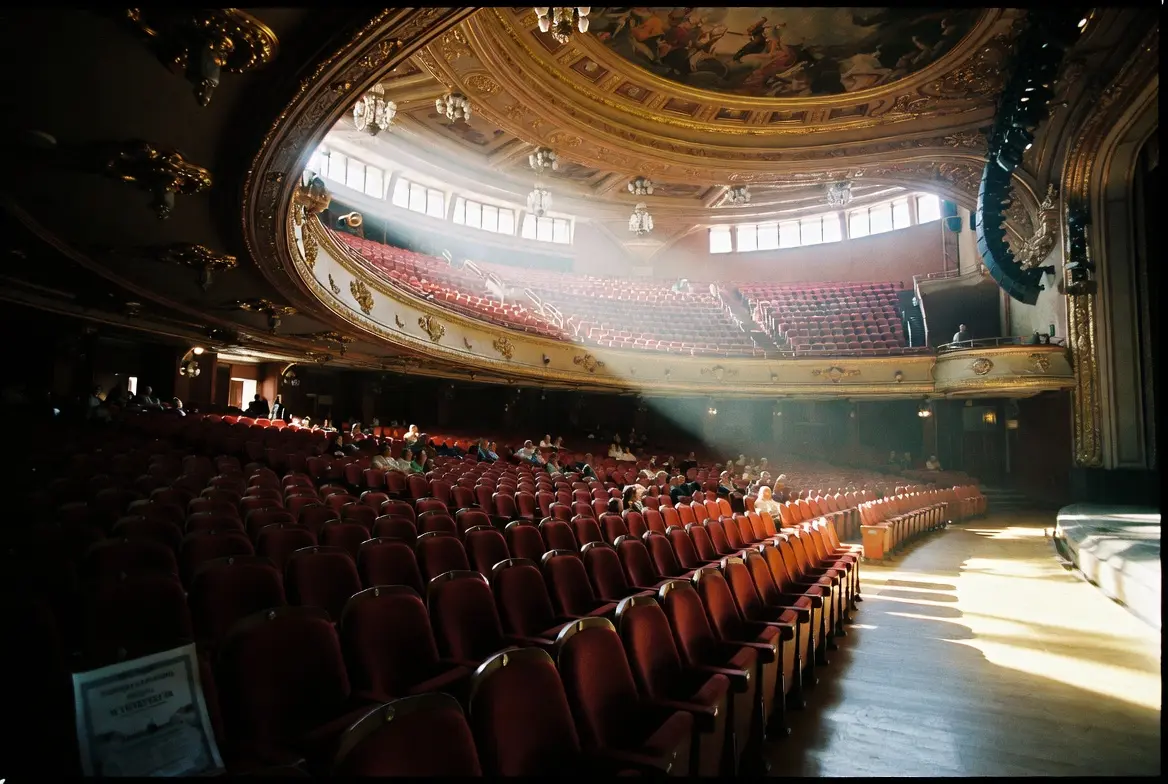
Students from a Russian creative university performed Soviet-era songs on the main stage of the Rustaveli Theater in central Tbilisi on May 14, an unusual booking that drew immediate criticism. The Ministry of Culture of Georgia said afterward that it had no role in the event and that the theater “conducts its activities independently,” per Radio Tavisupleba. The venue made the concert a flashpoint: the Rustaveli sits near government buildings and an area associated with past anti-Russian protest.
The Russian Interests Section framed the evening in language tuned for Russian domestic audiences. Its statement called the songs part of “the heroic pages of our shared history, the bright poetic memories of the Great Patriotic War,” which “will forever remain in the hearts of the peoples of Russia and Georgia.” To Tbilisi audiences the same phrase reads as a “Russian World” cue, the term Russia uses for the cultural sphere it claims as its own.
Tamta Mikeladze, a Georgian human rights defender and a leader in the country’s non-governmental sector, made that case publicly on May 17. She called phrases such as “shared history” part of a “policy of imperial memory, within which Moscow presents itself as the historical center.” Tbilisi-based outlets covered her framing inside Georgia; Russian outlets have not echoed it.
The Channel Through Switzerland
There is no Russian embassy in Georgia to run these events. Georgia severed diplomatic ties with Moscow after the 2008 invasion, an episode later documented in an ECHR POW ruling against Russia, and under a protecting-power arrangement set up in March 2009, Russian diplomats now operate inside the Swiss Embassy in Tbilisi. The Interests Section at that embassy has become Moscow’s main public-facing arm inside the country, and its head, Dmitry Olisov, has spent his first year on the job naming Russian-language promotion as a top priority (per a June 6, 2025, Tvpirveli.ge interview).
That office now functions as a cultural-attache operation. Over a single June fortnight, the Interests Section announced two Georgian winners of the XXVI International Pushkin Competition, themed “The Russian Language on Pravda Street. How is it living in your school and country?”; hosted an “Ambassadors of the Russian Language” round table with a researcher from the Russian Academy of Sciences; and invited Georgian musicians to compete at a Tchaikovsky-themed youth event in Russia. Each item is small on its own; the cumulative footprint is what Georgian civil-society groups are now tracking, according to the detailed Jamestown Foundation breakdown of Russia’s cultural events in Georgia.
Shvydkoy’s Two Trips to Tbilisi
Mikhail Shvydkoy, Vladimir Putin’s Special Representative for International Cultural Cooperation, was in Tbilisi on June 14 and 15, his second visit to Georgia in 2026.
His March trip was political in mourning dress. Shvydkoy attended events marking the death of the Catholicos-Patriarch of All Georgia, Ilia II, a moment heavy with symbolism for any Russian guest. The June trip wore a different cover: he was formally in town as artistic director of a Russian theater group performing in the Georgian capital (per a Sputnik Georgia report on June 16).
Shvydkoy used the cover. To Sputnik Georgia he said the two countries “have deep historical and human ties, and cultural contacts could gradually restore an atmosphere of mutual understanding,” and that Russia remains “open to creative people from Georgia.” Olisov, the Interests Section chief, made the same pitch through Tbilisi outlets, framing Russian-language promotion as part of Georgia’s cultural heritage.
Pushkin’s Birthday and the Backlash
The Interests Section marked Pushkin’s 225th birthday on June 6 with readings at the Pushkin bust in central Tbilisi. The crowd was thin: around two dozen elderly Georgian citizens attended, according to the Jamestown Foundation analysis citing X post @FormulaGe and Facebook posts by Mtavarinov. Members of the civic movement Georgian Republic showed up to protest, and police separated the two sides.
The protest drew a response from Moscow that critics in Tbilisi read as a request that a third country’s government prosecute its own citizens. On June 18, Russian Foreign Ministry spokesperson Maria Zakharova called the demonstrators “extremists, radicals, and hooligans,” declared that “Russian Language Day has become an integral part of Georgia’s cultural heritage,” and said Moscow expected Georgian law enforcement to “draw conclusions” about the protesters (per TASS, June 18, and a Tbilisi-based account of the Russian demand).
It was a handful of extremists. Russian Language Day has become an integral part of Georgia’s cultural heritage, its people, and its culture, and one of the symbols of friendship and mutual understanding between nations.
Zakharova framed her intervention as the protection of heritage. To critics in Tbilisi it read as pressure on the Georgian state to suppress peaceful protest. Either reading makes the next round of Russian-language events a sharper confrontation than it would otherwise have been.
The Push Beyond Tbilisi
The schedule is widening past the capital. The Georgian service of Radio Free Europe/Radio Liberty has published a summer-and-autumn roster of Russian performers booked for Batumi, the Black Sea resort city. Many of those acts, the Jamestown analysis flags, “support Russia’s war against Ukraine and have expressed support for, or justified, Russia’s occupation of parts of Georgia’s territory.” Booking them in Georgia’s second city is the next stage of the geography test.
Recent Interests Section activity, all logged on its official Facebook page over a single fortnight, sketches the volume:
- May 30: a gathering of Georgian teachers of Russian from across the country.
- June 6: Russian Language Day at the Pushkin bust in central Tbilisi.
- June 9: announcement of two Georgian winners of the XXVI International Pushkin Competition.
- June 10: an “Ambassadors of the Russian Language” round table.
- June 11: invitation for Georgian musicians to compete at a Tchaikovsky-themed youth event in Russia.
A Door Opened in 2012
The current effort leans on a political shift that began more than a decade ago. After the 2003 Rose Revolution, Georgia moved to reduce Russian cultural and educational reach. That trajectory reversed after Georgian Dream came to power in 2012. One early signal was Education Minister Giorgi Margvelashvili’s statement that Georgia should be treated as bilingual (Ekho Kavkaza, November 2, 2012). Margvelashvili went on to serve as Georgia’s president from 2013 to 2018. The shift has now drawn legislative attention in Washington, with the U.S. House passing a bill requiring reports on Russian and Chinese influence in Georgia.
Russian officials have echoed the framing ever since. Olisov told Tbilisi outlets in 2025 that some Georgian writers “not only created, but also thought in Russian,” anchoring the language question in national identity rather than trade.
The Caucasus Barometer 2024 survey, the most recent available, shows who Moscow is actually pitching. Older generations carry most of the fluency; among younger cohorts, Russian proficiency is “gradually and consistently declining,” the Jamestown Foundation summary reads. The current breakdown of Georgian self-reported proficiency:
- 17% report no Russian-language knowledge.
- 25% are at a beginner level.
- 38% are at an intermediate level.
- 18% are at an advanced level.
What Moscow Is Testing
The intelligence assessment summarized by UNN, which cites the Jamestown Foundation as its underlying analysis, concludes that none of this will produce a quick swing toward pro-Russian sentiment in Georgia. The stated goal is not mass support. It is a test of “how ready Georgian society is to tolerate Russia’s return to the public sphere under the guise of ‘non-political’ culture.” Each event, however small, measures how much pushback comes back and how the Georgian state responds.
That response is already shaping what comes next. Zakharova’s call for prosecution, the Batumi concert roster, and the steady weekly drumbeat of Russian-language events together amount to a pressure test on one specific question: can Russian themes re-enter Georgian public life with the formal seal of cultural normality, without triggering protests that force politicians to choose sides? The Pushkin bust, with two dozen elderly listeners and a louder youth counter-presence, is the latest reading on that dial.