Georgia’s bald eagle population is having one of its strongest years on the coast. The 2026 nesting survey by the Georgia Department of Natural Resources found that 82% of nests on the coast fledged at least one eaglet, with Chatham County leading the region at 29 occupied nests. The success rate across every surveyed area came in above the long-term average.
The survey also marks the end of an era inside the agency. Bob Sargent, the DNR program manager who has run the helicopter counts for years, logged his final flight in March before retiring this spring.
A Strong Year on the Georgia Coast
Georgia’s bald eagle population continues to soar, with above-average nesting success in all areas checked, the Georgia Department of Natural Resources reports. The 85% success rate across all surveyed areas sits above the long-term average. On the coast, 82% of nests fledged at least one eaglet, Sargent told The Current GA via email.
Chatham County posted the highest number of occupied nests, with 29. Camden County followed with the second-highest coastal total at 16. Public tips pushed the total up by six nests over what Sargent documented on his helicopter survey. Decatur County, which usually competes with Chatham for the statewide lead, was not surveyed this season.
On average, each nest produced 1.7 eaglets. Staff check nests for occupancy in January and February, then return in March and April to track eggs and chicks.
| County | Occupied nests |
|---|---|
| Bryan | 6 |
| Camden | 16 |
| Chatham | 29 |
| Glynn | 7 |
| Liberty | 9 |
| McIntosh | 14 |
Why Coastal Georgia Holds So Many Eagles
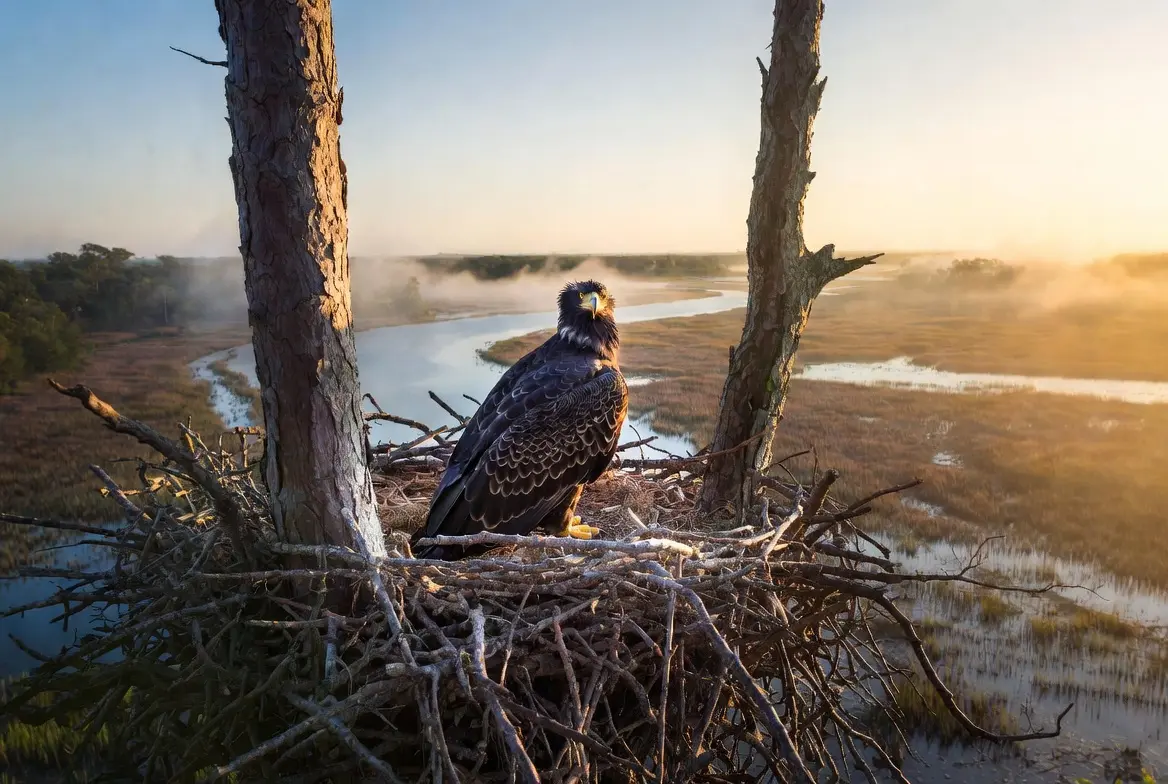
Coastal Georgia offers the national bird almost everything it needs. Tall pines give the birds somewhere to nest, and the stands scattered across the region match the kind of habitat the species has preferred for centuries. Just as important are the marshes and tidal creeks that drain into the Atlantic, where eagles find the fish that make up the bulk of their diet. The combination of high nesting structures and a steady food supply has made the coast the most productive region of the state. DNR noted in its 2026 summary that our national symbol thrives thanks to an abundance of the tall pine trees they prefer for nesting as well as plenty of marshes and creeks where eagles can hunt for their favorite food: fish.
Georgia’s bald eagle monitoring program turns up nests across the coast each year, often with help from landowners who report what they see. Six counties were checked this season, the same coastal run that Sargent’s helicopter survey has flown in past years. The state has now counted more than 200 nests each year since 2015.
Sargent’s Last Helicopter Flight
Bob Sargent is leaving the Georgia Department of Natural Resources this spring. His retirement closes his run as the program’s manager and the pilot at the controls of the helicopter counts that have tracked the state’s nesting eagles.
Sargent’s March departure meant some follow-up flights normally done in April were never flown. Bad weather also forced the cancellation of some northeast Georgia nest checks. Together those factors shrank the sample below what the state has monitored in past years. Even so, nearly half of all known eagle nests in the state were checked this season. That share, Sargent said, still provides a reliable measure of productivity for the national bird.
Tips from the public pushed the total up by six nests over what Sargent logged from the air. He became a public face of eagle monitoring in Georgia, handling the helicopter counts and the agency’s nest reports each year. The transition to a new program manager is one of the unknowns hanging over the next season’s count.
The Long Recovery From 417 Pairs
The 2026 success sits on top of one of America’s most cited conservation recoveries. By 1963, there were just 417 known nesting pairs of bald eagles in the lower 48 states, the U.S. Fish and Wildlife Service reports. The collapse came from DDT, a pesticide widely used after World War II that made eagle eggs too fragile to survive incubation. Bald eagle populations crashed across the country as the chemical moved up the food chain.
The U.S. banned DDT in 1972. Five years earlier, the bald eagle had gained protection under the predecessor to the Endangered Species Act. Captive breeding, reintroductions, and habitat protection work followed.
By 2007, the bald eagle had recovered enough to be removed from the federal endangered species list. Interior Secretary Dirk Kempthorne announced the decision at the Jefferson Memorial in Washington, D.C. The release described the recovery as a 25-fold increase over the previous 40 years, with the lower 48 rising from an all-time low of 417 breeding pairs to nearly 10,000 nesting pairs. The announcement captured the moment in a single line.
Today I am proud to announce: the eagle has returned.
The federal bald eagle species page tracks the listing timeline and current population estimates. Researchers now estimate there are more than 71,000 nesting pairs in the lower 48 states, a level reached more than four decades after the 2007 announcement. The Interior Department’s 2007 announcement put the lower 48 at some 10,000 nesting pairs, with the release noting 9,789 breeding pairs in the lower 48. Georgia’s statewide counts mirror that recovery, with Sargent saying in a press release that the findings suggest Georgia again had over 200 nests, as it has since 2015. The number of nesting eagles also is still increasing in some areas, although that growth has slowed in the past 10 years.
- 1940: Bald eagle gains federal protection under the precursor to the Bald and Golden Eagle Protection Act.
- 1963: Population bottoms at 417 known nesting pairs in the lower 48.
- 1972: EPA bans the general use of DDT.
- 2007: Bald eagle removed from the federal endangered species list.
- 2022: Initial avian influenza outbreak hits eagle productivity hard on the Georgia coast.
- 2026: Georgia coastal survey finds above-average nesting success in every area checked.
The Avian Flu Shadow That Won’t Lift
Not all of the news from this year’s survey is sunny. The 2022 avian influenza outbreak hit eagle productivity hard, especially on the coast.
Sargent said in a press release that this year’s results reflect a population that is having a strong year acquiring food resources and has clearly bounced back from the serious hit productivity took during the initial avian influenza outbreak in 2022. The disease, he added, persists in Georgia and elsewhere across the U.S. His survey, Sargent wrote, shows that these magnificent birds are resilient.
On top of the flu, development pressure is changing where eagles can nest. More Georgia eagles are now nesting closer to homes, roads, and construction sites along the coast. The trend of Georgia coastal eagles nesting closer to development has put young eaglets at risk in a year when the coast otherwise produced strong numbers. Biologists warn that human disturbance near active nests can cause eagles to abandon eggs.
Where the Population Goes From Here
Eagles still have room to grow in parts of Georgia, Sargent said. The statewide count has held above 200 nests every year since 2015. The number of nesting eagles is still increasing in some areas, although that growth has slowed in the past 10 years. The 2026 coastal survey adds one more data point to a recovery that began with the 1972 DDT ban. The next chapter will hinge on whether the coast can absorb the development pressure and the persistent avian flu without losing the productivity Sargent helped track.
Those pressures are still active. The 2022 outbreak hit coastal productivity hard, and the 2026 results show the species can still recover from a bad season. Sargent described the population as having bounced back while cautioning that the disease persists in Georgia and elsewhere across the U.S. Sargent retired this spring after his final helicopter survey, and his successor inherits a coast where productivity has rebounded but the threats have not gone away.
Frequently Asked Questions
How many bald eagle nests are on the Georgia coast in 2026?
The Georgia Department of Natural Resources counted occupied nests across six coastal counties during the 2026 helicopter survey. Chatham County led with 29, Camden County had 16, McIntosh 14, Liberty 9, Glynn 7, and Bryan 6. The county list runs from the Savannah area down through the Sea Islands.
Why are Georgia’s coastal counties such productive eagle habitat?
Coastal Georgia combines the two things bald eagles need most in one place. Tall pines give eagles somewhere to nest high off the ground, and the marshes and tidal creeks that drain into the Atlantic supply the fish that fill most of their diet. The configuration has made the coast the most productive eagle region in the state in most years since the survey began.
How many bald eagle nesting pairs were there in the lower 48 in 1963?
Just 417 known nesting pairs remained in the lower 48 states in 1963, according to the U.S. Fish and Wildlife Service. The number represents the all-time low after decades of DDT exposure made eagle eggshells too thin to survive incubation.
When was DDT banned in the U.S.?
The U.S. banned DDT in 1972, lifting the chemical pressure that had been breaking eagle eggshells and suppressing eagle reproduction across the country. The decision set the stage for the species’ later recovery.
Who is Bob Sargent?
Bob Sargent was the Georgia Department of Natural Resources program manager who ran the state’s helicopter bald eagle nesting survey. He retired in spring 2026 after his final flight for the 2026 monitoring season, capping a career spent tracking the bald eagle’s recovery in Georgia.