The European Court of Human Rights ruled on June 23 that Georgia violated a Batumi protester’s rights when police stopped him from pitching a tent for a solo hunger strike demanding free school meals. The unanimous judgment in Karchava v. Georgia, issued by the court’s Fourth Section, ordered Tbilisi to pay EUR 1,000 in non-pecuniary damages for breaches of Article 10 (freedom of expression) read alongside Article 11 (freedom of assembly) of the European Convention on Human Rights.
Karchava, a Batumi psychotherapist who specializes in children’s mental health, was arrested in December 2022 after police twice intervened to prevent him from setting up his tent on a public square near the Constitutional Court of Georgia. The court’s reasoning turns on a procedural point that lands well beyond the single protester: domestic authorities failed to give “relevant and sufficient” reasons for the interference, and the measures taken were, in the chamber’s own words, “capable of producing a chilling effect on the applicant’s exercise of his freedom of expression.”
What Strasbourg Decided
The court’s Fourth Section, sitting in a chamber of seven judges that included Georgia’s Lado Chanturia, deliberated in private on June 2, 2026 and delivered its judgment on June 23. Application no. 34790/23 had been lodged with the court on September 15, 2023. The chamber found a violation of Article 10 of the European Convention in conjunction with Article 11, and ordered Georgia to pay EUR 1,000 in non-pecuniary damages. The Government of Georgia was represented by its Agent, B. Dzamashvili of the Ministry of Justice.
Karchava was represented by three Tbilisi-based lawyers, D. Javakhishvili, A. Pataraia and S. Tsiklauri, working with the Georgian Young Lawyers’ Association (GYLA). The judgment was adopted unanimously and the court found the measures “capable of producing a chilling effect on the applicant’s exercise of his freedom of expression,” the language that has carried across a generation of ECHR protest cases.
The Day in Batumi
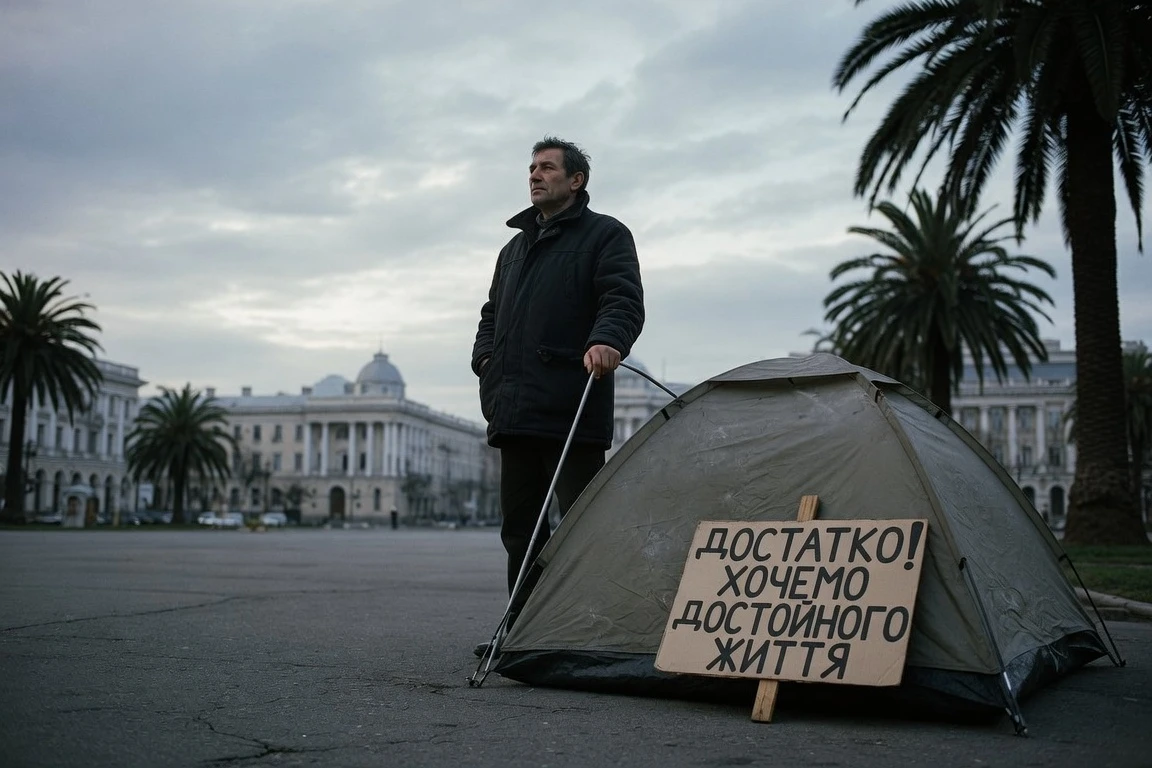
On December 26, 2022, Karchava submitted an advance notification to Batumi City Hall for a solo protest starting two days later. The plan was to set up a tent behind the statue of Memed Abashidze, in a public square near both the Constitutional Court of Georgia and the seat of local government, and to begin a hunger strike. The stated purpose, in his notification, was to denounce the lack of free lunches in public schools in Georgia during the academic year. He emphasized that he would not obstruct public roads or disrupt public order.
On December 28, City Hall notified local police of the planned protest and asked them to maintain public order. The same day, City Hall sent Karchava a letter, which reached him only after the events in question, citing the use of the area for upcoming New Year’s Eve celebrations and the “possible use” of pyrotechnics. The letter pointed to section 11(3) of the Assemblies and Demonstrations Act, which prohibits assemblies from “physically obstruct[ing], degrad[ing] the appearance of, damag[ing] or otherwise harm[ing] any building, structure, monument or memorial of historical, archaeological, architectural or scientific significance.” It also assured him he remained free to exercise his right to express his views.
Around 10 a.m., as Karchava was pitching the tent, plainclothes police told him to stop, allegedly without reasons. He was taken to a nearby police station at around 11 a.m., where he was given immediate access to his lawyer and to a representative of the Public Defender’s Office. Surveillance footage shows him standing freely outside the station, smoking with his lawyer and officers. He was released after roughly 30 to 40 minutes of persuasion and returned to the site at noon. By 12:45 p.m., he was under arrest.
| Ground cited by police | What the ECHR judgment records |
|---|---|
| Area designated for New Year’s Eve celebrations, with possible use of pyrotechnics | Ground reached the applicant in a letter that arrived after the events; the police had not relied on it at the scene |
| Tent within the protected zone surrounding the Memed Abashidze statue | The tent was pitched on a green lawn under a palm tree, several metres from the monument |
| Within 20 metres of the Constitutional Court building | First raised only in the arrest record; not mentioned during the on-scene warnings; video showed the tent at a considerable distance from the building’s entrance |
The Domestic Case
The charge was disobeying lawful police orders under Article 173, paragraph 1, of the Code of Administrative Offences. The arrest record, drafted by the arresting officer, cited a reason that had not been raised before: Karchava was “pitching a tent on the premises of the Constitutional Court during working hours and, having been repeatedly ordered by the police to remove the tent and to stop obstructing the functioning of the Constitutional Court, failed to comply with those lawful orders.” His lawyer filed a written objection noting that this was the first time the police had invoked the alleged obstruction of the Constitutional Court.
A Batumi City Court judgment of February 27, 2023 found Karchava guilty. According to the ECHR’s summary, the judgment “lacked specific reasoning assessing the circumstances of the case and omitted to address any of the three grounds advanced by the police in the administrative-offence report” and instead relied on “template-like general statements.” It gave him a verbal reprimand rather than a sentence, citing his clean record. The Kutaisi Court of Appeal dismissed his appeal on May 1, 2023. Karchava had spent nearly 24 hours in the Batumi Temporary Detention Centre after his December 28 arrest.
Why Strasbourg Saw a Chilling Effect
The court rejected the domestic authorities’ reasoning on its own terms. It found that the police had failed to give “relevant and sufficient” reasons for stopping the protest, that Karchava’s actions were peaceful, and that the underlying issue, free school lunches, was a matter of public interest. The court did not need the protest to succeed on the merits to see the violation. The procedural failure, the absence of clear reasons for the police intervention, was the violation.
The Court considers that such measures, taken together, were capable of producing a chilling effect on the applicant’s exercise of his freedom of expression.
The “chilling effect” language matters. In ECHR case law, the concept captures a way of regulating speech or protest that, even at low cost to the individual, can deter others from speaking. The principle applies whether the sanction is a fine, a brief detention, or a verbal warning. Strasbourg has used it in cases from media regulation to judges’ speech. The same phrase appears in the Council of Europe’s June 9-11 decision on Georgia, where deputies recorded “deep concern” over “legislative and enforcement measures which produce a chilling effect on the exercise of the right of freedom of assembly.”
Karchava was not seeking damages for a ruined protest. He spent one night in detention and left with a reprimand. The EUR 1,000 the court awarded him is a token figure in absolute terms. What the case adds to the record is a court of seven judges, including one Georgian, signing a unanimous judgment that says the underlying process was not lawful. The Council of Europe Committee of Ministers, in the document that prompted Karchava’s file to be reopened, treats the same phrase as a benchmark for evaluating the entire domestic framework.
Georgia’s New Protest Law Landscape
The case lands inside a much larger pattern. Since 2022, the ruling Georgian Dream party has tightened anti-protest legislation several times, according to Civil Georgia. In October 2025, parliament approved amendments that reclassify erecting “temporary structures” at a protest, along with repeated mask-wearing, road blockages, and joining a police-blocked protest, as grounds for immediate administrative detention of up to 15 days.
Earlier waves of legislation made the framework stricter still. February 2025 extended the maximum detention for protest-related administrative offenses from 15 to 60 days and created a new offense of “verbal insult” of officials, punishable by up to 45 days in custody. July 2025 added 30 to 60 days of detention for individuals with outstanding protest-related fines who commit even minor violations, tying unpaid fines to custodial sentences. The October 2025 amendments escalated the penalties for participants to up to two years in prison and for organizers to up to four years.
Human Rights Watch described the changes in December 2025 as provisions that would “dramatically weaken protections for peaceful assembly” and “effectively hollow out the right to peaceful assembly.” The Council of Europe’s Committee of Ministers, at its June 9-11 meeting, called on Tbilisi to “thoroughly revise the relevant legislation and practices and align them with the Convention standards,” with a particular focus on “disproportionate and arbitrary administrative arrest/detention and conviction, including criminal conviction, excessive sanctions.” That decision was issued twelve days before the Karchava judgment and uses the same language about chilling effects.
- EUR 1,000 in compensation ordered in Karchava v. Georgia
- 24 hours spent in detention by the applicant in December 2022
- 60 days maximum detention for protest-related administrative offenses under the February 2025 amendments
- 4 years in prison for organizers under the October 2025 amendments
- 77 European Court of Human Rights judgments against Georgia pending execution as of March 26, 2026
The Legal Aid Gap the Case Lands In
GYLA represented Karchava before Strasbourg. It is also the body that, in most other ECHR cases against Georgia, would file the application, draft the observations, and push the file through the Committee of Ministers’ execution stage. On March 14, 2026, the organization said it would cut its free legal aid services and focus only on strategic cases, entering what it called “crisis mode” amid growing repression. GYLA has delivered more than 1.3 million free legal consultations and services across Georgia’s nine regions since its founding in 1994.
The pullback matters because Karchava v. Georgia is not the only ECHR case in the pipeline. The Council of Europe’s Committee of Ministers said on March 26, 2026 that 77 European Court of Human Rights judgments against Georgia are pending execution, covering freedom of assembly, fair trial, and other Convention rights. The Council of Europe has called on Georgian authorities to create a “fully enabling environment” for the NGOs that monitor demonstrations and provide legal aid to participants.
| What the Council of Europe demanded | What the record shows on the ground in 2026 |
|---|---|
| Revise protest legislation and align it with Convention standards | Four waves of new protest laws in 2025 tightened, not loosened, the legal framework for demonstrations |
| Updated statistics on arrests, detentions, and convictions linked to demonstrations | First criminal conviction for “repeated road blockage” recorded on May 29, 2026, with a nine-month jail sentence |
| “Fully enabling environment” for NGOs that monitor assemblies and provide legal aid | GYLA said on March 14, 2026 it would cut free legal aid services and focus only on strategic cases |
| Engage in meaningful consultations with Council of Europe expert bodies | No Georgian government response to the consultation call has been published |
The category of NGO the Council of Europe is asking Tbilisi to protect is the same category that GYLA, the legal aid provider, said it was leaving crisis mode three months earlier. A solo protester with a tent and a hunger strike in a public square does not, on its own, generate a case at Strasbourg. It generates a case when there is a domestic lawyer, a legal aid NGO, and a chain of remedies to exhaust. The same chain that produced Karchava v. Georgia is the chain being thinned.
Frequently Asked Questions
What did the ECHR rule in Karchava v. Georgia?
The European Court of Human Rights ruled unanimously on June 23, 2026 that Georgia violated Article 10 (freedom of expression) read alongside Article 11 (freedom of assembly) of the European Convention on Human Rights when police stopped a Batumi psychotherapist from pitching a tent for a solo hunger strike. The court ordered Georgia to pay EUR 1,000 in non-pecuniary damages.
Why did police arrest Karchava in 2022?
Karchava, a Batumi psychotherapist, planned a solo protest in late December 2022 to denounce the lack of free school lunches in Georgian public schools. He had notified Batumi City Hall in advance and said he would not block traffic. Police intervened twice, citing the planned New Year’s Eve use of the square and the proximity of the protest to a monument and the Constitutional Court, and arrested him around 12:45 p.m. on December 28, 2022 for disobeying lawful police orders.
What does the ruling say about Georgia’s protest framework?
The court found that domestic authorities failed to give “relevant and sufficient” reasons for the interference and that the measures taken, taken together, were “capable of producing a chilling effect on the applicant’s exercise of his freedom of expression.” The judgment is a single-case ruling and does not strike down Georgian protest laws, but the language gives future applicants and the Council of Europe’s Committee of Ministers a clean textual hook for the broader protest law file.
What’s next for Georgia on the protest law file?
The Council of Europe’s Committee of Ministers has called on Tbilisi to revise its protest laws and bring them into line with Convention standards. As of the June 9-11 meeting, 77 ECHR judgments against Georgia were pending execution, and the Committee has asked Tbilisi to provide updated statistics on administrative arrests, detentions, and convictions linked to demonstrations. Georgia’s Ministry of Justice, which represented the Government in Karchava, will be the channel for that reporting.
Disclaimer: This article is for informational purposes only and does not constitute legal advice. Court rulings, legislation, and statistics cited are accurate as of the date of publication (June 24, 2026). For specific legal questions, consult a qualified attorney.