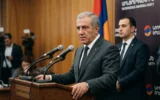
Georgia’s Parliament backed amendments to the Law on General Education in a first reading under expedited procedure on June 9, 2026, with 75 votes in favour. The bill, presented by Deputy Minister of Education, Science and Youth Tamar Makharashvili, adds new definitions to widen who can teach in the country’s schools. The package, if adopted, also tightens the link between a teacher’s degree and the subject they will be assigned to teach.
The headline wording frames the changes as an expansion of school employment, but the same draft pins down a rule that the existing law leaves ambiguous. It also creates two new fixed-term teaching categories that did not previously exist in the country’s education statute. The 75-vote first-reading report on teacher hiring sets out the full text of the proposed amendments.
The Four New Position Categories Created by the Bill
The amendments add four new position definitions to the Law on General Education: teacher candidate, substitute special teacher, programme teacher, and programme special teacher. Each one defines a separate way into a classroom, with its own entry conditions. The full breakdown of who each category covers and what it requires appears in the table below.
| New position | Who it covers | Conditions |
|---|---|---|
| Teacher candidate | Any applicant entering the teacher candidate programme | At least a bachelor’s degree; must prove subject competency if the qualification does not match the intended subject |
| Substitute special teacher | Stand-in for a temporarily absent special education teacher | Temporary replacement under rules set by the draft law |
| Programme teacher | Hire for a specific, targeted school programme | Fixed-term post; may be transferred to another school where necessary |
| Programme special teacher | Special-needs hire for a specific, targeted school programme | Fixed-term post; may be transferred to another school where necessary |
The current text of the law, in the consolidated version on the Legislative Herald of Georgia, lists beginning teachers as holders of at least a bachelor’s academic degree in a subject or group of subjects under the National Curriculum, employed for not more than two years. Supply teachers, who substitute for temporarily absent regular teachers, also require at least a bachelor’s degree in a subject or subject group. Invited teachers, by contrast, can teach with appropriate competencies and practical experience, capped at half the full teaching load. The four new positions sit alongside, rather than replace, these existing categories. The consolidated text of the Law on General Education on the Legislative Herald of Georgia sets out the existing definitions in full.
The closest existing parallel to the new programme-teacher category is the invited-teacher route. Both involve fixed-scope teaching, and both sit outside the Teacher Professional Development and Career Advancement Scheme. The difference is that invited teachers are scoped by subject and hours, while programme teachers are scoped by programme and by school transfer. The new categories therefore extend, rather than replace, the existing flexibility mechanisms in the law.

The Subject-Match Gate Written Into Law
The most consequential change in the package may be the one that clarifies, rather than expands, who can teach what. Under the current law, a teacher needs a bachelor’s academic degree in a subject or subject group under the National Curriculum, but the text does not specify that the degree has to match the subject being taught. The amendment closes that ambiguity by stating explicitly that the subject-match requirement applies. Makharashvili framed the change in parliamentary debate as both a clarification and a tightening.
The mechanism is a new subject competency proof. Anyone with at least a bachelor’s degree can enter the teacher candidate programme, the bill says, but if the applicant’s qualification does not match the subject they intend to teach, they must first demonstrate competency in that subject. The competency check is set as a prerequisite for entering the teacher candidate pathway. The practical effect is that a degree alone is no longer enough.
The rule applies to a wide pool of would-be teachers, including the new ICT vocational route. The current text of the law, in the consolidated version hosted by the Legislative Herald of Georgia, lists beginning teachers as holders of at least a bachelor’s academic degree in a subject or group of subjects under the National Curriculum. That wording, ministry officials have long noted, left a gap that individual schools had to fill on a case-by-case basis when a candidate’s degree was in a different subject. The new draft removes that judgement call from school hiring. It does not yet say who administers the competency check or how it is graded, leaving those details to subordinate acts.
The same change also widens entry by lowering the de facto matching bar at the start of the pipeline. Holders of vocational qualifications in Information and Communication Technologies will be eligible to work in schools under the draft, a category the previous law did not name for general education. The vocational route is paired with the same subject competency proof. The parallel English-language report on the same vote from the Georgian public broadcaster runs the full list of changes.
Vocational ICT Graduates Get a Pathway In
One of the headline elements of the package is the addition of Information and Communication Technologies (ICT) vocational graduates to the pool of people schools can hire. Under the current law, ICT was not on the list of acceptable qualifications for general-education teaching posts. The amendment makes it a recognised entry route, with subject competency proof as a prerequisite where the vocational qualification does not cover the subject being taught. Makharashvili told Parliament the move broadens the pool of eligible candidates.
The ICT route sits alongside the existing teacher pathways in the law, not on top of them. It is the only vocational qualification named in the bill as a standalone school-employment route. Whether other vocational streams would be added later is not addressed in the draft, and the Ministry of Education, Science and Youth has not yet published a comparison of how the route will be staffed in practice.
Programme Teachers, Special Teacher Substitutes, and the Power to Move Them
The new programme teacher and programme special teacher positions are the most operational of the four new categories. They are created for specific, targeted programmes and run for a defined period. Holders of these positions may, where necessary, be transferred to another school, a power the existing supply-teacher and invited-teacher categories do not give schools in the same form.
The substitute special teacher role addresses a staffing gap that the existing supply-teacher definition does not cover. The current law already lets supply teachers stand in for absent regular teachers, but it does not spell out who covers an absent special-needs teacher. The amendment allows that replacement, with conditions set by the bill. The bill also opens the special-teacher role itself to a wider group of applicants.
Should the amendment be adopted, the law will introduce new teaching positions, such as programme teacher and programme special teacher. These positions will be established on the basis of specific targeted programmes for a defined period of time, and, where necessary, holders of these positions may be transferred to another school.
Deputy Minister of Education, Science and Youth Tamar Makharashvili made the remarks during the June 9, 2026 first reading in Tbilisi. Under the draft, individuals who hold a recognised subject-teacher status and have passed the special teacher examination will be eligible to work as special teachers. The route applies regardless of where the teacher was originally trained, as long as the status and exam are recognised in Georgia. It does not require a fresh bachelor’s in special education. The four programme-related categories are the only new teaching positions the bill creates; the rest of the package is about who can fill existing slots.
Who Presented the Bill and What Comes Next
Deputy Minister Tamar Makharashvili presented the draft to Parliament on June 9, 2026. She was appointed First Deputy Minister of Education and Science of Georgia on January 11, 2022, replacing Ekaterine Dgebuadze, and has overseen preschool and general education, the National Center for Teacher Professional Development, and the Resource Officer Service. The expedited procedure used for the first reading shortens debate and committee review stages relative to the standard three-reading path. The 2022 appointment notice for the deputy minister from Civil Georgia sets out the background.
The first reading, supported with 75 votes, sends the bill to committee and, in due course, to a second and third reading. The Georgian Parliament’s website shows that other education-related drafts, including separate amendments to the laws on general and vocational education, have moved through the same expedited path in recent months. The Ministry of Education, Science and Youth has not yet published a comparison table of how the four new categories will be staffed in practice, a detail likely to emerge in the committee stage.
Where the Existing Teacher Definitions Stay in Place
The amendment adds new categories but does not remove the existing ones. The law’s current text, in the consolidated version on the Legislative Herald, still defines beginning teachers, supply teachers, and invited teachers, each with their own entry conditions. Beginning teachers remain holders of at least a bachelor’s academic degree in a subject or group of subjects under the National Curriculum, employed for not more than two years. Invited teachers can teach with appropriate competencies and practical experience, capped at half the full teaching load.
The invited-teacher category is the closest existing parallel to the new programme-teacher category. Both involve fixed-scope teaching, both sit outside the Teacher Professional Development and Career Advancement Scheme, and both have workload limits or terms. The difference is that invited teachers are scoped by subject and hours, while programme teachers are scoped by programme and school transfer. The new categories therefore extend, rather than replace, the existing flexibility mechanisms in the law.
Supply teachers, who cover temporarily absent regular teachers, are unchanged by the amendment. The new substitute special teacher category is a parallel addition, not a replacement for the supply teacher role. For schools that already struggle to find special-needs cover, the gap the new role addresses is the day-to-day one created by a teacher going on leave.
Frequently Asked Questions
What did the Georgian Parliament vote on, and by what margin?
Parliament backed the package in its first reading under expedited procedure on June 9, 2026, with 75 votes in favour. The bill now moves to committee, then to a second and third reading before it can become law.
What new teaching positions does the amendment create?
The draft adds four position categories to the Law on General Education: teacher candidate, substitute special teacher, programme teacher, and programme special teacher. The two programme categories are fixed-term, targeted at specific programmes, and allow transfers between schools where necessary.
Can anyone with a bachelor’s degree become a teacher in Georgia under the new rules?
Anyone with at least a bachelor’s degree can enter the teacher candidate programme, but if the degree is in a subject different from the one they intend to teach, they must first prove subject competency. The amendment formalises a subject-match requirement that the existing law left ambiguous.
Why does the bill name vocational ICT graduates specifically?
The current law does not list Information and Communication Technologies (ICT) vocational qualifications as a route into school employment, even though ICT is taught in Georgian schools. The amendment adds ICT vocational graduates to the eligible pool, with the same subject competency check as for bachelor’s holders whose major does not match their subject.
What happens to the bill after this first reading?
The first reading sends the draft to committee, then to a second and third reading. The bill was processed under expedited procedure, which shortens the standard debate and review stages relative to a normal three-reading path.