The House Armed Services Committee passed two amendments on Georgia in the fiscal year 2027 National Defense Authorization Act markup on June 4, both authored by Rep. Joe Wilson (R-SC). One requires the Secretary of Defense to report to Congress on how the Pentagon plans to incorporate Georgia’s political prisoners into military engagement with Tbilisi. The second orders a classified intelligence assessment of Russian and Chinese penetration into Georgian government institutions and security services.
Both provisions land inside a bilateral relationship that has deteriorated sharply since Georgian Dream’s disputed 2024 elections. The ruling party faces US sanctions on its leadership, a House-passed sanctions bill stuck in the Senate, and growing questions in Washington about whether Tbilisi’s deepening alignment with Moscow and Beijing has compromised the institutions through which the Pentagon runs its cooperation programs.
What the Amendments Require
The political-prisoners provision directs the Secretary of Defense to deliver an unclassified report to the House Armed Services Committee by October 1, 2026. That report must detail the Pentagon’s strategy for incorporating the issue into military engagement with Georgia and the Georgian Armed Forces; committee language describes the detainees as “widely regarded as political prisoners” and specifies the matter “should be consistently and appropriately raised at a high level in bilateral relations.”
The intelligence provision is classified. The Secretary of Defense, coordinating with the Director of National Intelligence (DNI) and the Secretary of State, must report to the relevant congressional committees within 180 days of the NDAA entering into force. That report covers two specific inquiries:
- The penetration of Russian and Chinese intelligence elements and their assets into Georgia
- The potential intersection of Russian and Chinese influence and cooperation inside the country, including any evidence of coordinated activity between the two adversaries
Each provision creates a deadline-driven paper trail inside the Pentagon’s institutional record, stopping short of sanctions or spending cuts.
A $1.15 Trillion Markup, 14 Hours
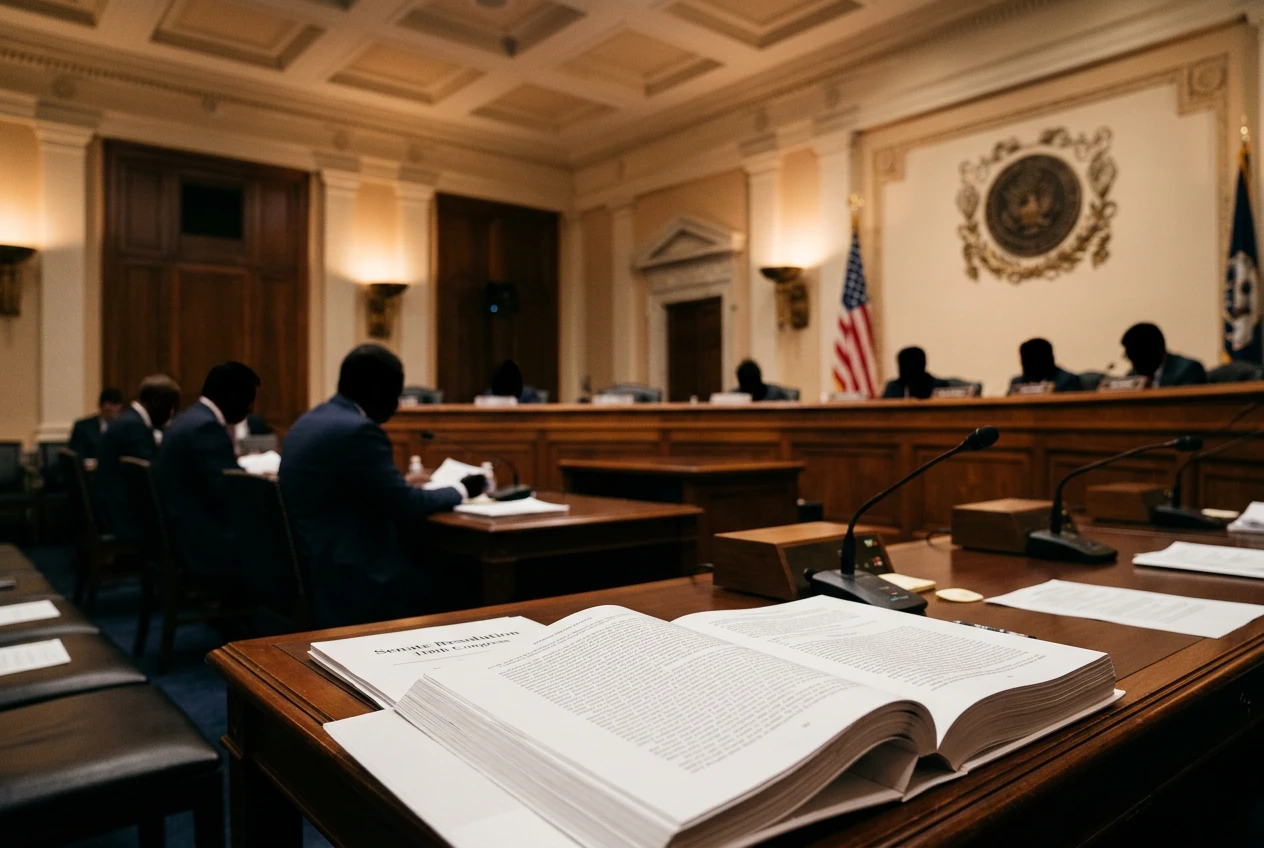
The Georgia amendments surfaced inside one of the largest defense bills in recent memory. The FY27 NDAA chairman’s mark, authored by Rep. Mike Rogers (R-AL), authorized roughly $1.15 trillion for defense programs (the base-budget portion of the Trump administration’s $1.5 trillion total request, with the remaining $350 billion sought through a separate reconciliation measure). The committee worked through approximately 900 amendments over 14 hours at the House Armed Services Committee markup of H.R. 8800 before approving the full bill 44 to 12 shortly before midnight.
Big debates consumed most of the session. A proposal to rename the Department of Defense to the Department of War passed 29 to 27. Confederate base names generated hours of floor argument. A right-to-repair amendment for military equipment drew fierce resistance from defense contractors. The investigation into a March attack in Kuwait that killed six US service members required its own separate measure. The Georgia provisions cleared by voice vote as part of an amendment bloc.
The bill now heads to the full House, expected before the July recess. The Senate Armed Services Committee (SASC) opens its closed markup on June 9. After both chambers pass their versions, a conference committee reconciles the two. Congress has passed the authorization bill every year since 1961, and neither party wants to break that streak heading into an election cycle.
Georgian Dream’s Westward Problem
The timing of the two amendments tracks a deterioration in US-Georgia relations that accelerated after Georgian Dream claimed victory in the disputed October 2024 parliamentary elections. The Organization for Security and Cooperation in Europe (OSCE) said the process was marred by vote-buying, double-voting, physical violence, and intimidation. Mass street protests followed; in December 2024, the Biden administration imposed sanctions on Bidzina Ivanishvili, the billionaire who built his fortune in post-Soviet Moscow and is widely regarded as Georgia’s de facto ruler.
According to an Atlantic Council analysis of bilateral US-Georgia financial flows, the US has channeled more than $6.2 billion in assistance to Georgia since independence in 1991. The EU provided roughly $126 million annually before suspending payments. Prime Minister Irakli Kobakhidze declared in late 2024 that his party would reject EU financial assistance until 2028.
A few indicators of where the relationship stands:
- Georgian exports to Russia grew 1,700 percent between 2012 and 2024 as Georgian Dream deepened economic ties with Moscow
- In May 2024, Georgia selected a Chinese-led consortium to build the Anaklia Deep Sea Port on the Black Sea, alarming US officials tracking Beijing’s strategic footprint in the region
- Georgia continued allowing Iran to use its transit corridors to assist Russian trade, undercutting Western sanctions pressure on Moscow
- The Biden administration suspended the US-Georgia Strategic Partnership in December 2024; the Trump administration did not restore it, though bilateral military exercises resumed in 2025
The political-prisoner population has been growing throughout. In January 2025, journalist Mzia Amaglobeli became the first female journalist jailed in Georgia since the Soviet era, arrested following protests over Georgian Dream’s EU decision and charged with assaulting a police officer, a charge widely condemned as disproportionate and politically motivated. Human rights organizations have documented hundreds of similar politically motivated detentions.
Congress Orders a Penetration Assessment
The classified intelligence mandate goes further than a diplomatic posture check. Getting a formal, deadline-bound assessment of Russian and Chinese intelligence penetration into Georgia’s government and security services into the Pentagon’s record changes the decision calculus for military cooperation in a specific way. If the report confirms meaningful penetration, the Secretary of Defense has a documented institutional basis to restrict what information flows during joint exercises and limit what Georgian officers can access in US-run training programs.
Wilson had been pushing this line of inquiry for months before the committee vote. In April, Radio Free Europe/Radio Liberty reported that a standalone bill he introduced would require the US administration to produce a classified assessment of Russian and Chinese intelligence penetration in Georgia, “including any overlap between the two.” The Center for European Policy Analysis (CEPA) assessment of Georgian Dream’s strategic trajectory documents how Ivanishvili, drawing on instincts formed navigating post-Soviet Moscow, directed Georgia’s foreign policy away from Western integration through what analysts describe as tactical accommodation of adversary powers. The Anaklia port decision, CEPA noted, handed “strategic ground on Georgia’s Black Sea coast to Chinese-linked actors.”
The relevant congressional committees will hold the classified report without publishing it, and that institutional record shapes what questions get asked when senior Pentagon officials testify and whether the MEGOBARI Act hearings have a factual foundation to work from.
The MEGOBARI Backdrop
These NDAA provisions don’t exist in isolation. The Mobilizing and Enhancing Georgia’s Options for Building Accountability, Resilience, and Independence Act (MEGOBARI Act, “megobari” is Georgian for “friend”) passed the House in May 2025 with a 349-42 bipartisan margin. Wilson called the spread “totally unprecedented” for foreign-policy legislation of its kind. The bill stalled in the Senate after then-Senator Markwayne Mullin (R-OK) succeeded in stripping it from the FY26 NDAA in August 2025; Mullin has since joined the cabinet as Secretary of Homeland Security, and Wilson has said publicly that his departure clears a “lifeline” for the legislation.
Nobody has to explain to Marco Rubio what the consequence of totalitarianism is. Both Rubio and President Donald Trump want the best for the people … which is clearly fair and free elections.
He told Radio Free Europe/Radio Liberty in April, responding to Georgian Dream’s attempt to frame a Rubio-Kobakhidze phone call as a diplomatic reset in relations.
The full text of H.R. 36, the House MEGOBARI bill, includes its own mandate for a classified assessment of Russian intelligence penetration in Georgia. The NDAA amendment channels a parallel version of that requirement through the Pentagon rather than the State Department. Both requirements run through separate agencies and produce separate classified documents, creating two converging institutional channels aimed at the same factual territory: how deeply Russia and China are embedded in Tbilisi’s government.
The bill has also drawn industry lobbying. Steve Nicandros, chairman and CEO of Houston-based Frontera Energy, sent at least one House Republican a letter in January arguing that his company’s more than $500 million in Georgia investments, and a planned $100 million follow-on program, would be damaged by sanctions. Nicandros called Georgian Dream an ideological ally of the Trump administration, a framing the bill’s supporters dispute.
The October 1 Deadline and What Follows
The NDAA’s path runs through conference. After the SASC finishes its closed markup and both chambers pass their versions, a conference committee reconciles the differences and the finished bill goes to the president. The FY26 NDAA was signed on December 18, 2025; the pressure to avoid breaking Congress’s 65-year consecutive authorization streak will push this year’s bill toward the president’s desk before year’s end.
If the Georgia provisions survive conference, the October 1 unclassified report lands while the Senate is still debating the MEGOBARI Act. A Pentagon document detailing the department’s strategy for pressing Tbilisi on political prisoners would reach Congress at roughly the same time senators weigh authorizing sanctions on Georgian Dream officials. The classified penetration assessment’s 180-day clock starts only after the president signs the NDAA; based on the FY26 timeline, that report arrives somewhere around spring 2027.
Until then, the October 1 report is the first concrete test of whether these provisions do any diplomatic work, or simply accumulate paper.