Paris Saint-Germain retained the Champions League on Saturday, beating Arsenal 4-3 on penalties at the Puskas Arena in Budapest after the final finished 1-1 across 120 minutes. The result made PSG the first club to hold onto Europe’s biggest club prize since Real Madrid’s run from 2016 to 2018, and only the second team to win it in consecutive seasons since the competition was rebranded in 1992.
Gabriel Magalhaes settled it the hard way. Arsenal’s defender had to score the Gunners’ fifth penalty to keep the shootout alive, and he blasted it over Matvey Safonov’s crossbar. One miss, and a French club that spent more than a decade being called rich and hollow had a dynasty.
Budapest Gave PSG the Title After a Havertz Scare
For an hour, the script belonged to Arsenal. Kai Havertz pounced in the sixth minute when Marquinhos’ clearance ricocheted off Leandro Trossard and dropped into his path, and the German striker drove into the roof of the net. It was the nightmare opening for PSG: an early deficit against the meanest defence in the competition.
Mikel Arteta’s side then did what they do best. They smothered Khvicha Kvaratskhelia with two markers, choked the supply to Fabian Ruiz in midfield, and dared PSG to find a way through. By half-time the territorial split was lopsided in one direction and the danger in another: PSG had attacked 32 times, Arsenal three, yet the English side led.
The turn came in the 65th minute. Cristhian Mosquera hauled down Kvaratskhelia in the box, and Ousmane Dembele tucked away the penalty for his eighth goal of the campaign. From there the final lost its shape. Vitinha grazed the top of the net in the 89th minute, Bradley Barcola shot over after a counter, and both teams ran themselves empty before extra time settled into a cautious stalemate.
When referee Daniel Siebert sent it to penalties, the lottery favoured the side that has stopped treating shootouts as a lottery. Eberechi Eze missed for Arsenal, David Raya saved from Nuno Mendes to level the ledger, and then Gabriel skied his kick. Lucas Beraldo, an extra-time substitute, buried the spot kick that won it.
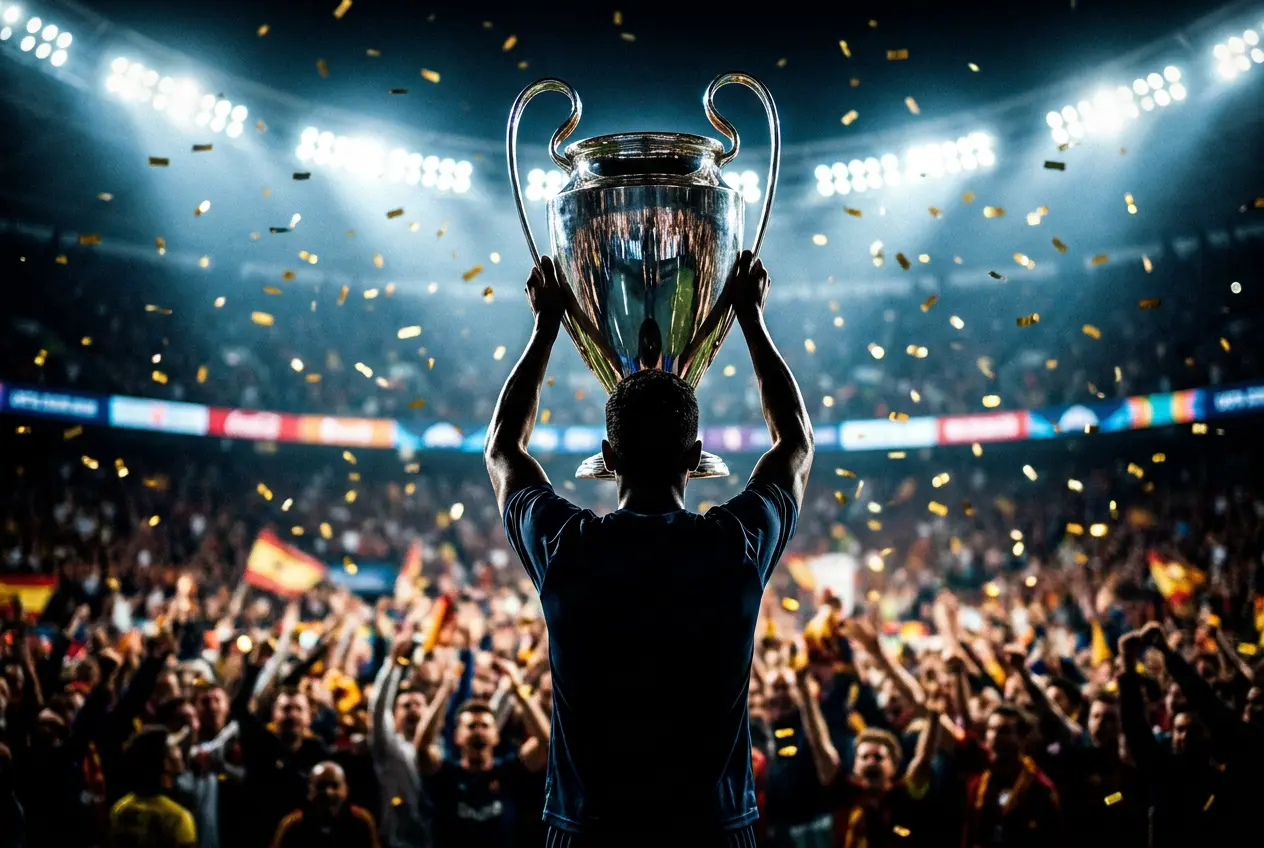
Only Real Madrid Had Repeated in the Champions League Era
Back-to-back European titles used to be common. In the old European Cup, dynasties came in clusters: Real Madrid won the first five, Ajax took three straight, Bayern Munich matched them, and AC Milan closed the pre-1992 era with a double. Since the competition became the Champions League, retaining it had proved almost impossible until Real Madrid strung together three in a row last decade.
PSG are now the second name on that short modern list. The company they keep, set out in the official roll of European Cup and Champions League winners, explains why Saturday felt like more than another trophy.
| Club | Consecutive titles | Era |
|---|---|---|
| Real Madrid | 1955-56 to 1959-60 (five) | European Cup |
| Ajax | 1970-71 to 1972-73 | European Cup |
| Bayern Munich | 1973-74 to 1975-76 | European Cup |
| AC Milan | 1988-89, 1989-90 | European Cup |
| Real Madrid | 2015-16 to 2017-18 | Champions League |
| Paris Saint-Germain | 2024-25, 2025-26 | Champions League |
Luis Enrique’s Shootout Record Decided It
The numbers behind PSG’s calm from 12 yards are not normal. Since Luis Enrique, the Spanish coach who arrived in 2023, took the bench, PSG have faced six penalty shootouts and won all six. For a club whose history with spot kicks ran from disappointing to traumatic, that is a wholesale rewiring of nerve.
Enrique’s personal record in one-off finals is just as stark.
- 6 of 6: shootouts PSG have contested and won under Enrique
- 12 of 13: one-off club finals Enrique has won as a head coach
- 4-3: the shootout margin that retained the trophy in Budapest
He framed this triumph as harder than the last, when PSG dismantled Inter Milan 5-0 to win the trophy for the first time.
It’s stronger than last year because we knew before the match just how difficult it would be to play against Arsenal. As a club and a city, it’s incredible to win, and I think we deserved it over the course of the season. The final was a real battle.
Those were Enrique’s words at the Puskas Arena, with captain Marquinhos beside him.
Arsenal Leave With a Premier League Crown and a Scar
Eleven days before Budapest, Arsenal had ended a 22-year wait for the Premier League title, their first championship since the 2003-04 Invincibles. A maiden European crown would have crowned a generational season. Instead they became the latest side to learn that getting to a Champions League final and winning one are different sports.
This was Arsenal’s second final, after the 2006 defeat to Barcelona, and on the balance of the night they could feel aggrieved. They scored first, defended for an hour as well as any team in the tournament, and went home from Europe unbeaten across the whole campaign apart from the shootout. They had beaten Premier League rivals on the way to deeper rounds; PSG had eliminated Chelsea and Liverpool to reach the same stage.
The error was tactical as much as emotional. Once Jurrien Timber and Viktor Gyokeres came on for Mosquera and Martin Odegaard, Arsenal chased the game and handed PSG the open spaces their counterattack craves. In extra time, drained, they managed a single shot on target.
Declan Rice, the England midfielder, summed up the mood afterward.
“It’s gutting. It’s devastating to lose a Champions League final on penalties,” Rice said. “But we try to take a lot of perspective from how far we’ve come as a group. An incredible season. We took the game to penalties. It’s a lottery.”
The Treble Behind the Back-to-Back
The trophy did not arrive alone. PSG completed a continental treble in 2025-26, and the haul reframes the whole debate about whether the club’s spending could ever buy substance rather than spectacle.
- Ligue 1: a domestic title secured before the European run reached its climax
- Coupe de France: the cup leg of the treble
- Champions League: the piece that turns a strong season into a historic one
Enrique became the second manager after Pep Guardiola to win the treble twice, and PSG’s broader trophy run, charted on the club’s official men’s fixture record, now stretches across domestic, continental and global silverware after a FIFA Intercontinental Cup title delivered French football its first club world crown. Havertz, for his part, joined a four-man list of players to have scored in two European Cup or Champions League finals for two different clubs, a footnote that will sting in north London.
What a Three-Year Reign Would Require
One question now hangs over Paris. Real Madrid did not just repeat; they won three straight, the benchmark that separates a great team from a dynasty in the record books. PSG have matched the first two steps and will spend the summer being measured against the third.
The off-field picture is less settled than the trophy cabinet suggests. The club has been weighing changes in its football structure, including a search for a new sporting director, the kind of churn that has derailed PSG projects before. Squad continuity, not transfer-market noise, is what built the calm Budapest exposed.
If PSG arrive at next year’s final still carrying the trophy, the Real Madrid comparison stops being flattering and becomes literal. If they fall short, Saturday in Budapest will still stand as the night a French club finally turned money into something that endures.