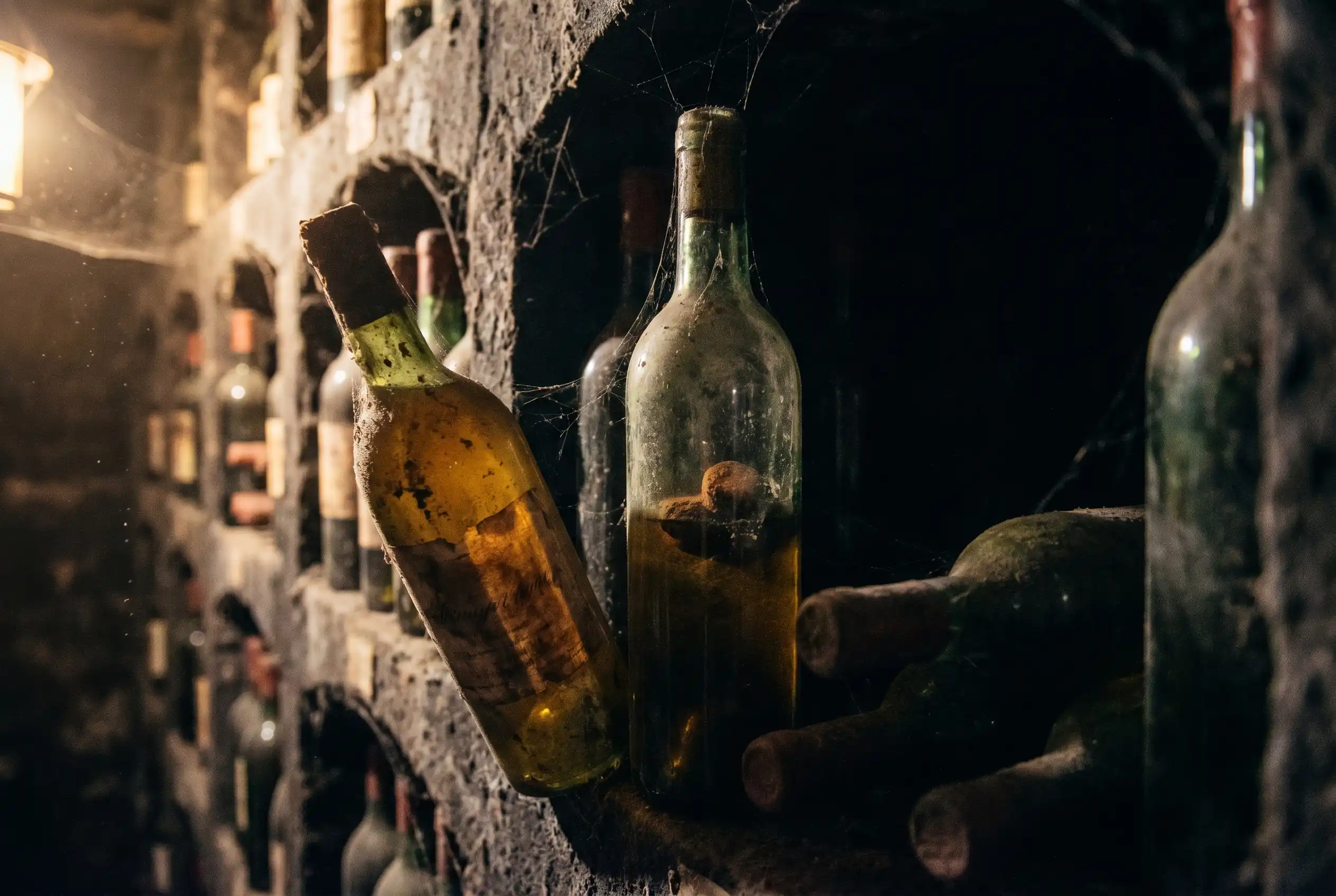
Georgia opened Joseph Stalin’s wine cellar for the first time this week, revealing roughly 40,000 bottles of French and Georgian rarities, some of them dating to the early 19th century. The government that owns the hoard does not plan to drink it. It plans to sell the collection and spend the proceeds on a national winemaking school.
That plan turns a macabre curiosity into a marketing budget. Georgia ships around $268 million of wine a year and has spent the past decade trying to trade up from cheap volume to prestige. A cellar stocked partly with bottles seized from the murdered Russian imperial family is the loudest advertisement the country has ever owned.
Inside Stalin’s Sealed Vault
The collection had sat behind locked doors for decades before officials unsealed it in Tbilisi, the Georgian capital. What they found was less a wine list than a confiscated inheritance. Bottles from Bordeaux’s most famous estates sat alongside Georgian varieties, the oldest reaching back to a time before Georgia was part of the Russian empire.
The provenance is the part collectors are circling. Some of the French bottles once belonged to Tsar Alexander III and his son Nicholas II. After the 1917 Russian Revolution, Soviet authorities confiscated the Romanov imperial collection, and the wine eventually passed into Stalin’s keeping. He became its custodian and added his favorite Georgian labels over the years.
Stalin himself was a Georgian, born in the town of Gori in 1878. He led the Soviet Union from 1924 until his death in 1953, and he kept the habits of a serious collector throughout. The country he ruled for nearly three decades now wants to monetize the cellar he left behind, in the place he was born.
- 40,000 bottles of French and Georgian wine in the collection
- Early 19th century dating for the oldest bottles, predating the modern Georgian state
- 1924 to 1953, the span of Stalin’s rule over the Soviet Union
- Two tsars, Alexander III and Nicholas II, among the wine’s former owners
An Auction Built to Fund a School
The headline number, 40,000 bottles, is not the reason the agriculture ministry got involved. The reason is what the sale could pay for. Officials say the proceeds will go toward a national winemaking school, an institution meant to train the next generation of Georgian producers and certify the craft the country keeps telling the world it invented.
Irakli Gilauri, owner of Gilauri Wines, worked with the ministry on the project and framed it as a positioning play rather than a one-off windfall.
The auction would help to put Georgia on the collectors’ map.
That phrase carries the whole strategy. A school funded by the sale outlasts the sale. A single auction generates headlines for a week, but a credited training institution, named after the country and seeded by Stalin’s cellar, generates a story producers can repeat at every trade fair for years.
It also solves an awkward problem. Selling a tyrant’s wine for cash looks crass. Selling it to educate winemakers looks like stewardship. The school is the line that lets the government cash in the collection without simply liquidating a dictator’s estate.
A $268 Million Trade Looking for a Premium
Behind the spectacle is an export business that needs exactly this kind of attention. Georgia sold around 89.7 million litres of wine across 71 countries in 2025, worth close to $268 million, according to the country’s National Wine Agency export figures. The harvest behind it was the largest in three decades, with roughly 340,000 tonnes of grapes processed by 730 companies and 22,000 growers.
Where the Wine Goes
The trade still leans heavily on a handful of nearby markets, and the per-bottle prices are modest. That concentration is the weakness the prestige push is meant to fix.
| Market | 2025 export value | Change vs 2024 (YoY) |
|---|---|---|
| Poland | $17 million | +2% |
| China | $9.8 million | +6% |
| Germany | $6 million | +1% |
| Latvia | $4.7 million | +16% |
Note: YoY stands for year over year, the change against the same figure a year earlier.
The Push Upmarket
The average price of Georgian wine crept up to $2.98 per litre in 2025 from $2.91 the year before, a small move that the industry wants to turn into a trend. Tbilisi has already moved to reward quality at the source, with tougher grape-pricing rules meant to lift wine quality and global prestige. Sector analysts at a Georgian wine and spirits sector report have flagged the same problem for years: volume is strong, value per litre is not. A Stalin auction does nothing for the price of a bottle of everyday Saperavi, but it does buy the kind of global notice that no marketing line ever could.
Why Infamy and Royal Provenance Pay
Old wine rarely survives as a drink. Bottles from the early 1800s are almost certainly past the point of being pleasant, and many will be undrinkable. The value sits in the glass, the label, the cork, and the chain of ownership, not in the liquid.
That is where Stalin and the Romanovs earn their keep. Provenance is the single biggest multiplier at the top of the wine market, and a bottle that can document a path from a tsar’s table to a dictator’s cellar carries two layers of it. Collectors who would never pay a fortune for the wine will pay it for the story stamped on the bottle.
Victor Chen, a wine collector from Dallas who saw the cellar, captured the gamble of buying blind into a sealed trove. “I feel like you’re Indiana Jones opening up a cave: it could be nothing, it could be something,” he said. The uncertainty is part of the appeal, and so is the darkness of the name attached. Infamy sells at auction in a way that comfort never does, which is why two Georgian wineries that recently climbed the World’s 50 Best Vineyards extended list still cannot generate the headlines a single Stalin bottle can.
Eight Thousand Years as the Sales Pitch
The deeper asset Georgia is leveraging is age. The country bills itself as the birthplace of wine, with archaeological finds near Tbilisi pointing to a winemaking tradition stretching back about 8,000 years. Its clay-vessel method, the qvevri, was added to the list of intangible cultural heritage by UNESCO (the United Nations Educational, Scientific and Cultural Organization, the UN’s culture body) in 2013.
That heritage is the thread connecting an ancient burial of grape pips to a modern export drive. Georgia has been pressing the message hard in mature markets, including a state-backed Georgian wine campaign launched in Germany, and its tourism arm sells the same line to visitors who read about the country as the cradle of winemaking.
The Stalin cellar slots neatly into that pitch. A school funded by his collection lets Georgia tell a single continuous story: the oldest wine culture on earth, interrupted by tsars and Soviets, now training its own winemakers with money pulled from the most notorious cellar in its history. For a marketing team, that arc is worth more than any single lot.
The Obstacles Between Cork and Hammer
None of it is banked yet. The government has announced the plan and opened the doors, but the practical work of turning 40,000 bottles into a funded school still has several gates to clear.
- No auction house or date has been confirmed, leaving the headline value as collector speculation rather than a hammer price.
- Provenance has to be proven, bottle by bottle, before buyers will pay tsar-and-dictator premiums rather than ordinary old-wine prices.
- Condition is unknown, since many bottles will have degraded and only the rarest labels will command serious money.
- The optics cut both ways, because some buyers and observers will balk at profiting from a hoard built on confiscation and a regime that killed millions.
If the rarest Romanov and Bordeaux bottles fetch the six-figure prices collectors are whispering about, the school gets built and Georgia gets the prestige story it has been chasing for a decade. If the sale stalls on provenance doubts or buyer unease about whose cellar this was, the country is left holding 40,000 bottles it cannot drink and a sales pitch it cannot yet cash.