The Blue Moon that rises Saturday night, May 30, into the early hours of Sunday, May 31, 2026, is the smallest full moon of 2026, a micromoon that will look about 6% smaller and roughly 10% dimmer than an average full moon. It earns the “Blue” label for one reason only: it is the second full moon to land inside a single calendar month. The color never changes.
So the name promises more drama than the sky will deliver. The genuinely uncommon detail is one no observer can catch by eye, because the moon reaches full phase just 19 hours before it swings out to apogee, its farthest point from Earth, and a Blue Moon that doubles as a micromoon will not come back around for decades.
Why This Full Moon Sits at Its Farthest Point From Earth
The moon reaches peak illumination at 08:45 UTC on May 31, which is 4:45 a.m. EDT on Sunday for viewers in the eastern United States. People across the Americas, Europe and Africa will see the disk looking essentially full on the night of May 30, while observers west of the International Date Line catch it on May 31. At that moment the moon sits about 252,360 miles (406,134 km) away, the greatest distance of any full moon this year.
The reason is orbital geometry. The moon travels an elliptical path, so its distance from Earth changes through the month. When a full moon happens close to perigee, the nearest point, you get a supermoon. When it happens close to apogee, the farthest point, you get the opposite, a moon that looks slightly shrunken and faded. This one falls only 19 hours shy of apogee, which is why it claims the smallest spot on the 2026 calendar.
None of that registers as drama on a casual glance. The shrink is real, the dimming is real, and both are too subtle for most people to notice without a side-by-side reference.
- 252,360 miles (406,134 km) is the moon’s distance at full phase, the most distant of any full moon in 2026.
- About 6% smaller and 10% dimmer than an average full moon, the figures published by the team running tonight’s livestream.
- 19 hours is the gap between full phase and the moon reaching lunar apogee.
The Two Definitions Behind the Blue Moon Name
A Blue Moon has nothing to do with color. There are two accepted meanings, and tonight’s moon qualifies under the more familiar one. May 2026 carried two full moons, the first on May 1 and the second on May 31, which makes the late-month moon a monthly Blue Moon. You can read more about the two competing definitions of a Blue Moon and how the calendar version took hold by mistake.
- Monthly Blue Moon: the second full moon to fall within one calendar month. These come around about seven times in every 19 years, or roughly once every two to three years.
- Seasonal Blue Moon: the third of four full moons squeezed into a single astronomical season, the older and original sense of the phrase.
The lunar cycle runs 29.5 days, a touch shorter than most months, so a second full moon occasionally sneaks in before the month ends. That mismatch is the entire source of the term. Gianluca Masi, the astronomer who directs the Virtual Telescope Project in Italy, summed up the mashup of labels bluntly.
One might therefore call it a Blue Micromoon, although the term has no scientific value.
That line is worth holding onto as the headlines stack up. The science here is ordinary lunar mechanics. The naming is folklore.
Micromoon and Supermoon, Side by Side
The clearest way to understand tonight’s moon is to set it against its loud cousin. A supermoon is the same moon near perigee, looking bigger and brighter. According to the mechanics of perigee and apogee explained by NASA, the difference between the two extremes is measurable but modest to the eye.
| Feature | Micromoon (tonight) | Supermoon |
|---|---|---|
| Orbital point | Apogee, the farthest point | Perigee, the closest point |
| Approx. distance | About 252,000 mi (406,000 km) | About 226,000 mi (363,300 km) |
| Apparent size | Up to 14% smaller | Up to 14% bigger |
| Brightness | Up to 30% dimmer | Up to 30% brighter |
NASA puts it plainly: at its closest the full moon can look up to 14% bigger and 30% brighter than the faintest moon of the year. That sounds large on paper. In practice, with nothing to compare against in the sky, almost nobody clocks the change with the naked eye. Tonight’s moon runs roughly 25% to 30% dimmer than a full supermoon, yet it will still flood a clear night with light.
The honest takeaway: the micromoon label describes a precise astronomical fact, not a visible event. If you went out expecting a noticeably tiny moon, you would come back disappointed.
How to Watch the Blue Micromoon Tonight
There are two good ways to take this one in, and neither requires expensive gear. One puts a professional telescope on your screen, the other puts you under the actual sky.
The Free Livestream From Italy
The Virtual Telescope Project is broadcasting the moon live from Manciano, in central Italy, beginning at 9:30 p.m. EDT on May 30, which is 01:30 UTC on May 31. The free stream pairs live robotic-telescope views with archival images of the moon hanging over Rome’s best-known monuments, a nice touch if clouds spoil your local view. The feed runs on the project’s WebTV and YouTube channel, weather permitting.
Seeing It With Your Own Eyes
If your sky is clear, you do not need a telescope. The full moon is bright enough to find on its own. A few steps make the view better.
- Check the moonrise time for your location and look low toward the eastern horizon shortly after it climbs into view.
- Watch it while it sits near the horizon, where the moon illusion makes any full moon, even a micromoon, look unusually large against buildings or trees.
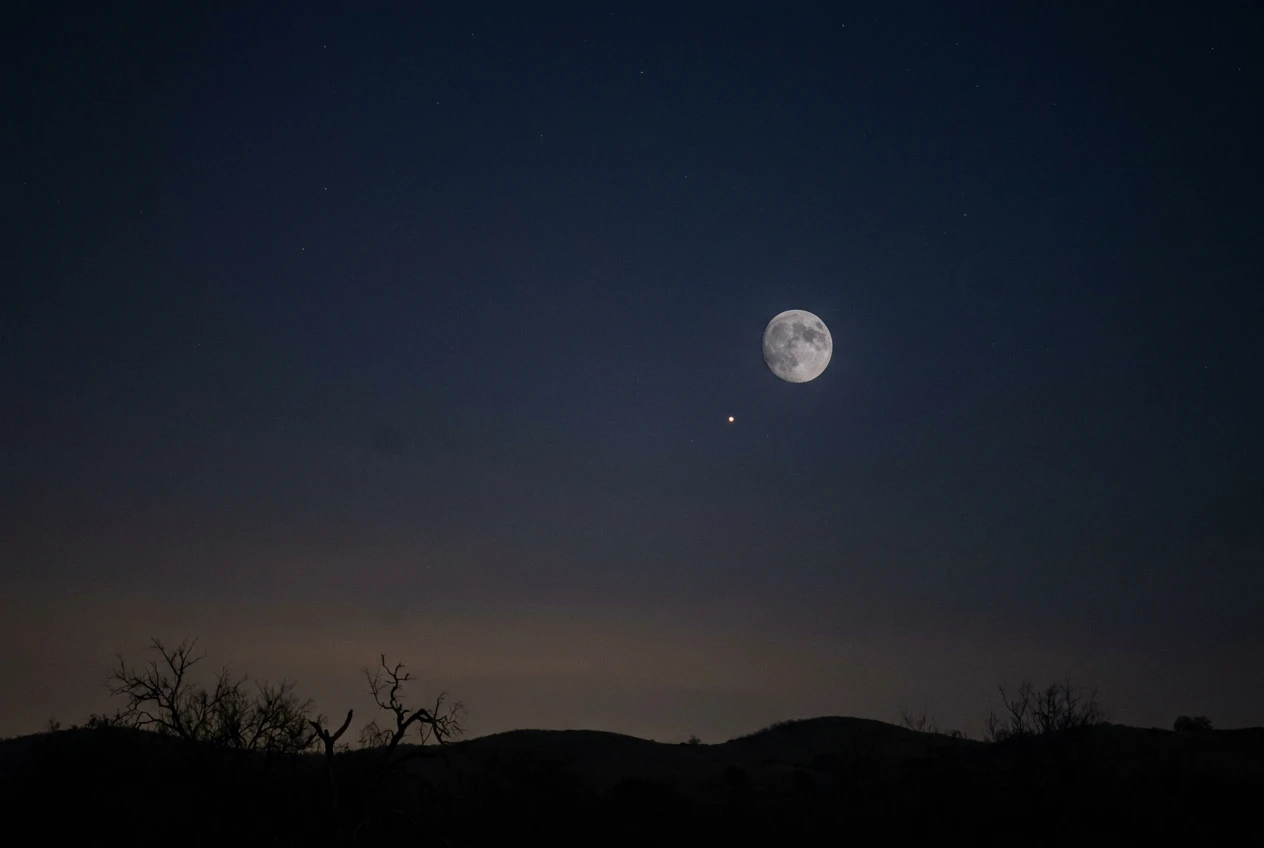
- Bring binoculars to pick out the bright reddish star sitting beside the moon all night.
- For photos, mount a phone or camera on a tripod and use a long lens, since handheld shots of the moon almost always blur.
A Pairing the Naked Eye Will Miss, and One That Returns in 2028
There is a quieter sight worth knowing about. Through the night the moon tracks close to Antares, the orange-red heart of the constellation Scorpius, a magnitude-1 star that holds its own beside the glowing disk. For most of the world the two simply sit near each other. From parts of the Southern Hemisphere, including eastern Australia, New Zealand, southern South America and Antarctica, the moon briefly passes directly in front of Antares in what astronomers call an occultation, blotting the star out for a few minutes before it reappears.
The rarity claim around tonight needs a careful read. The next monthly Blue Moon of any size arrives on December 31, 2028, a New Year’s Eve full moon, while the next seasonal Blue Moon comes sooner, on May 20, 2027. A Blue Moon that is also a micromoon is the genuinely scarce combination. NASA’s astronomy picture of the day, which ran a side-by-side supermoon and micromoon comparison, notes that the next blue micromoon pairing is not expected until 2053.
That same distant moon is also the target of a renewed human push, from the multibillion-dollar plan to build a permanent outpost at the lunar south pole to the crewed flights now in testing, including the Artemis II journey around the Moon. Tonight it is just far away and faintly lit. For now, the smallest full moon of the year does its quiet work overhead, and the next time a Blue Moon shrinks to a micromoon, the calendar will read 2053.
Frequently Asked Questions
What time is the Blue Moon on May 31, 2026?
The moon reaches full phase at 08:45 UTC on May 31, which is 4:45 a.m. EDT on Sunday morning. It will look full to the eye on the night of Saturday, May 30, so you do not need to stay up for the exact peak to see it.
Why is it called a Blue Moon if it isn’t blue?
The name has nothing to do with color. This is a monthly Blue Moon, meaning the second full moon to fall in a single calendar month, after the first full moon of May on the 1st. The moon stays its usual silver-grey.
What is a micromoon?
A micromoon is a full moon that happens near apogee, the farthest point in the moon’s elliptical orbit. Because it is more distant, it appears slightly smaller and dimmer than usual, the opposite of a supermoon, which occurs near the closest point.
Can I see that the moon is smaller with the naked eye?
Barely. Tonight’s moon is about 6% smaller and roughly 10% dimmer than an average full moon, a difference almost nobody notices without a direct comparison photo. It will still light up a clear night sky.
Where can I watch the Blue Micromoon livestream?
The Virtual Telescope Project is streaming the moon live from Manciano, Italy, starting at 9:30 p.m. EDT on May 30 (01:30 UTC on May 31). The free broadcast runs on the project’s WebTV and YouTube channel and includes archival images of the moon above Rome’s monuments.
When is the next Blue Moon?
The next seasonal Blue Moon falls on May 20, 2027, and the next monthly Blue Moon lands on December 31, 2028. A Blue Moon that is also a micromoon, like this one, is not expected to recur until 2053.