Lenovo unveiled the ThinkStation P4 on May 13 at NXT BLD 2026 in London, and the 30-liter tower carries a quiet first inside. It is the first workstation in the world to feature the latest AMD Ryzen PRO 9000 Series processors paired with NVIDIA’s RTX PRO 6000 Blackwell Workstation Edition GPU, and select models introduce AMD 3D V-Cache technology to the professional segment for the first time, a piece of silicon that until now lived only in gaming chips.
For two decades, the tier-one OEM workstation tower has been Intel turf, with Ryzen relegated to boutique system builders and self-builds. The P4 changes that arithmetic before a single benchmark publishes.
AMD Just Cracked a Door Intel Held Shut
The mainstream workstation tower has had a fixed shape for years. Dell Precision, HP Z, Lenovo ThinkStation. Intel Xeon W inside. AMD’s professional silicon has lived on the fringes: Threadripper Pro in Lenovo’s larger P620 and P8 chassis, EPYC in servers, and Ryzen wherever a boutique would solder it.
That mattered for buyers because Ryzen workstations have typically come from boutique builders such as Armari, Scan, BOXX and Puget Systems, or from self-builds, while many AEC firms prefer ISV certifications, long lifecycle support and enterprise-grade warranty. The P4 is the first time Ryzen PRO arrives wearing all three of those badges at once, on a tier-one OEM SKU sheet.
It is also a quiet repositioning of the chip itself. The new processors will not appear at retail; distribution is OEM-only, mirroring how Intel ships vPro platforms. AMD has built a channel-managed workstation product, not a rebadged consumer chip.
One AEC industry magazine put the implication directly: Lenovo says it expects to be first to market and may be the only major OEM shipping such a system for some time, even if this is not a formal exclusivity deal in the same sense as its original Threadripper Pro-based ThinkStation P620. Translation: Dell and HP can answer, but they have not yet.
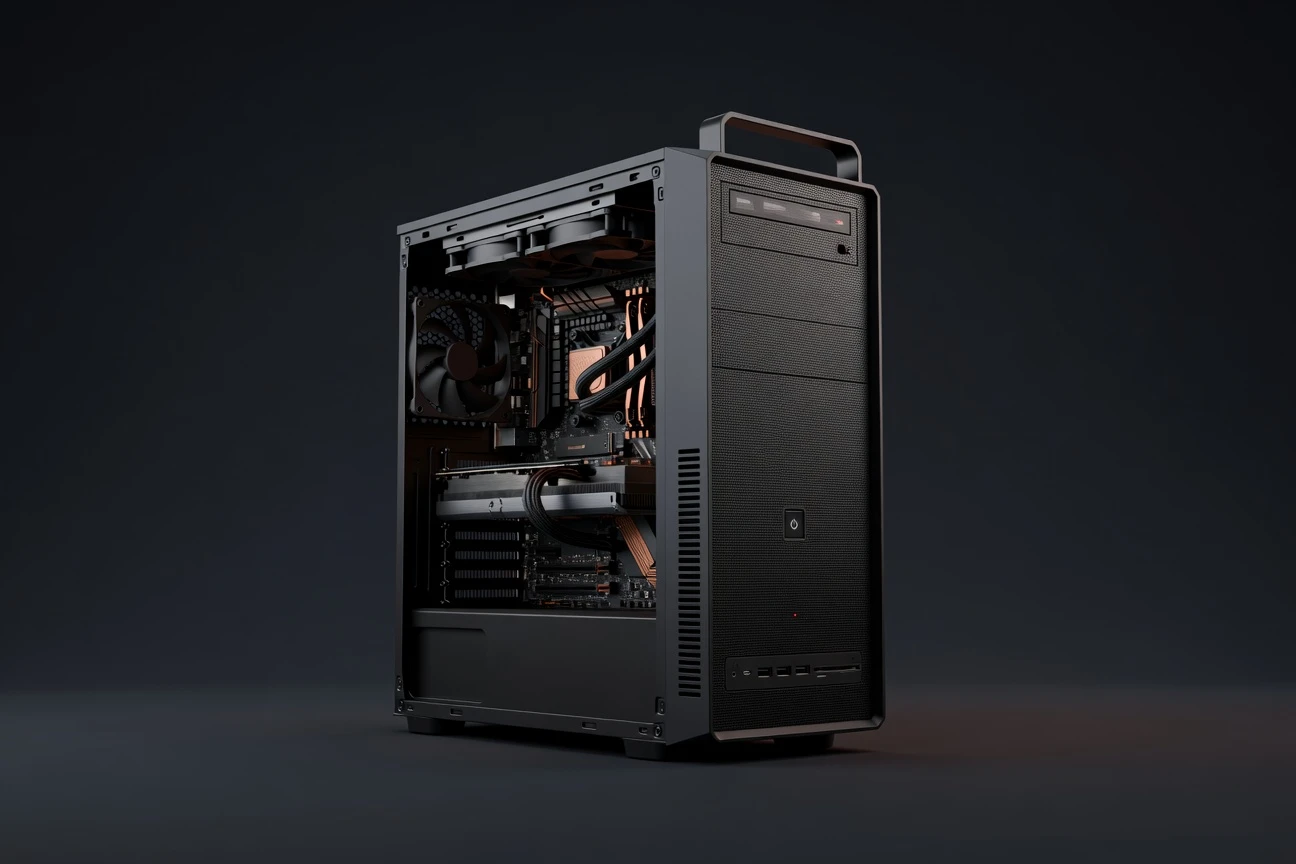
Inside the 30-Liter Hardware Stack
The P4 is built around AMD’s AM5 platform with up to a 16-core flagship. The top SKU is the Ryzen 9 PRO 9965X3D, and Lenovo has paired it with a single high-end NVIDIA GPU, four DIMM slots, and a hybrid storage cage. The full kit is summarised below.
| Component | Top option | Mid-tier X3D option |
|---|---|---|
| CPU | Ryzen 9 PRO 9965X3D, 16 cores, 5.5 GHz boost, 170W TDP | Ryzen 7 PRO 9755X3D, 8 cores, 5.2 GHz boost, 120W TDP |
| L3 cache | 128 MB (with 3D V-Cache) | 96 MB (with 3D V-Cache) |
| GPU | NVIDIA RTX PRO 6000 Blackwell Workstation Edition | RTX PRO 6000 Blackwell Max-Q |
| GPU memory | 96 GB GDDR7 ECC, 512-bit bus, 1,792 GB/s | 96 GB GDDR7 ECC, lower-power variant |
| System memory | Up to 256 GB DDR5-6400, four DIMMs | Up to 256 GB DDR5-6400, four DIMMs |
| Storage | Up to 3x M.2 PCIe Gen5 NVMe (12 TB) + 3x 3.5″ HDD (36 TB) | Same hybrid cage |
| Cooling | Factory-fitted liquid AIO required for 170W chips | Air cooling sufficient |
| Power supply | 1100W | 500W or 750W |
Sources for the spec set: the Ryzen 9 PRO 9965X3D runs up to 5.5 GHz with a 170W TDP, and the Ryzen 7 PRO 9755X3D is an 8-core part with 96MB of L3 cache and a 5.2 GHz boost clock at 120W, and both NVIDIA GPUs feature 96GB of GDDR7 ECC memory linked to a 512-bit bus, delivering up to 1,792GB/s of memory bandwidth.
Expansion is the second story under the lid. PCIe layout includes one PCIe 5.0 x16 slot, one PCIe 4.0 x4 slot, and two PCIe 4.0 x1 slots, with Wi-Fi 7 and Bluetooth 5.4 capabilities via a Foxconn module, and 2.5GbE wired Ethernet from a Realtek controller. Connectivity on the front panel adds a 20Gbps USB-C port, four USB-A ports, audio, and a media card reader.
Cache as a Workstation Feature, Not a Gaming One
The headline change is the 3D V-Cache itself. For the first time, AMD is bringing 3D V-Cache to its Ryzen PRO processors with the expansion of the Ryzen PRO 9000 series; until now, AMD has never offered 3D V-Cache on its Ryzen PRO models for commercial desktops. The stacked-cache trick was a gaming optimization, baked into chips like the 7800X3D and 9950X3D to cut frame-rate-killing memory latency in CPU-bound titles.
AMD is now selling the same trick as a professional acceleration layer. Lenovo’s product chief framed the workload pitch this way at the launch.
As workflows become more complex and AI-driven, professionals of all levels require systems that keep pace with their evolving needs.
That came from Tom Butler, Vice President for Commercial Portfolio and Product Management at Lenovo Intelligent Devices Group, at the company’s NXT BLD launch. The case for the cache is the same one gamers made: less waiting on memory, more time on compute. AMD claims 3D V-Cache cuts memory latency in workloads like Blender rendering, finite-element simulation, and AI-assisted development, though no independent benchmarks are available yet for the PRO variants. That last clause is doing real work. Buyers will want third-party numbers before refresh budgets shift.
The strategic read is broader than one product. The launch demonstrates that AMD now sees 3D V-Cache as far more than a gaming optimization; the broader industry implication is that large on-die cache is evolving into a foundational enterprise compute technology, not merely an enthusiast gaming enhancement.
The ISV Stamp That Makes Tier-One Different
Workstation purchasing in architecture, engineering, and manufacturing runs on a quieter currency than benchmarks: independent software vendor certifications. The P4 ships with the full set buyers in those verticals expect.
- AVID for media production and audio
- Altair for engineering simulation
- Autodesk for CAD, Revit, and Maya
- ANSYS for finite-element and CFD
- Bentley for civil and infrastructure BIM
- Dassault for SolidWorks and CATIA
- Nemetschek for AEC design
- PTC for Creo and Windchill
- Siemens for NX, Solid Edge, and Teamcenter
That list is the real moat. Lenovo is listing ISV certifications from companies such as Autodesk, ANSYS, AVID, Altair, Bentley, Dassault, Nemetschek, PTC, and Siemens, which matters for workstation buyers because certified systems are often preferred in professional environments where software reliability is more important than raw benchmark numbers. A boutique BOXX or Puget tower can deliver the same chip and similar thermals, but the procurement officer at a 4,000-seat engineering firm needs the vendor’s name on the certification PDF.
The platform also covers the OS variety enterprise IT actually deploys. Lenovo workstations are fully compatible with Windows 11 Pro, Ubuntu Linux, and Red Hat Enterprise Linux, with independent software vendor certification for most professional applications from developers such as Autodesk, Bentley, and Siemens.
Hybrid AI Moves From Slide Deck to Deskside
The pitch underneath the spec sheet is on-device inference. Lenovo cites a survey number to anchor it: according to the CIO Playbook 2026, two thirds of companies prefer hybrid AI as their primary model, making workstations capable of handling AI workflows on-device a must. The 96 GB of GDDR7 on the NVIDIA RTX PRO 6000 Blackwell is the hardware answer.
Memory capacity is where the platform also stretches. The Ryzen PRO 9000 platform offers dual-channel memory with two DIMMs per channel, allowing four DIMMs in total and configurations up to 256 GB using 64 GB modules, with Lenovo saying it worked directly with AMD to enable 64 GB DIMMs, citing growing workstation requirements driven by large BIM and reality models, and emerging AI-assisted workflows where memory capacity is becoming critical.
There is a thermal cost to all of this. Top-end Ryzen Pro 9000 CPUs in this system can draw up to 170 W, and while air cooling will still be offered, Lenovo is introducing a factory-fitted liquid cooling option that is a requirement for the highest-end configurations. For a vendor that has historically kept liquid loops out of the mainstream ThinkStation line, that is a meaningful design shift, driven as much by acoustics in deskside engineering offices as by peak performance. Adjacent product news this year, including AMD’s broader CES 2026 push into AI-tuned consumer laptops, has tracked the same on-device-inference thesis from a different angle.
The Calendar, the Caveats, and What Comes for Xeon W
The rollout is staged. The Lenovo ThinkStation P4 will be available in select markets worldwide starting in June, and then North America in August 2026, and pricing will be available closer to launch. Pricing silence is standard for OEM-channel workstation gear, and it will stay that way through the back half of the year.
What this product is not is also worth flagging. It is a single-socket, single-GPU box. Architecturally, the P4 remains a single high-end GPU workstation; for users who need multiple GPUs, extensive PCIe lanes, more memory and more memory channels, Lenovo continues to position its Threadripper Pro-based ThinkStation P8 and P620 systems as the better fit. Buyers running 3-GPU local LLM rigs or multi-tile simulation jobs still have a separate shopping list.
The disruption read is therefore narrower than headlines suggest. AMD has not displaced Intel Xeon W across the workstation aisle. It has done something more surgical: claimed the volume tier of the AEC and content-creation workstation buyer, the seat where a 16-core, 5.5 GHz, large-cache chip with ECC GPU memory matters more than 32-core throughput. That is the seat Intel had to itself. Lenovo, which already runs the largest installed PC base globally, is the most expensive partner AMD could have picked to make the claim stick.
If the August North America ship date holds and third-party benchmarks for the Ryzen 9 PRO 9965X3D show the cache pivot pays off in Revit, ANSYS, and Blender, expect Dell and HP to answer with their own Ryzen PRO 9000 designs before the calendar turns. If the benchmarks land flat or thermals trip up the liquid loops, the door cracks shut and Intel keeps the floor at Autodesk University in November.
Frequently Asked Questions
When Will the Lenovo ThinkStation P4 Ship?
June 2026 in select markets globally, and August 2026 in North America, per Lenovo’s launch communications. Pricing has not been announced and is expected closer to each regional launch.
What CPUs Can the ThinkStation P4 Be Configured With?
The P4 supports the AMD Ryzen PRO 9000 Series, topping out at the Ryzen 9 PRO 9965X3D with 16 cores, 32 threads, a 5.5 GHz boost clock, 128 MB of L3 cache, and a 170 W TDP. A second X3D option, the Ryzen 7 PRO 9755X3D, runs 8 cores at up to 5.2 GHz with 120 W.
How Is the P4 Different From the ThinkStation P8 and P620?
The P4 is a single-CPU, single-GPU 30-liter tower built on AMD’s AM5 mainstream workstation platform. The P8 and P620 use AMD’s Threadripper Pro platform with more PCIe lanes, more memory channels, and multi-GPU support. Lenovo positions the larger systems for buyers who need multiple GPUs or more than 256 GB of system memory.
Why Is 3D V-Cache a Big Deal for Workstations?
3D V-Cache stacks additional L3 cache vertically on the CPU die, sharply reducing memory access latency. Until this launch, AMD had only shipped the technology in gaming chips. Bringing it to Ryzen PRO targets cache-sensitive professional workloads such as simulation, real-time visualization, code compilation, and Blender rendering, where memory latency often dominates performance.
Does the P4 Support Linux for Engineering Workflows?
Yes. Lenovo lists full compatibility with Windows 11 Pro, Ubuntu Linux, and Red Hat Enterprise Linux, alongside ISV certifications from Autodesk, ANSYS, Bentley, Dassault, Siemens, PTC, Altair, Nemetschek, and AVID.