The National Eucharistic Pilgrimage crossed into Georgia by boat on Memorial Day, May 25, carrying the Blessed Sacrament from Fernandina Beach, Florida, to St. Marys, Georgia, on the second day of a six-week East Coast route that ends in Philadelphia over the July 4 weekend.
The waterborne handoff gave the Catholic procession a striking public image, but the harder measure comes after the crowds leave the dock. The bishops are testing whether a movement built around national events can still reach ordinary parishes, lapsed Catholics and curious onlookers.
A Boat Crossing Turned the Route Into a Public Question
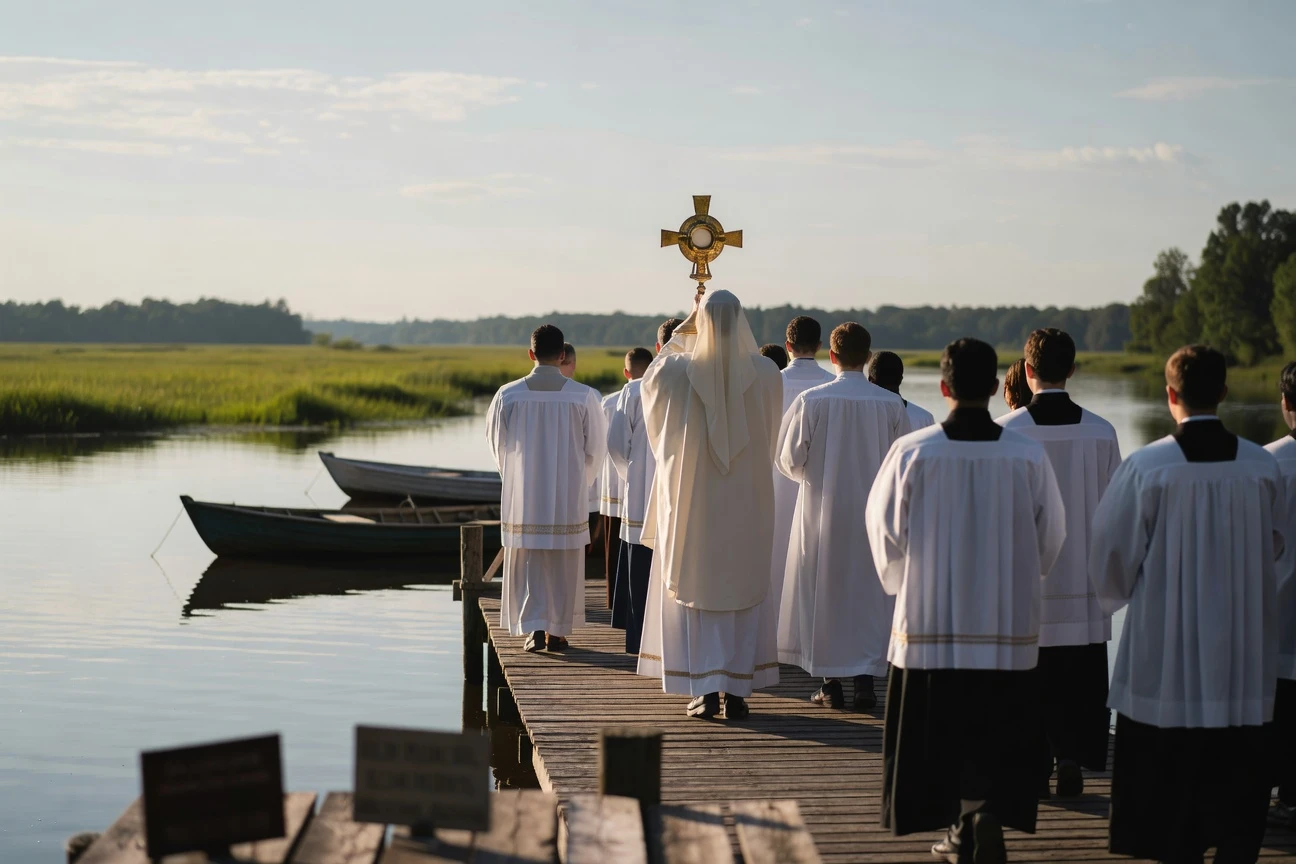
After a procession from St. Michael Church in Fernandina Beach to the waterfront, Bishop Erik T. Pohlmeier, bishop of St. Augustine, offered a Eucharistic blessing as the pilgrimage left Florida. Boats then carried the monstrance north toward the Diocese of Savannah, with police vessels escorting the group on the St. Marys River.
On shore, Bishop Stephen D. Parkes, bishop of Savannah, received the Blessed Sacrament before the procession continued to a nearby parish. The scene was local and visible at once: clergy, seminarians, religious sisters, private boaters, bystanders leaning out of cars and a crowd waiting on the Georgia side.
I’ve never been with Jesus before on a boat, like the Blessed Sacrament.
Mary Carmen Zakrajsek, a perpetual pilgrim from the Diocese of Fort Wayne-South Bend, Indiana, gave that reaction to OSV News after the crossing. Her line captured why the boat mattered. A procession that might have stayed inside parish walls moved through a public waterway on a federal holiday, asking people who had not planned to attend a Catholic event to stop and ask what they were seeing.
The Cabrini Route Builds a Catholic Map of the Coast
The official calendar from the United States Conference of Catholic Bishops lists the pilgrimage from May 24 through July 5 on the St. Frances Xavier Cabrini Route. The route begins in St. Augustine, moves up the Eastern Seaboard through much of the old colonial corridor and ends in Philadelphia for the Independence Day weekend.
That geography is deliberate. The official Cabrini Route page ties the journey to One Nation Under God, a theme chosen for America’s 250th year. It also lists the Diocese of Savannah stop for May 25-May 28, followed by Charleston, Charlotte, Richmond, Arlington, Washington, Baltimore, Wilmington, Camden, Paterson, Springfield, Manchester, Portland, Boston, Fall River, Providence and Philadelphia.
| Pilgrimage Moment | Route Shape | Public Signal | Pastoral Test |
|---|---|---|---|
| 2024 National Pilgrimage | Four routes from different corners of the country converged in Indianapolis | More than 6,500 miles of processions and local stops | Could a national congress be preceded by public witness? |
| 2025 Drexel Route | Indianapolis to Los Angeles | A single westbound route after the congress | Could the movement keep going after its central gathering? |
| 2026 Cabrini Route | St. Augustine to Philadelphia | An East Coast route tied to the nation’s founding anniversary | Can anniversary symbolism become parish practice? |
The comparison matters because the Georgia arrival was not an isolated flourish. The 2024 pilgrimage record describes a cross-country effort that led to the 10th National Eucharistic Congress in Indianapolis. A Diocese of Des Moines flyer for the 2025 St. Katharine Drexel Route described the next step as an Indianapolis to Los Angeles route. The new journey is smaller in shape than the 2024 map, but heavier in civic symbolism.
The Georgia Stop Carries a Parish-Level Test
For bishops and parish leaders, the question is less whether a river procession photographs well. It did. The bigger question is whether those images bring people to Mass, adoration, confession, catechesis or a parish conversation that lasts beyond a holiday weekend.
A USCCB-hosted National Eucharistic Revival impact study by Vinea Research gives that question teeth. The study surveyed 2,472 respondents in the summer and fall of 2025, one year after the first national pilgrimage and congress. Its strongest finding for the bishops was hopeful: clergy and lay point persons reported gains in Eucharistic devotion, adoration and reverence at Mass.
- 2,472 respondents completed the impact survey, including clergy, Church staff, point persons and lay Catholics.
- 63% of pilgrimage attendees in the clergy sample identified the National Eucharistic Pilgrimage among the most fruitful revival activities.
- Reaching beyond engaged Catholics appeared as the most cited challenge for lay point persons in the study.
That last point is the Georgia test. The people waiting at the dock were already disposed to welcome the procession. The more revealing moment came along the route, when onlookers asked what was happening. A public Catholic procession has value for the Church only if someone can answer that question in plain language and invite the next step without turning the encounter into a spectacle.
Why the Bishops Took the Sacrament Into the Street
The revival’s background is blunt. A 2019 Pew Research Center survey on Catholic belief in the Eucharist found that 31% of U.S. Catholics said they believed the bread and wine at Mass become the body and blood of Jesus, while 69% said they believed they are symbols. Catholic leaders later debated the wording and meaning of the survey, but the alarm it caused was real.
The pilgrimage is one answer to that alarm. It takes a doctrine often taught in classrooms and puts it in front of people as prayer, movement and worship. That can be risky. Processions depend on police escorts, weather, timing, public patience and the discipline of participants. A boat crossing adds another layer of logistics: wind, docks, vessel space and safety.
Public witness also changes the audience. In a parish chapel, the congregation mostly knows the gestures. On a riverbank, people may know nothing. That forces the Church to decide whether it can explain itself without jargon. The National Eucharistic Revival has always carried that tension: reverence for the faithful, clarity for the unsure and an open door for people who do not already speak the Church’s language.
The Perpetual Pilgrims Make the Logistics Personal
The national route depends on people who do the unglamorous work. The official pilgrimage site lists nine perpetual pilgrims for the Cabrini Route: Zachary Dotson, Marcel Ferrer, John Paul Flynn, Eduardo Gutierrez, Cheyenne Johnson, Angelina Marconi, Raymond Martinez II, Sharon Phillips and Zakrajsek. They are the young adults traveling the full route with the Blessed Sacrament from St. Augustine to Philadelphia.
Their role makes the journey more than a string of diocesan events. They give continuity to a route that moves through cathedrals, small parishes, waterfronts and city streets. They also carry the human cost of the project: long days, host homes, early Masses, heat, rain and repeated public explanation.
- Prayer keeps the procession from becoming a civic parade with Catholic objects.
- Hospitality turns parishes and families into part of the route, not just places on a map.
- Plain speech matters when bystanders ask why a monstrance is moving down a street or across a river.
- Follow-up decides whether a moving crowd becomes a parish invitation.
The St. Augustine launch showed the same pattern before the boats ever reached Georgia. The National Shrine of Our Lady of La Leche at Mission Nombre de Dios posted a Memorial Day weekend schedule with an opening Mass, procession to the Cathedral Basilica of St. Augustine, overnight adoration, confession, rosary, talks and service. The route is public, but its engine is sacramental and local.
Philadelphia Is the Finish Line, Parish Memory Is the Measure
For now, the Georgia leg continues through the Diocese of Savannah until May 28, when the pilgrimage moves north toward the Diocese of Charleston. The official route then climbs through the Carolinas, Virginia, the Mid-Atlantic and New England before turning back toward Philadelphia.
The route’s civil symbolism will grow louder as July approaches. St. Augustine gives the journey an origin point near the earliest Catholic story in what became the United States. Baltimore brings the first Catholic diocese. Boston adds another historic Catholic city. Philadelphia supplies the national anniversary frame.
But anniversary framing can fade quickly. The harder work belongs to local pastors, catechists, volunteers and families who meet the procession for a few hours and then return to ordinary parish life. If the boat crossing is remembered only as a beautiful Memorial Day image, it will have done less than organizers hope. If it helps one parish explain the Eucharist more clearly, invite one lapsed Catholic back or teach one child why the monstrance drew a crowd, the river crossing will have carried more than pilgrims.
If those parish memories hold after the Philadelphia closing Mass, the Georgia handoff will look like an early sign of a revival learning how to travel light and land locally.