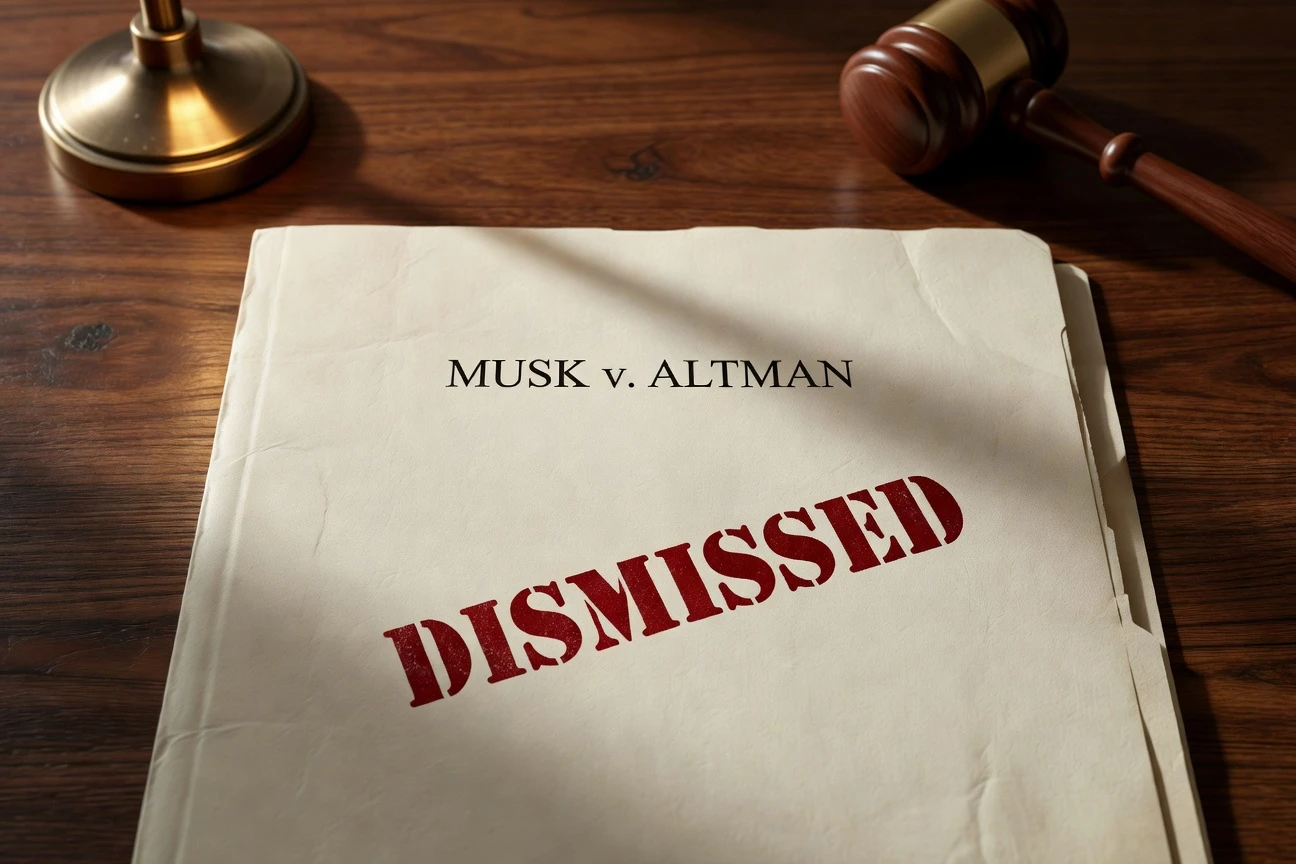
Sam Altman, the OpenAI chief executive Elon Musk spent $150 billion in legal pleadings trying to dethrone, walked free on a clock. Nine jurors in Oakland needed roughly ninety minutes on Monday to decide that Musk had sat on his charitable-trust claim for too long, and US District Judge Yvonne Gonzalez Rogers accepted the advisory verdict and dismissed the case from the bench the same afternoon.
The verdict settles nothing about whether OpenAI betrayed the nonprofit mission Musk helped draft in 2015. The jurors were never asked that. They were asked only whether he sued in time, and they said no, a procedural ruling that now clears OpenAI’s runway toward a public listing worth as much as $1 trillion.
Ninety Minutes of Deliberation, Three Weeks of Trial
The nine-person jury in Judge Gonzalez Rogers’s courtroom took less time to reach a verdict than the trial took to read the average witness’s deposition aloud. Neither Musk, Altman, nor OpenAI co-founder Greg Brockman were in the room when the foreperson handed up the slip clearing all three of them, along with the company itself and Microsoft, of every claim Musk had brought.
Musk had asked for a remedy that would have flattened the company. He wanted Altman removed from the board, Brockman removed alongside him, the for-profit recapitalization unwound, and a disgorgement of as much as $150 billion paid into the OpenAI nonprofit foundation. He walked away with none of it. The Microsoft side claim, filed four months after the original complaint, fell on the same procedural grounds.
- ~90 minutes of jury deliberation after a three-week trial
- 9 jurors, unanimous verdict, advisory to the bench
- $150 billion in compensatory and punitive damages sought
- 0 of 3 defendants found liable on any claim presented
A Three-Year Clock the Jurors Ran Backwards
The defense never had to argue the merits. It had to argue a calendar, and the calendar did the rest.
The August 2021 Cut-Off
California law gives a plaintiff three years from the moment he knew, or reasonably should have known, about an alleged breach of a charitable trust. Musk filed his complaint in February 2024. That meant his lawyers had to convince the jury that he had no usable notice of OpenAI’s pivot before August 2021. The jurors decided he plainly did, and that he had banked the information for years before walking into court. The Microsoft aiding-and-abetting count, filed in June 2024, hit a slightly later cut-off and collapsed on the same logic.
What the Jury Did Not Decide
Nothing about whether OpenAI Group PBC, the public benefit corporation (PBC) OpenAI’s for-profit arm became in October 2025, betrayed the spirit of the 2015 founding charter. Nothing about whether Altman and Brockman unjustly enriched themselves. Nothing about whether Microsoft’s roughly $13 billion of cumulative investment quietly converted a charity into a commercial joint venture. Those questions were on the docket. They never reached the jury.
An Advisory Verdict the Bench Adopted Anyway
Because the claims sounded in equity rather than damages-at-law, the jury was technically advisory and the judge had final authority. Gonzalez Rogers accepted the panel’s recommendation in open court within minutes. Before excusing the jurors she paraphrased an older judge on what a jury actually is, telling the room a verdict is “as human as the people who make it up.”
Musk’s Own 2017 Emails Sank Him
The trial’s most damaging moments for Musk were not Altman’s, Brockman’s, or Microsoft chief executive Satya Nadella’s. They were his own correspondence, read back to him slowly.
Internal messages from 2017, surfaced in discovery and projected on courtroom screens, showed Musk himself sketching a for-profit conversion for OpenAI a full year before he walked off the board. He proposed taking majority control. OpenAI’s other founders refused. He left in February 2018. The pivot he is now calling a betrayal was a structure he had floated first.
Under cross-examination, Musk logged more than 150 separate “I don’t recall” answers across two days of testimony.
This one is not over. I can sum it up in one word: appeal.
That was Marc Toberoff, Musk’s lead attorney, outside the courthouse after the verdict. He told reporters the case at its core was about preserving charities from exploitation. The judge had just ruled, in effect, that the charity question had aged out before his client filed it.
What OpenAI Walked Out With
The verdict was about as clean an outcome as the company’s counsel could have drafted. Every structural change Musk wanted to reverse stays in place. Every executive he wanted removed keeps his seat. The capital partnership with Microsoft, extended last October through 2032 on intellectual-property rights to OpenAI’s models, is undisturbed.
| Item | What Musk Sought | Post-Verdict Status |
|---|---|---|
| Damages into nonprofit foundation | Up to $150 billion | $0 |
| Sam Altman, chief executive | Removed from board | Retains board seat |
| Greg Brockman, president | Removed from board | Retains seat; $30 billion stake intact |
| OpenAI Group PBC structure | Unwound to nonprofit | Public benefit corporation intact |
| Microsoft equity | Stripped or restricted | Roughly 27% stake confirmed |
| Foundation control | Restored to original charter | Foundation holds ~26%, appoints PBC board |
Brockman’s stake was the small unexpected disclosure of the trial. Pressed under oath on May 4, he confirmed his equity in the PBC is now worth close to $30 billion, a figure that would put him near the top of the Forbes global wealth list and one his lawyers had previously not volunteered.
The IPO Two-Step Both Sides Are Now Running
Strip the personalities out and what Monday’s ruling unblocked is the most expensive public-listing calendar in technology history. Both the man who won and the man who lost are racing toward an initial public offering (IPO) in the next two quarters, and a Musk win in Oakland would have detonated only one of them.
OpenAI is targeting a Q4 2026 listing at a valuation that could touch $1 trillion, building off the $852 billion mark set in March’s $122 billion private round led by SoftBank, Amazon and Nvidia. SpaceX, which absorbed Musk’s xAI venture earlier this year, is pricing a $75 billion IPO at $1.75 trillion as soon as June 11 under the Nasdaq ticker SPCX, with BlackRock alone reportedly committing $5 billion to $10 billion to the book.
The competitive backdrop matters because a verdict for Musk would have given Judge Gonzalez Rogers grounds to break the OpenAI structure his SpaceX-xAI vehicle is now built to outpace. That motive, hobbling a rival before pricing his own deal, was the strategic read several analysts attached to the lawsuit. It failed on both ends.
- June 11, 2026: SpaceX is expected to price its $1.75 trillion offering, the largest IPO ever attempted
- Q3 2026: OpenAI’s S-1 filing window opens, contingent on no successful Ninth Circuit injunction
- Q4 2026: Target listing window for OpenAI Group PBC at up to a $1 trillion valuation
- 2032: Microsoft’s extended IP rights to OpenAI models expire, the next structural pressure point
The Question the Court Left Open
Toberoff’s appeal is real and will probably be filed within weeks, but the Ninth Circuit reviews statute-of-limitations findings on a deferential standard, and the trial record on Musk’s 2017 emails is the kind of contemporaneous evidence appellate panels rarely overturn. The likelier path to a renewed merits fight runs through the attorneys general of California and Delaware, who conditioned their approval of OpenAI’s October recapitalization on continued oversight of how the foundation balances its charitable purpose against Group PBC’s commercial trajectory.
Whether OpenAI is, in spirit, the lab Musk helped name a decade ago, is a question this verdict leaves entirely alive. The court just decided he had forfeited his right to ask it. If the appeal lands a hearing before the S-1 lands on file, the IPO calculus tightens fast. If it does not, the November window stays as quiet as Monday afternoon at the courthouse, after the panel left and the plaintiff’s chair stayed empty.
Disclaimer: This article is for informational purposes only and is not investment advice. References to OpenAI’s and SpaceX’s prospective public offerings reflect publicly reported plans that remain subject to regulatory review and market conditions. Readers considering any related securities should consult a qualified financial professional. Figures cited are accurate as of publication on May 19, 2026.