China and Georgia moved to deepen their strategic partnership this week, with Georgian parliament speaker Shalva Papuashvili meeting Zhao Leji, chairman of the National People’s Congress (NPC) Standing Committee, inside Beijing’s Great Hall of the People on Monday. Zhao publicly committed to “continuously enrich the connotation” of an arrangement Tbilisi signed with Beijing in 2023.
That handshake was the third of its kind in the South Caucasus in fourteen months. Azerbaijan signed a strategic partnership with China in April 2025, Armenia followed in August 2025, and Georgia’s existing arrangement received its highest-profile parliamentary reaffirmation yet on May 18. Beijing now holds a strategic-partnership document with every government in the region, at exactly the moment Western capitals have stopped extending invitations to Tbilisi.
Two Capitals, One Handshake
Zhao spent Monday afternoon walking the speaker through the standard Beijing menu of strategic-partnership language: a “fast lane of high-quality and all-round development,” opposition to “external forces’ interference in Georgia’s internal affairs,” and a pledge to “carry forward the traditional friendship.” The substantive lines sat in the middle. China would expand cooperation with Georgia in artificial intelligence, the digital economy, and green energy, the NPC chairman told the delegation, and would encourage more “capable Chinese enterprises” to invest and start businesses in the country.
China is willing to work with Georgia to continuously enrich the connotation of the China-Georgia strategic partnership.
Those were Zhao’s words at the Great Hall of the People on May 18, according to the official transcript of the Beijing meeting. The Georgian side answered with its own ritual. Papuashvili reaffirmed Tbilisi’s adherence to the one-China principle and said Georgia is “willing to participate in jointly building the Belt and Road Initiative,” the trillion-dollar Chinese connectivity framework Tbilisi has formally backed since the late 2010s.
Later that day, Papuashvili crossed town to meet Wang Huning, chairman of the Chinese People’s Political Consultative Conference (CPPCC, China’s top political advisory body), who repeated the line about “firmly supporting each other on issues concerning each other’s core interests.” Two of the four most senior figures in the Chinese state spent a working day on a delegation from a country of 3.7 million people. The official Georgian readout, predictably, led with the meeting’s symbolic weight.
Beijing’s Caucasus Trifecta Quietly Closes
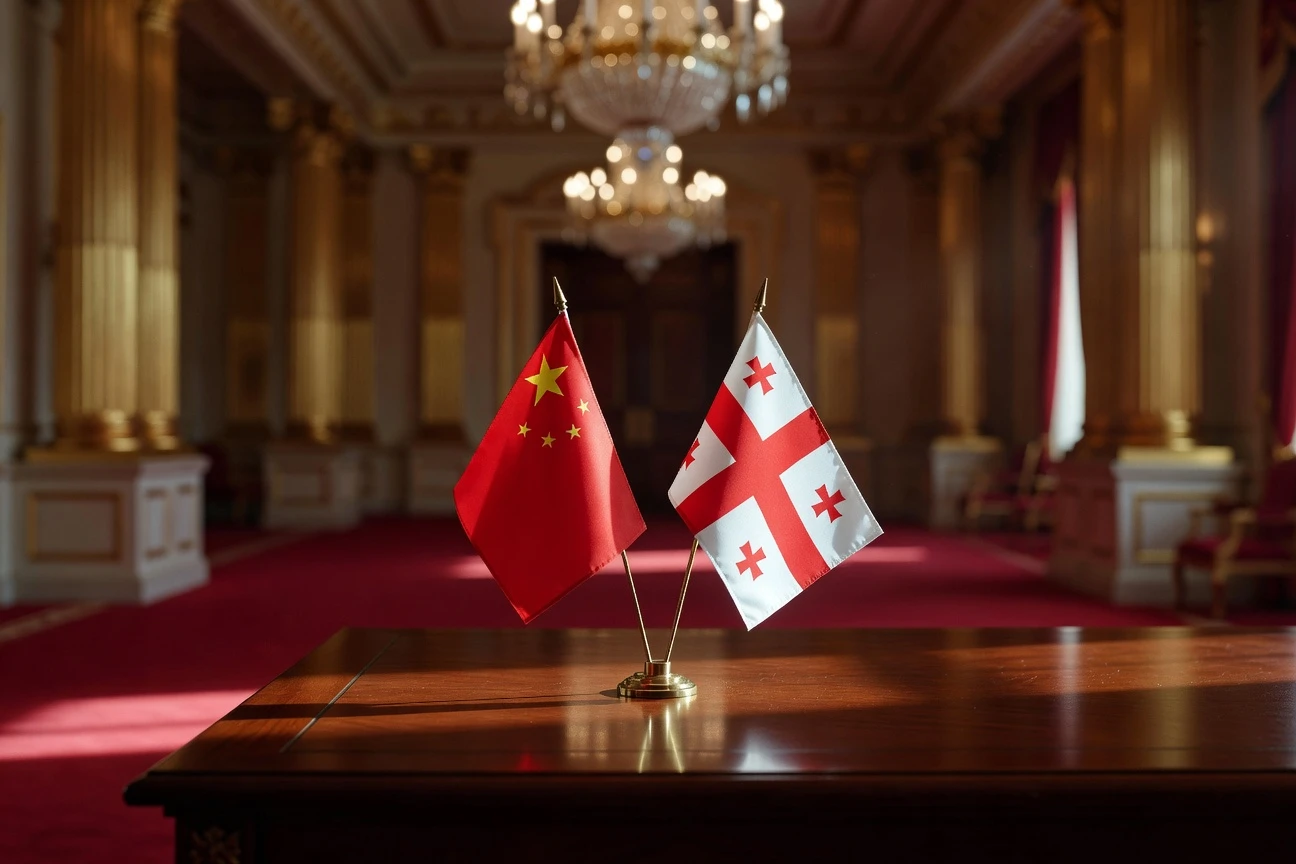
The pattern only becomes visible when you stack the calendar. China and Azerbaijan announced their strategic partnership in April 2025, formally linking the framework to the Belt and Road Initiative. Four months later, Armenia became a Chinese strategic partner at the August 2025 ceremony in Yerevan. Georgia’s own document dates to the July 2023 joint statement signed in Beijing by then-prime minister Irakli Garibashvili, but Monday’s parliamentary meeting marked the most public reaffirmation since.
That makes this week the closing seal on a third strategic partnership in fourteen months across the South Caucasus.
| Country | Strategic partnership signed | Headline infrastructure exposure | 2024 to 2025 trade with China |
|---|---|---|---|
| Azerbaijan | April 2025 | Baku-Tbilisi-Kars rail; Caspian port upgrades | USD 3.81 billion (10 months 2025, up 26%) |
| Armenia | August 2025 | North-South road corridor; tech transfer | USD 2.12 billion (2025, down 9%) |
| Georgia | July 2023, reaffirmed May 2026 | Anaklia deep-sea port; Middle Corridor terminus | USD 1.91 billion (2024, up 8%) |
The three documents are not identical, but they share a core architecture: a one-China commitment from the partner, a connectivity pillar tied to either the Middle Corridor or the Belt and Road framework, and a tech-cooperation clause covering green energy, digital economy, or AI. They also share a strategic effect. Beijing now has a paper relationship with every Caucasus capital that pre-empts any Western framework Brussels or Washington might try to layer on top.
The Brussels Door That Shut in 2024
What gives this week’s Beijing meeting its weight is the contrast with what is no longer happening in Brussels. On November 28, 2024, Georgian prime minister Irakli Kobakhidze announced that Georgia’s EU accession negotiations would be paused, with no new chapters opened and no new budget support sought, until at least the end of 2028. Street protests followed for more than 200 days. Western capitals moved fast.
- On December 27, 2024, the US Treasury designated Bidzina Ivanishvili, founder and honorary chairman of the ruling Georgian Dream party, for “undermining the democratic and Euro-Atlantic future of Georgia for the benefit of the Russian Federation.”
- In January 2025, the European Union suspended visa-free travel for holders of Georgian diplomatic and service passports.
- EU member states declared in spring 2025 that Georgia’s accession process had “effectively come to a standstill,” and the European Commission has since described the country as a “candidate in name only.”
- Germany’s ambassador in Tbilisi was publicly rebuked by Papuashvili in late February 2026 after raising concerns about democratic backsliding.
The gap between government posture and public opinion is wide. A 2025 survey by the National Democratic Institute found that 74 percent of Georgians would vote in favor of EU membership if a referendum were held tomorrow, with only 5 percent against. The protests on Rustaveli Avenue this winter and last waved European Union flags as often as Georgian ones. The Beijing trip lands into that domestic divide rather than papering over it.
Anaklia: The Six-Hundred-Million-Dollar Anchor
If the strategic partnership is the diplomatic skin, the deep-sea port project at Anaklia is the concrete underneath. Construction is what every “enriched connotation” line in Zhao’s script ultimately points at, and it is the largest single Chinese-linked project on Georgian soil.
The Consortium and Its Baggage
On May 29, 2024, Georgia’s Ministry of Economy announced that a Chinese-Singaporean consortium had won the public-private partnership tender for the Black Sea facility. The state company Anaklia Deep Sea Port retains 51 percent; the consortium takes a 49 percent stake and commits roughly USD 600 million to a first phase. China Communications Construction Company and China Harbor Investment lead the bid, with China Road and Bridge Corporation and Qingdao Port International signed on as subcontractors.
Two of those names sit on US restriction lists. China Communications Construction Company has been under US Treasury Office of Foreign Assets Control (OFAC, the agency administering sanctions programs) restrictions since 2021 over ties to the Chinese military-industrial complex. The same concession was originally awarded in 2016 to a Georgian, American, and European consortium led by US investor Conti International; Tbilisi cancelled that contract in 2020. The Western consortium sued. The Chinese one is now building.
Why a Black Sea Port Matters Now
The site sits on the eastern Black Sea coast, the western terminus of what Beijing calls the Middle Corridor, the rail-and-road route that runs from western China through Kazakhstan, across the Caspian by ferry, into Azerbaijan and Georgia, and onto European markets. The corridor’s selling point is that it does not pass through Russia. Volumes have roughly tripled since 2022, off a small base, as European importers test sanctions-resilient alternatives, according to Belt and Road Initiative investment tracking from the Green Finance and Development Center.
Beijing has set itself a goal of capturing 20 percent of EU and China maritime trade through Middle Corridor and Black Sea routes by 2035. A deep-water container facility on the Georgian coast, operated by a Chinese-led consortium, is the kind of asset that goal requires.
The Risk Both Sides Carry
For Tbilisi, the risk is sanctions exposure: any escalation of US measures against China Communications Construction Company or its parent group could freeze financing, insurance, and re-export licensing for cargo touching the port. For Beijing, the risk is delivery. The same project has already failed under a Western consortium and stalled under domestic Georgian financing. A third stall would burn political capital just as China is locking in its Caucasus posture.
What the Trade Ledger Says
Numbers help anchor the rhetoric. Bilateral trade between Georgia and China reached USD 1.91 billion in 2024, an 8 percent rise from 2023 and enough to make China Georgia’s fourth-largest trading partner, according to Georgian customs data. The composition tells a less flattering story.
Georgian exports to China totaled USD 303 million, down 2.5 percent on the year. Chinese imports into Georgia ran USD 1.61 billion, up 21 percent. Imports are now more than five times exports.
- USD 1.91 billion total bilateral trade in 2024, up 8 percent year on year.
- 5.3x import-to-export ratio in China’s favor.
- 88,583 Chinese visitors recorded in Georgia in 2024, a record, after the visa-free regime took effect.
- 96.5 percent of Chinese product lines now enter Georgia at zero tariff under the 2018 China-Georgia free-trade agreement.
The free-trade agreement that frames all of this was signed in 2017 and took effect on January 1, 2018, before the ruling Georgian Dream’s pivot was visible. Beijing is now drawing down on a tariff regime negotiated by an earlier political consensus. The strategic partnership signed in 2023, and reaffirmed this week, is the political superstructure that prevents the agreement from being renegotiated downward.
The Window Open Through Autumn
Three concrete tests sit between now and the end of the year. The first-phase groundbreaking at the Black Sea port is scheduled, on paper, before construction season closes. The European Commission’s annual enlargement report, traditionally published in October, will set the formal language on whether Georgia remains a candidate at all or only on the list as a courtesy. And US Treasury decisions on any further sanctions against Georgian Dream figures or affiliated entities will signal how much Washington is willing to spend disciplining a government Beijing is now actively underwriting.
For Tbilisi, the Beijing trip closes one option and opens another. The trifecta narrative becomes the working frame of Caucasus diplomacy for the next political cycle only if Anaklia breaks ground on schedule and the autumn EU report avoids fresh punitive language. If the port slips again and Brussels finds a way to make the candidacy formally meaningful, this week’s photo opportunities will read in retrospect as another framework document filed in a Beijing archive rather than a hinge moment.
The hinge sits roughly 90 days away, between the EU’s autumn paperwork and the first concrete pour on the Anaklia quay. Which way it falls will determine whether “continuously enrich the connotation” translates into freight on a Black Sea container terminal, or into another laminated commitment that does not move cargo.