
LIFESTYLE
Why Do People Stare?
Why do people stare? The eyes usually have a job. A street glance held past about a second, with no job you can name, is the look that feels like scrutiny.

Why do people stare? The eyes are collecting something: a talking face, busy hands, a person who looked back, or someone who stands out.
The look feels personal when you cannot see a reason for it. You can sort the one in front of you by the job the eyes are doing, how long they hold, and what the face does when you look back.
A street glance has a length, talk and tasks pull the eyes to different places, and a look that will not break has a few plain answers. Interest, a blank zone-out, and a hard face are not the same event.
What Makes a Look a Stare?
On a sidewalk you are expected to show that you see the other person, then to show that they are not a project. Erving Goffman described that courtesy as enough of a look to mark their presence, followed by a withdrawal so they are not a target of curiosity, with the look happening as you close to about 8 feet (about 2.4 m) and the eyes dropping as you pass.
Real passings put a clock on that habit. The street rows below come from a video study of 300 street passings, and the last row comes from measurements of preferred mutual gaze on filmed faces.
| Setting | Kind of look | Length |
|---|---|---|
| Passing on foot | Ordinary glance, then the eyes leave | 0.02 to 0.56 seconds, median 60 milliseconds |
| Same kind of passing, close in | Line used for an overlong look | About 1 second or longer |
| Head turned toward a stranger | Extended direct gaze in that sample | 1.02 to 3.40 seconds, median 1.94 seconds |
| Filmed face, comfort rating | Length rated most comfortable | 3.3 seconds |
Arminen and Heino, who timed those passings, treat about 1 second as the point where a street look starts to count as overlong. Distance and a turned head change how strong that feels, so the second is a guide rather than a law, and the comfort length in the last row belongs to a screen test, not to a sidewalk pass.
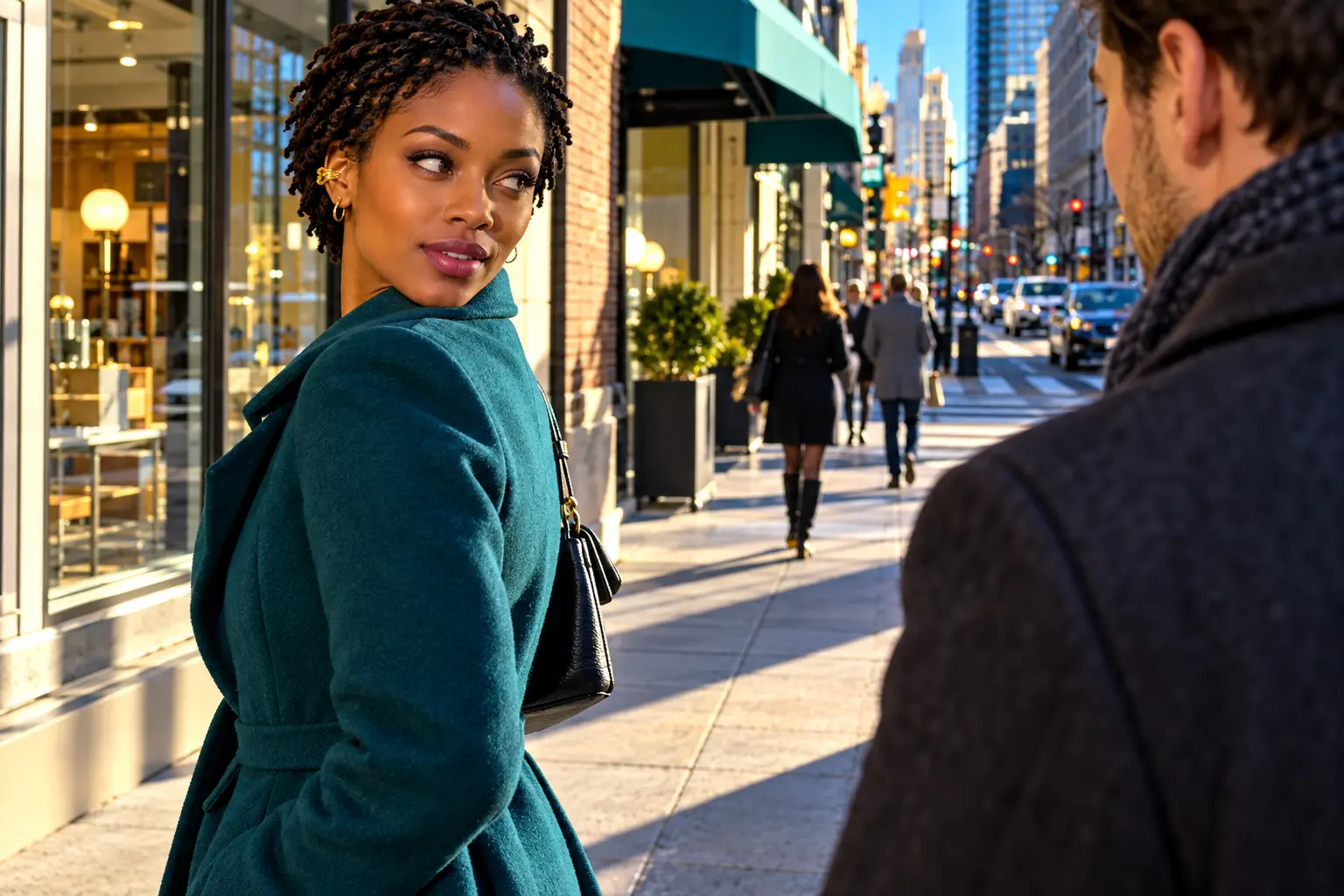
Why Does a Returned Glance Become a Stare?
A direct look is hard to ignore, and your eyes answer it before you have held a meeting about it. In the eye-tracking work on everyday scenes, viewers looked back at the face when the person on screen looked straight out at them, and that pull was stronger while the hands were busy than while the person was only talking.
That answer is why two strangers freeze. You can decide not to greet anyone, then find your eyes have landed in the same instant the other person looked up. Once you are locked, neither of you wants to be the one who breaks it, and a glance that should have died stretches into a stare.
You do not have to win that contest. Dropping your eyes to the floor, a window, or your phone ends your half of it, and the other person no longer has a look to match. The researchers who measured the pull read the look back as a nonverbal acknowledgment, a silent “I see that you see me,” not as a verdict on your worth.
What Do People Watch During Talk and Tasks?
Eyes follow the part of you that is carrying the information. In a 2019 eye-tracking study of social scenes, viewers spent more time on the face than on the hands while a person gave a monologue, and more time on the hands than on the face while that person did a manual task or a magic trick built to send attention elsewhere.
Hearing speech added a small amount of looking at the face, and that extra looking was not aimed at the mouth. If you are speaking, people watch your face to catch the words and the expression. If the sound is poor they still are not, on this evidence, locked on your lips.
Busy hands change the target. Paying at a kiosk, tying a lace, or showing how a latch works gives nearby people a reason to study your hands, because they may need the same move in a moment. Looking those people in the eye pulls them up to your face and off the task, which is the practical half of the same result.
How to Read a Stranger’s Stare
On a sidewalk you do not get an eye tracker. You get the face, the timing, and whether the look breaks when you notice it. Sort the look by what it is doing before you decide what it means about you.
WHAT THE LOOK IS DOING
- Interest: Repeated glances, a smile, or a quick look away when you catch them are the pattern a body-language specialist treats as attraction, shyness, or a wish to come over and talk.
- Admiration: An upright posture, a steady pace, and a put-together outfit draw eyes because people notice someone who looks sure of their place.
- A task: Speaking, or using your hands for a move they may need to copy, puts their eyes on the face or the hands as information, not as a comment on you.
- A mix-up: They think you are someone they know, or they are watching an event behind you, which you can test by taking a few steps to the side.
- No plan: A glazed face means they zoned out and their eyes settled on you, and they may not know it until you meet them.
- A hard edge: A tight, unsmiling face that stays on you after you have looked back reads as judgment or a challenge.
The same direct look can be friendly, blank, or hostile, and a review of what direct gaze signals puts threat, social interest, and ordinary attention on one list that only the setting can sort. A long look is also not read the same way in every culture, so the one-second street habit is a local courtesy, not a worldwide rule.
If you do not fit neatly into someone’s expectation, they will look a little longer while their brain figures it out. That pause can feel intense, but it is often just cognitive processing.
Dr. Abbie Maroño, body language expert
You still do not get their private motive from across a room. You get a pattern you can act on: smile back if you want the conversation, step aside if the eyes were aimed behind you, or end it if the face stays hard.
Why Do People Stare at Someone Who Stands Out?
Some looks are not a returned glance and not a task. They land on a person whose appearance does not match what the passerby expected to see, and the look runs long while that person gets filed as different.
In the street video, the same woman walked in ordinary clothes, in a large sun hat, and in an abaya and niqab. Breaches of the short glance were 10 times as common in the marked outfits as in the ordinary clothes. A blank face on the passerby still leaves the feeling behind the look unknown, so the extra attention can be admiration or hostility and you cannot tell which from the duration alone.
Women, children, and people whose appearance stands out from the local crowd are the usual targets of those longer looks, both the warm kind and the hostile kind. You do not owe a stranger an explanation of your clothes, your body, your hair, or your face. The pause is their sorting, not a bill you have to pay.
What to Do When a Stare Will Not Stop
Naming the look is useful, and ending it is a separate move. You are allowed to want it to stop even when the reason is harmless.
- Look once at the space behind you, then take a few steps to the side. If their eyes stay on the old spot, they were never looking at you.
- If the eyes come with you, meet them once with a calm face. A smile invites talk, and a flat look or a small frown tells them you have noticed.
- Give the look one job from the list above, and let that job pick the next move, whether that is a hello, a step aside, or nothing at all.
- For a look you want ended, use one short line, “Can I help you?”, and then turn your body away.
- If they follow you, block your way, comment on your body, or ignore the line, go toward other people or a staffed place and treat it as harassment.
A stare that moves when you move is no longer a glance that got stuck. Leave toward a busier spot, a shop, or someone you know, and contact local emergency services if you are being followed or you feel in danger. You do not have to test their intentions any further to be allowed to go.
Eye Contact That Feels Like Too Much
Everything above assumes a look you can choose to break. For some people the eyes themselves are the hard part, and the social rule makes that harder, because other people read a missing look as coldness and a held look as rudeness.
Autistic adults describe eye contact as intense, uncomfortable, or painful, and some look away so they can follow the words. Others lock the look and leave it there so they do not have to keep deciding where to put their eyes, then get told they are staring. Fear of being judged pulls eyes down as well. None of those patterns is a diagnosis you can make from across a room, and none of them is an insult by default.
A LOOK THAT STILL COUNTS
- The face: Rest your eyes on the general area of the face while you listen, which still reads as attention without a locked stare at the eyes.
- The break: Looking down at your hands for a beat while you think is a focus tool adults already use, and you can plan that break if a held look gets you called rude.
If you are on the receiving end of a fixed, calm look, wait for the rest of the face before you call it hostility. A blank hold during an order at a counter is often someone spending their attention on the words, not someone picking a fight.
Frequently Asked Questions
Is Staring at a Stranger Rude?
Staring at a stranger is rude when the look has no shared reason and keeps going after they could have looked away. A glance that shows you noticed someone, then leaves, is the polite version of the same impulse. In a talk you are both part of, holding eye contact is a normal piece of listening, not an insult. What crosses the line is the sense that you have become a spectacle.
Why Do People Stare on Public Transport?
People stare on trains and in elevators because the space is tight and there are few places to put their eyes, so a look feels longer than it would on an open street. An elevator study from 1983 put the polite version at one or two glances, with a median length of 0.35 seconds. If the look stays on you after you step off, or the person moves when you move, treat it as following, not as boredom.
Why Do Children Stare Without Looking Away?
Children stare without looking away because the adult habit of a brief glance, then a drop of the eyes, is learned rather than automatic. At three and four, children in developmental work have claimed to be hidden when they cover their own eyes, and even when they only look away while someone else looks at them. A child fixed on your hair, your uniform, or your wheelchair is gathering information. A short smile is enough, and you do not owe them a conversation.
Why Do I Stare Without Meaning To?
You stare without meaning to because faces and eyes pull attention before you have time to stop the look. You can decide not to make eye contact and still lock eyes at the same moment the other person looks up. The stare stretches when neither person wants to be the first to break it. Drop your eyes to the floor or to your phone, and you give the other person room to look away too.
Should You Stare Back at Someone?
Meet their eyes for a moment if you want them to realize they are staring, then look away. A brief meeting, with a neutral face or a small frown, tells them the look has been seen. Matching a hard stare with a harder one can turn a one-way look into a contest on the street. If you would rather not engage at all, shift your body so you are out of their line of sight.
The next time a look hangs on you, name the job before you name the motive. A talking face, busy hands, a returned glance, a marked outfit, or a gaze that got stuck will cover most of what you meet, and if the person closes the distance after you have stepped away, that is the moment you leave.
Disclaimer: This guide is general information about why people stare and how a look tends to work in everyday life. It is not medical, psychological, or safety advice, and it does not diagnose autism, anxiety, or any other condition. If a stare frightens you, follows you, or comes with threats, contact local emergency services or a qualified professional rather than relying on this page. The figures and social patterns here reflect the studies named above and can change as newer work appears.

Greed Held After a $697 Million Crypto Long Flush

Fed Minutes Keep a Year-End Rate Hike Alive

A Nanny-Cam Tape Follows Tyreek Hill Into Free Agency

Star Wars Galactic Racer Makes a Crash End the Tour

Amazon Puts Apple’s June MacBook Prices Back on Sale

Sophia Wootten Turns the Miss Georgia Crown Toward Cleft Care

Georgia Beach Bacteria List Leaves Swim Areas Open

The iPhone 16 Pro Flipkart Cut Did Not Last

IXI Autofocus Glasses Still Lack a European CE Mark

UltraTech’s Ultravolt Launch Puts Cable Multiples on Trial
-
 ENTERTAINMENT5 months ago
Sophia Wootten Turns the Miss Georgia Crown Toward Cleft Care
-
 NEWS5 months ago
Georgia Beach Bacteria List Leaves Swim Areas Open
-
 NEWS10 months ago
IXI Autofocus Glasses Still Lack a European CE Mark
-
 NEWS1 year ago
The iPhone 16 Pro Flipkart Cut Did Not Last
-
 BUSINESS2 months ago
UltraTech’s Ultravolt Launch Puts Cable Multiples on Trial
-

 NEWS4 months ago
Little St. Simons Island Hatches Loggerheads at 72.4 Percent
-
 NEWS2 months ago
Microsoft Prints Azure’s $29.42 Billion Quarter and Shrinks the Map
-

 NEWS1 year ago
Capyfriends Cafe Routes Helen Tourists to Cleveland Capybaras