
LIFESTYLE
Tying a Red String Bracelet: A Complete Step-by-Step Guide
Tying a red string bracelet is seven knots on the left wrist by someone who cares for you, while Jewish sources disagree on whether the custom is allowed.

A red string is thin wool that people knot around a wrist and leave there until the fibers fray and the loop falls off. Tying a red string bracelet, as knotting guides teach it, puts that wool on your left wrist, with the knots made by someone who cares about you.
After the knots come the tomb story, the length of time you leave the wool on, and the texts that disagree about wearing a red string at all. Those texts speak of a pagan custom, a folk habit some rabbis accept, and a blue color that is not this red.
What Is a Red String Bracelet?
People put the thread on against ayin hara, the evil eye. Jewish sources explain what the evil eye means in Judaism as a resentful look at someone else’s good fortune, separate from any piece of wool. In Yiddish the old household version is a roite bendel, a red band, tied on a coat or a baby’s crib as well as on a wrist.
Nothing in the law codes commands the bracelet, and no blessing is attached to putting it on. Classic Kabbalah books do not set out a wrist ritual for it either. Shop strings are often sold with a story that the wool was wound at Rachel’s Tomb in Bethlehem, the burial place of the matriarch Rachel, before it was cut into bracelet lengths.
Elly Teman describes the same red thread in Chinese, Greek, Romanian, and Dominican folk practice, each time against the evil eye or plain bad luck. Madonna and other public figures later wore the wrist string, and the Kabbalah Centre sold it far from the tomb, which carried an older family habit into ordinary shops.
A few biblical red threads get offered as proof, and they are about other events. A midwife tied a red thread on the wrist of Tamar’s older twin so the family would know which baby had come first. Spies told Rahab to hang a red cord in her window at Jericho so her household would be spared. Neither story is a rule for a bracelet against envy.
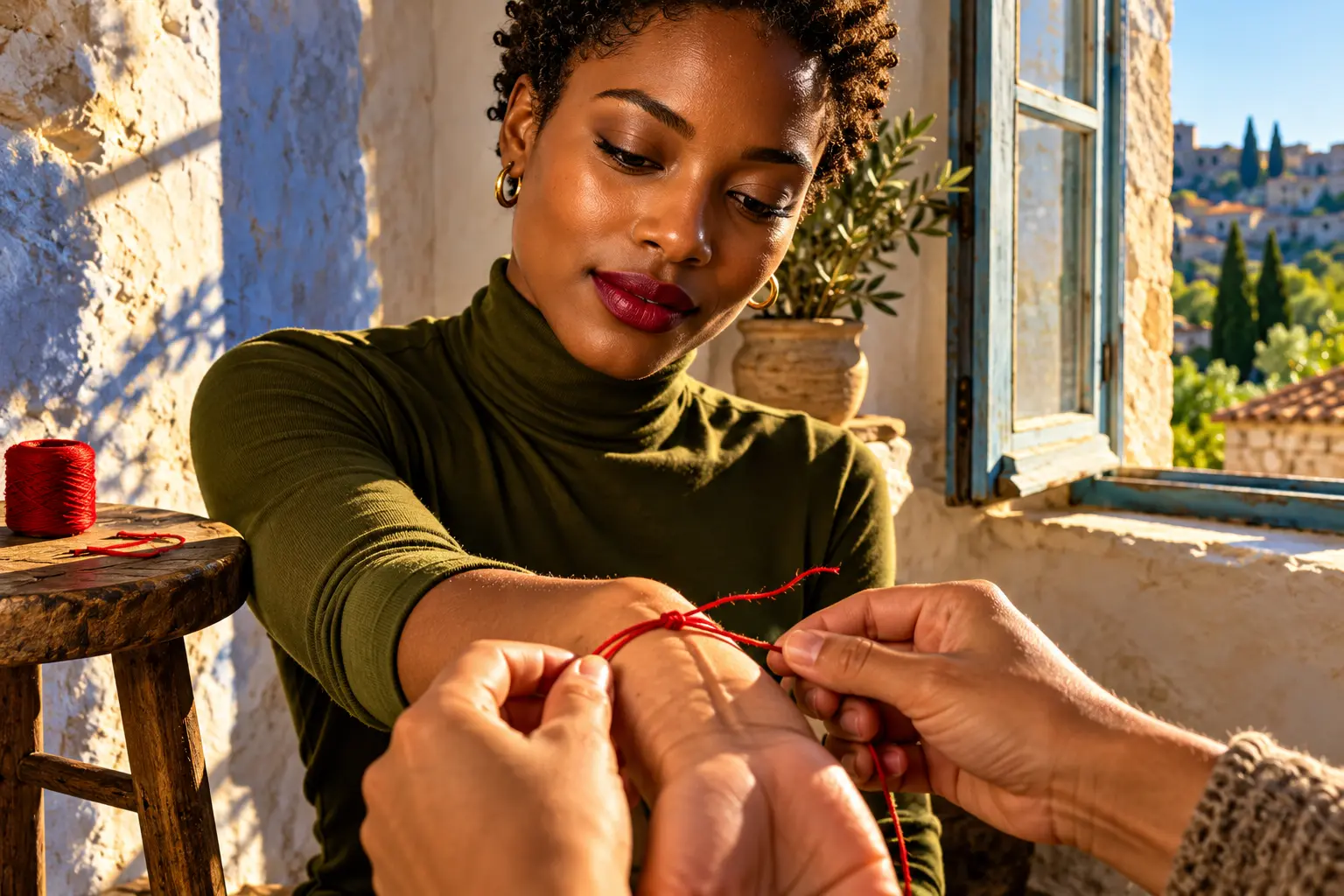
Tying a Red String Bracelet Knot by Knot
You need a length of thin red wool long enough to circle the wrist and still leave ends for the knots, plus one other person. Knotting guides want someone who loves you, or at least wishes you well, because they treat the tying as that person’s care. A quiet minute is enough. You do not need a special room, a candle, or a shop certificate.
Stack every knot in one place, at the top of the wrist, so the string closes once. Seven knots spaced around the arm will not hold a loop shut. The count and the closure are the same stack of overhand knots.
- Rest your left arm so the other person can reach the wrist, and have them wrap the wool once, loose enough that a finger still slides under the thread.
- Have them cross the two ends, pass one end through the loop, and pull an overhand knot until it sits on top of the wrist.
- Have them tie six more overhand knots on that same spot, with a short pause between each one, so the stack totals seven.
- If either of you wants words, say a short wish for safety in any language you both understand. Many guides use “Ben porat Yosef, ben porat alei ayin,” Jacob’s blessing of his son Joseph, meaning a fruitful son is Joseph, a fruitful son by a spring.
- Trim the tails short so they do not catch on a sleeve, then leave the string where it was tied.
The wool should not pinch. If the hand tingles or the skin pales, the wrap is too tight, and the person tying should undo it and start with a looser circle. Some guides also name Ana BeKoach, a Kabbalistic prayer said in seven lines, one line to a knot. Any words you actually know will serve the same role in the tying.
If nobody is with you, wrap and knot the wool on your own left wrist with the same count and the same stack. The form knotting guides call correct still uses another person’s hands, so a self-tied string is the backup when you are alone.
Which Wrist Should the Red String Go On?
Knotting guides for this custom put the string on the left wrist. The reason they repeat is that the left side receives and the right side gives, so the wool sits where they think a resentful look gets in. That is a teaching of the popular method, not a line in a law code.
Sellers sometimes mix in a different rule and tell you to use the non-dominant hand, which comes from feng shui advice rather than from the red-string custom. A string you already tied on the right wrist for that reason is on the wrong arm for the method above. Take it off and tie a new one on the left, or have someone move the same wool if it is still long enough to knot again.
Other cultures tie red thread on a wrist for their own reasons, and their side of the body is not always the left. Follow the left wrist when you are doing this custom. Follow the other tradition’s rule when you are doing that tradition instead of mixing the two in one knot.
What Do Seven Knots Have to Do With Rachel’s Tomb?
The number seven shows up twice, and the two acts are easy to blur. One is a stack of knots on your arm. The other is what people do with a long thread at the tomb before any bracelet exists. Shop copy often talks as if they were one ritual.
| Step | On the wrist | At Rachel’s Tomb |
|---|---|---|
| What happens | Seven overhand knots, stacked so the loop closes | A long red thread is wound or measured around the tomb, and some people insist on seven turns |
| Who does it | A person who cares about you | Visitors at the tomb, after which the thread is cut into short pieces |
| What you can know | You watched each knot | Wool from a shop does not show whether it was ever at the tomb |
Around 1900, Avraham Shmuel Hershberg stood in that crowded tomb and wrote, “And there are those who stand and measure strings around the tomb. These strings are used afterwards for healing the sick.” The measured string came first. The cut piece on a wrist is what people did with it later. If there is a tomb string at all, it is one that went around the tomb, and a package cannot prove that trip.
How Long Should You Leave a Red String Bracelet On?
Leave the wool on through sleep, work, and washing until it frays and falls off on its own. Knotting guides treat that fall as the end of the wearing. If you want the thread back, you tie a new one with the same wrist, the same stack, and another person’s hands when you have them.
Wet wool and soap, plus a snag on a cuff or a bag strap, are what break the fibers. You do not take it off for an ordinary day. You do take it off if it swells tight, rubs the skin raw, or you have decided you are done with it.
Extra beliefs travel with the string and are not part of the knots. A single woman may be told to wear it until it falls, with a promise that she will then meet a spouse. Some people tie red thread at the waist while trying to conceive, and some men carry a bit of red thread in a wallet. Those are separate folk uses. They do not change the seven knots on the wrist.
What Do Jewish Sources Say About a Red String?
The evil eye has a long place in Jewish teaching, including a warning in Deuteronomy about looking at a needy neighbor with a resentful eye and then refusing help. A red bracelet is a separate claim. Rabbi Yehuda Shurpin, in a Chabad.org answer, writes that a solid source for wearing a red string against the evil eye is hard to find, in Kabbalah or outside it.
Tying a Red String on the Finger
The darkei Amori, the ways of the Amorites, are pagan customs that Jewish law tells Jews not to copy. The list sits in the Tosefta chapter on Amorite ways, Shabbat chapter 7, and the line quoted from it includes tying a red string on one’s finger.
A second text, the wording where two rabbis disagree, does not give a flat ban. Rabban Gamliel says tying a string onto something red is not an Amorite way, and Rabbi Elazar son of Rabbi Tzadok says it is. The oldest lines are about a finger or a red object, and they already contain a dispute. They are not instructions for a modern bracelet.
Rabbis Who Permit a Red String and Rabbis Who Do Not
Later rabbis inherit that split, and Shurpin sets both sides down without calling the matter closed. The Be’er Moshe, the Debreczyner Rav, remembered pious people wearing red strings when he was a child and could not find a written source that explained the practice. His responsum is cited among the voices that do not treat the string as a violation.
| Side | What that side points to |
|---|---|
| Voices that allow it | One version limits the ban to a string placed on a wound. Some rabbis count only Amorite customs named in the Talmud, and this string is not named there. The old line says finger, not wrist. A further view allows a pagan custom once people have dropped it. |
| Voices that warn against it | The Darkei Teshuvah, quoting the Reishit Chochmah, lists wearing a red string as an Amorite way. Rabbi Menachem M. Schneerson, the Lubavitcher Rebbe, was asked in a private audience, hesitated, and then cautioned against the bracelets for that reason. Whether the custom has fallen out of pagan use is very questionable, because red threads are still worn in many cultures. |
Rabbi Chaim Elazar Spira of Munkacs, the Minchat Elazar, records a different red custom: carrying a red cloth or another red item against the evil eye. He links the color with gevurah, the divine attribute of strict judgment, so that red meets red. He does not mention a string, and he does not mention a bracelet. A cloth in a pocket is the custom he wrote down.
Techelet Blue and the Evil Eye
The color with a mystical text behind it is the blue thread called techelet. The Zohar says that if someone looks at you with an evil eye, you look at something the color of techelet and that look has no power over you. A Talmudic teaching connects that blue with the sea, the sky, and the divine throne.
The act the Zohar names is looking, not knotting a bracelet. On a garment, techelet belongs in tzitzit, the ritual fringes, which is its own commandment and not a substitute wrist band. If you want a color those texts actually name, it is this blue, and the use they name is your eye on the color.
Common Mistakes When Tying a Red String
- Right wrist: This custom, as knotting guides teach it, uses the left wrist, not the hand you write with.
- A pinch: A wrap that leaves no room for a finger is too tight, and the stack should be undone before you keep it on.
- Spaced knots: Seven knots dotted around the wrist do not close a loop. Stack them at one fastening point.
- Shop wool as tomb wool: Unless you saw the thread go around Rachel’s Tomb, the package has not shown you that it did.
- A law-code count: Seven is the popular knot count, and it is what some people insist on at the tomb. It is not a number from a code of Jewish law.
If your question is Jewish law for your own life, ask a rabbi who knows you before you tie one, because the texts above do not all say the same thing. If you want a reminder on the wrist and nothing more, the steps still tell you how to knot wool, with no claim beyond the habit you attach to it.
Frequently Asked Questions
Do You Have to Be Jewish to Wear a Red String Bracelet?
Anyone can wear one. Knotting guides teach the wrist custom to people of any background, and many who are not Jewish wear the thread as protection or as a sign of care from the person who tied it. The ban on Amorite ways is a matter of Jewish law, so it speaks to Jews who keep that law, not to every person who likes the thread.
Can You Shower With a Red String Bracelet On?
Leave it on in the shower if you are following the custom of wearing it until it falls off. Sleep, handwashing, and ordinary work stay in the picture too. Wet wool and soap weaken the fibers, which is how a string that is left alone eventually breaks. Take it off if it tightens, rubs the skin raw, or you no longer want it.
What Should You Say If You Do Not Know Ben Porat Yosef?
Say any short wish for safety that you and the person tying both understand. Guides that use Ben Porat Yosef are quoting Jacob’s blessing of his son Joseph, “a fruitful son is Joseph, a fruitful son by a spring.” The Hebrew is traditional in those guides, and the knots do not depend on it.
What Do You Do With the String After It Falls Off?
Tie a new string the same way if you still want one on the wrist. The fallen piece is worn wool. Some people bury it or drop it in running water, which is a folk habit of disposal, not a step you must add. A trash bin is a complete ending for the old thread.
Should You Still Guard Your Words While Wearing a Red String?
Yes. People who take the evil eye seriously still watch how they talk about good news, because flaunting a blessing is part of what the idea warns against. A traditional aside after praise is “bli ayin hara,” meaning without the evil eye. Rabbi Yehuda Shurpin points to a plainer protection in letters of the Lubavitcher Rebbe: be wholehearted with God, study Torah, and add mitzvot, which those letters call the true and tried remedy.
Wool on the left wrist, tied by someone else into one stack of knots, is the whole craft those guides can teach with your hands. What you trust past that craft is your reading of the Tosefta and of the rabbis who caution against the thread.

Greed Held After a $697 Million Crypto Long Flush

Fed Minutes Keep a Year-End Rate Hike Alive

A Nanny-Cam Tape Follows Tyreek Hill Into Free Agency

Star Wars Galactic Racer Makes a Crash End the Tour

Amazon Puts Apple’s June MacBook Prices Back on Sale

Sophia Wootten Turns the Miss Georgia Crown Toward Cleft Care

The iPhone 16 Pro Flipkart Cut Did Not Last

Georgia Beach Bacteria List Leaves Swim Areas Open

IXI Autofocus Glasses Still Lack a European CE Mark

Microsoft Prints Azure’s $29.42 Billion Quarter and Shrinks the Map
-
 ENTERTAINMENT4 months ago
Sophia Wootten Turns the Miss Georgia Crown Toward Cleft Care
-
 NEWS1 year ago
The iPhone 16 Pro Flipkart Cut Did Not Last
-
 NEWS5 months ago
Georgia Beach Bacteria List Leaves Swim Areas Open
-
 NEWS10 months ago
IXI Autofocus Glasses Still Lack a European CE Mark
-
 NEWS2 months ago
Microsoft Prints Azure’s $29.42 Billion Quarter and Shrinks the Map
-

 NEWS4 months ago
Little St. Simons Island Hatches Loggerheads at 72.4 Percent
-

 BUSINESS2 months ago
UltraTech’s Ultravolt Launch Puts Cable Multiples on Trial
-

 SCIENCE3 years ago
What Is a Corpak Feeding Tube?