Parker Solar Probe Sets New Record as It Gets Closer Than Ever Before
On December 25, 2024, NASA’s Parker Solar Probe reached an unprecedented milestone in space exploration, as it made its closest approach to the Sun. The spacecraft, which launched in 2018, is now within 3.8 million miles (6.1 million kilometers) of the Sun’s surface—more than seven times closer than any previous spacecraft has ever come. This historic event marks a significant achievement in the ongoing mission to understand the Sun’s behavior and its impact on the solar system.
The Parker Solar Probe’s proximity to the Sun allows it to gather critical data that will enhance human understanding of the solar wind’s origins and evolution. It also aims to better predict space weather, which can have significant effects on life and technology here on Earth. By studying the Sun from such a close distance, scientists hope to unlock answers to long-standing questions about the dynamics of our star.
Progressing Closer with Every Flyby
Since its launch, the Parker Solar Probe has made steady progress in its approach to the Sun, completing 21 solar flybys to gradually inch closer to the star at the center of our solar system. Each pass has brought the spacecraft within closer proximity, allowing scientists to collect increasingly detailed measurements and images of the Sun’s outer atmosphere, known as the corona.
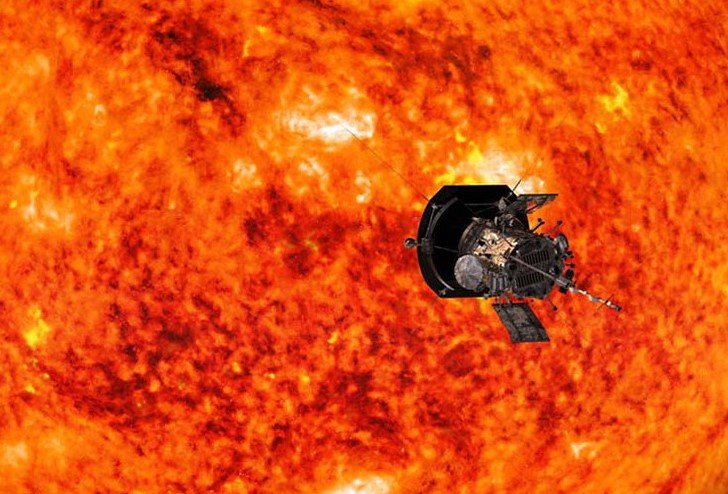
This latest flyby marks the closest that any human-made object has ever been to the Sun, breaking the previous record set by the 1970s-era Helios spacecraft. This record-breaking distance is not only a triumph for NASA but also a testament to the Parker Solar Probe’s advanced technology, which is designed to withstand the extreme heat and radiation of space.
The Mission’s Groundbreaking Goals
The Parker Solar Probe’s mission is driven by two primary objectives: to deepen our understanding of solar wind and to improve space weather forecasting. Solar wind, the stream of charged particles emitted by the Sun, influences everything from satellite communications to power grids here on Earth. Understanding its origin and evolution is crucial for predicting solar storms that can disrupt global technology.
The spacecraft’s instruments are gathering invaluable data about the Sun’s magnetic fields, solar wind, and the high-energy particles that constantly stream from it. This data will be vital for scientists working to develop more accurate models of space weather, which could lead to better preparation for solar events that can damage communications systems, GPS, and even power infrastructure on Earth.
The Parker Solar Probe’s Impact on Solar Science
What makes the Parker Solar Probe’s mission so extraordinary is its proximity to the Sun. The spacecraft is equipped with a suite of scientific instruments designed to gather information on the Sun’s composition, solar winds, and its magnetic field. For decades, scientists have struggled to directly observe the Sun’s corona, which is much hotter than its surface. By getting so close, the Parker Solar Probe can now study the source of the Sun’s energy and how it generates the solar winds that affect space weather on Earth.
As the spacecraft continues its orbit, it will send back new insights that could reshape our understanding of the Sun. These discoveries are expected to have wide-ranging implications for fields such as space weather forecasting, astrophysics, and planetary science.
Implications for Life on Earth
While the scientific community celebrates the Parker Solar Probe’s achievements, the mission also has practical implications for life on Earth. The Sun’s activity affects not only space technology but also Earth’s environment. The spacecraft’s data will help scientists predict solar storms, which can cause geomagnetic disturbances and affect technologies such as satellite communications, GPS, and even electrical power grids.
The mission’s contributions are timely and significant, especially as technology becomes increasingly dependent on space-based systems. Better predictions of solar events could help mitigate the potential damage caused by these disruptions, ultimately safeguarding technology and infrastructure that society relies on daily.