
NEWS
Georgia Tick Bite ER Visits Hit a Nine-Year High
Georgia tick-bite ER visits hit a nine-year high, then an August record, as a Lyme shot sits in review and lone star ticks drive a different disease mix.

Tick-bite visits to U.S. emergency rooms hit their highest April rate since 2017, and Georgia later posted a record August on the same tracker. Adult blacklegged ticks are active again in October and November.
The spring numbers were a warning light, not the whole season. A Lyme vaccine is in regulatory review, and it would not cover the lone star illnesses that already shape Georgia’s risk.
The Tracker Caught a Nine-Year Spike
CDC’s Tick Bite Tracker, built from National Syndromic Surveillance Program emergency-department data, found weekly tick-bite visits highest for this time of year since 2017 in every U.S. region except the South Central states. In mid-April 2026, 71 of every 100,000 ER visits were for tick bites, more than double a typical weekly reading of about 30.
Later monthly totals moved higher. The April 2026 rate settled at 105 visits per 100,000, above 101 in April 2017 and 68 in April 2025. Those are monthly figures, not the mid-April weekly snapshot. CDC issued a public warning on April 23, 2026, ahead of Lyme Disease Awareness Month.
Tick season is here and these tiny biters can make you seriously sick. The good news is you have options to help prevent tick bites when you spend time outdoors: You can wear EPA-registered insect repellent and permethrin-treated clothing, do tick checks, and remove attached ticks as quickly as possible.
Alison Hinckley, PhD, epidemiologist, CDC Division of Vector-Borne Diseases
On that same statement, CDC said an estimated 31 million people are bitten by a tick in the United States each year, and about 476,000 patients are diagnosed and treated for Lyme disease. The tracker counts ER visits for bites, not confirmed infections, so it is an early-season proxy rather than a case tally.
TICK-BITE ER VISITS PER 100,000 VISITS
| Place and period | Rate | Benchmark |
|---|---|---|
| U.S. weekly, mid-April 2026 | 71 | About 30 in a typical week then |
| U.S. April 2026, monthly | 105 | 101 in April 2017; 68 in April 2025 |
| Georgia, June 2026 | 70 | Third-highest June since 2017 |
| Georgia, August 2026 | 30 | State August record on the tracker |
Goudarz Molaei, who directs tick surveillance at the Connecticut Agricultural Experiment Station, said his lab received 1,131 human-biting tick submissions in April 2026, up from 821 in April 2025. That local load matches the national ER curve even though most bitten people never go to an emergency room.
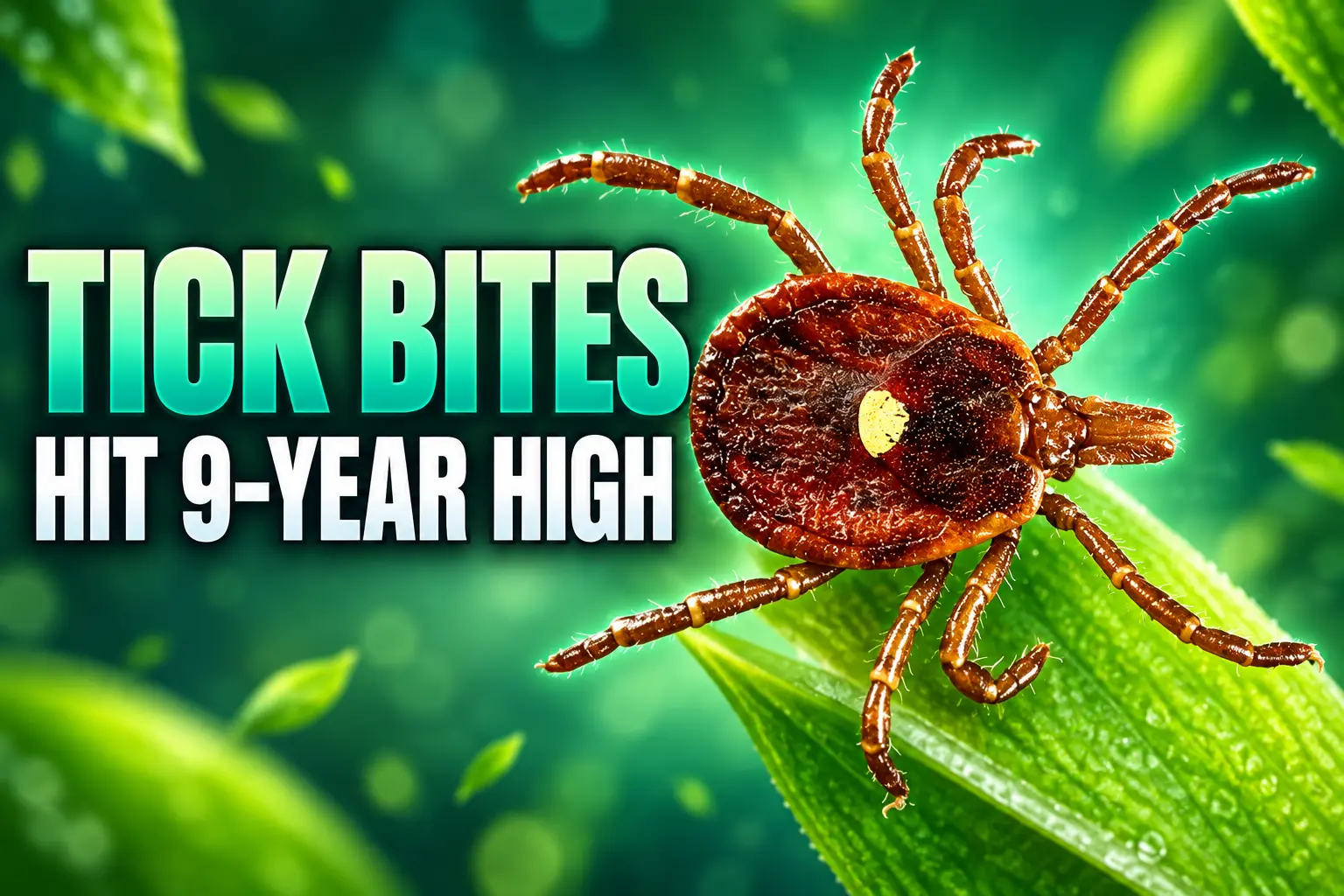
Georgia’s June Peak and an August Record
Georgia’s own tracker line did not stop with the national April surge. The state hit 70 tick-bite ER visits per 100,000 in June 2026, the third-highest June since CDC began the dashboard in 2017. It then broke its August record at 30 per 100,000, a high for a month that is usually past the first nymph peak.
University of Georgia entomologists list three tick species most commonly associated with humans in the state: the lone star tick, the American dog tick, and the blacklegged tick. UGA counts 23 tick species in Georgia. Lyme disease was first recognized here in 1987, with more cases in the northern half of the state, and the blacklegged nymph is small enough that many people never see it feeding.
Rosmarie Kelly, a public health entomologist with the Georgia Department of Public Health, has not called the Southeast a year-round tick zone. Reports rose early, went quiet in dry weather, then returned with rain. “It appears to be changing more according to local weather conditions,” Kelly said. State health staff still treat mid-April through mid-July as the core season, with a second adult blacklegged wave in October and November.
Kelly also said alpha-gal syndrome, the red-meat allergy tied to lone star bites, is not yet a reportable condition in Georgia. Epidemiologists have been training physicians and drafting the paperwork to add it. The Asian longhorned tick is already listed as established in Georgia on the department’s 2025 tick summary.
The Lyme Vaccine Would Not Cover Georgia’s Main Tick
Pfizer and Valneva reported Phase 3 results on March 23, 2026, for PF-07307405, also called LB6V and formerly VLA15. The six-protein shot showed more than 70% efficacy in preventing Lyme in people aged 5 years and older after a four-dose series. Efficacy was 73.2% from 28 days after the fourth dose (95% CI 15.8 to 93.5) and 74.8% from one day after that dose (95% CI 21.7 to 93.9).
Fewer Lyme cases occurred than the trial plan assumed, so the first pre-set statistical bar (a 95% confidence-interval lower bound above 20) was not met. The second analysis did clear that bar, and Pfizer said it would file with regulators. Doses were given at months 0, 2, and 5 to 9, with a fourth dose a year later, just before the next Lyme season. Antibodies against outer-surface protein A are meant to stop Borrelia inside the feeding tick, before the bacteria reach the person.
Annaliesa Anderson, Pfizer’s chief vaccines officer, said there is currently no vaccine available and called the VALOR result highly encouraging. Thomas Lingelbach, Valneva’s chief executive, said the companies want the shot delivered as quickly as possible. On August 14, 2026, Valneva said European regulators had validated the marketing authorization application and opened a formal review. No licensed human Lyme vaccine is on the U.S. market while that process runs.
That filing calendar sat beside the ER spike, and some public argument treated the timing as proof the shot is being rushed. The trial’s missed first statistical test is a real limit on how strong the claim can be. The larger gap for Georgia is biological. A Lyme vaccine targets Borrelia in blacklegged ticks. It does not block ehrlichiosis, tularemia, Heartland virus, Bourbon virus, or alpha-gal syndrome, the cluster Dr. Steven Goldberg, a family-medicine physician at UofL Health in Louisville, Kentucky, tied to the lone star tick in the Southeast and South Central states.
Dr. Suraj Saggar, chief of infectious disease at Holy Name Medical Center in Teaneck, New Jersey, called alpha-gal a growing concern and said rare deaths have followed anaphylaxis after a bite. Goldberg warned that clinicians farther north may not yet look for those illnesses as the lone star’s range moves. Coating a tick in petroleum jelly, nail polish, or a match, a habit that still circulates in home advice, can make the tick empty its gut into the bite. Fine-tipped tweezers and a straight pull remain the method CDC describes.
Ohio’s Case Count Shows How Fast the Map Moves
Goldberg called the Ohio River Valley one of the sharpest examples of range change, with Lyme cases in Ohio up roughly 10-fold over the past decade as Northeastern and Upper Midwestern tick populations meet. Dr. Bruce Vanderhoff, director of the Ohio Department of Health, put the state’s reported Lyme count at 40 in 2010, 415 in 2020, and 2,819 in 2025. The 10-fold figure matches 2010 to 2020. The 2025 total is a separate, larger jump.
A CDC MMWR report dated August 13, 2026, documented the same southward push in western North Carolina. Community collections in Biltmore Forest from November 2024 through August 2025 took 373 ticks; 287 of them (76.9%) were blacklegged ticks, and 19 of 48 adults (39.6%) carried Borrelia burgdorferi sensu stricto. CDC said Lyme is emerging in southern Appalachia and is not yet treated as endemic there. That corridor sits on Georgia’s northern doorstep.
FROM THE 2017 BASELINE TO THE FALL PEAK
- 2017: CDC opens the Tick Bite Tracker; April that year later stands at 101 visits per 100,000.
- March 23, 2026: Pfizer and Valneva report VALOR efficacy above 70% and say they will file.
- April 23, 2026: CDC warns that weekly ER tick-bite rates are the highest for the date since 2017, except in the South Central region.
- June 2026: Georgia reaches 70 tick-bite ER visits per 100,000, its third-highest June on the tracker.
- August 14, 2026: European regulators accept the Lyme vaccine filing for review.
- August 2026: Georgia records 30 tick-bite ER visits per 100,000, an August high for the state.
- October and November: Adult blacklegged ticks enter their second activity peak.
Saggar said warmer, wetter weather lets ticks live in places that used to be too cold, and milder winters keep both ticks and their animal hosts alive longer. Goldberg added land clearing into woods, reforestation of old farmland, and the rebound of white-tailed deer, which feed adult blacklegged ticks. White-footed mice remain a main reservoir for the Lyme bacterium. Those are the same forces Vanderhoff listed for Ohio, including shorter stretches of extreme winter cold and people moving into recovered forest.
Kids and Older Adults Fill the Waiting Rooms
CDC’s 2026 tracker again showed the highest tick-bite ER rates among children younger than 10 and among adults aged 70 to 79. An earlier CDC study of 2017 through 2019 ER data found the same two peaks, with the 0 to 9 group at the top of the age curve. Parents of young children and older adults walking wooded edges are the groups the dashboard keeps flagging.
Saggar said Lyme cases have increased roughly two- to threefold over 20 years. He listed anaplasmosis, ehrlichiosis, and babesiosis beside Lyme, and Goldberg called Powassan virus the emerging infection that worries him most because it can move within minutes of attachment, unlike Lyme, which often needs about 36 hours. Goldberg put Powassan’s fatality rate at about 10% to 15%, with lasting neurologic injury in more than half of survivors.
Common symptoms Saggar named are fever, chills, fatigue, headache, muscle aches, and joint pain, plus the expanding “bull’s-eye” rash of erythema migrans. Early lab tests can read negative, so doctors may treat on symptoms and exposure. Anyone who develops a rash or fever in the days or weeks after a bite, or after time in tick habitat, is told to seek care rather than wait for a perfect test.
What Still Stops a Tick Bite in the Yard
Until a licensed Lyme shot exists, and even after one arrives for people at Lyme risk, Georgia’s mix still turns on clothing, repellent, and speed of removal. CDC says taking an attached tick off within 24 hours can help prevent Lyme. Goldberg’s list matches that guidance and is the part of the season a household can still control.
STEPS THAT CUT BITE RISK
- Skin repellent: Use an EPA-registered product with DEET, picaridin, IR3535, or oil of lemon eucalyptus on exposed skin.
- Treated cloth: Wear permethrin-treated clothing and gear, or buy pre-treated pieces, with long pants tucked into socks in brush.
- Body check: Look over the scalp, ears, armpits, groin, and behind the knees after time outside, and shower within two hours of coming in.
- Dryer heat: Tumble-dry clothes on high heat for at least 10 minutes to kill ticks still on fabric.
- Straight pull: Grasp the tick with fine-tipped tweezers close to the skin and pull upward with steady pressure, then clean the bite.
Clearing brush and tall grass at the lawn-woods edge cuts the shade and humidity ticks use to quest. Pets need their own checks, because they walk the same edge and bring ticks indoors. Kelly’s point on local weather still applies in a dry stretch or after a soaking rain: activity can jump or stall inside a single county without a clean statewide shift.
Fall Adult Ticks Are Already Questing
Blacklegged adults search for hosts in October and November, including on days when winter air is still above freezing. Georgia’s August record showed the season did not end when school started. The national April rate of 105 per 100,000 already beat 2017. The state’s June reading of 70 showed the first peak was not a one-month blip.
A Lyme vaccine that posted 73.2% efficacy is in front of regulators and is not in clinics. It would not change a lone star bite. The work that still cuts risk in a Georgia yard is the same list CDC repeated in April: repellent, treated clothing, a full-body check, and a tick pulled off the skin before it finishes a long feed.
Disclaimer: This article is news reporting on CDC tracker data, state health comments, and company trial results, and it is for information only. It is not medical advice, a diagnosis, or a treatment plan for a tick bite, Lyme disease, alpha-gal syndrome, or any other illness. Readers who have a bite, a rash, fever, or an allergic reaction should contact a licensed physician or seek emergency care, and they should not start or stop medicines based on this story. Figures and regulatory status come from the cited public sources as of the dates those sources give and can change as trackers update and reviews proceed.

Ukraine Hits the Fuel Hub That Feeds Moscow’s Airports

Gold Lost 3% After the Jobs Print It Usually Wants

XRP’s $31.87 Target Is a $2 Trillion Market Bet

Mortgage Rates at 7.28% Push Buyers Into Adjustable Loans

Six Ex-Bills Return as Patriots Open New Highmark

Microsoft Prints Azure’s $29.42 Billion Quarter and Shrinks the Map

UltraTech’s Ultravolt Launch Puts Cable Multiples on Trial

IXI Autofocus Glasses Still Lack a European CE Mark

The iPhone 16 Pro Flipkart Cut Did Not Last

Little St. Simons Island Hatches Loggerheads at 72.4 Percent
-
 NEWS1 month ago
Microsoft Prints Azure’s $29.42 Billion Quarter and Shrinks the Map
-
 BUSINESS1 month ago
UltraTech’s Ultravolt Launch Puts Cable Multiples on Trial
-
 NEWS9 months ago
IXI Autofocus Glasses Still Lack a European CE Mark
-
 NEWS1 year ago
The iPhone 16 Pro Flipkart Cut Did Not Last
-
 NEWS3 months ago
Little St. Simons Island Hatches Loggerheads at 72.4 Percent
-

 BUSINESS3 months ago
Georgia Furniture Mart Closes a Growing 40-Year Business
-

 NEWS4 months ago
Georgia Beach Bacteria List Leaves Swim Areas Open
-

 NEWS3 years ago
Eyal Waldman Keeps a Two-State Bet After Gaza