Tensions rise in Georgia as the country’s outgoing pro-Western president Salome Zourabichvili refuses to recognize her far-right successor, Mikheil Kavelashvili, as the legitimate president, despite his controversial inauguration.
Tbilisi, Georgia – In an escalating political standoff, Salome Zourabichvili, the pro-European Union president of Georgia, has firmly declared she remains the country’s only legitimate leader, even as Mikheil Kavelashvili, a far-right politician with ties to the ruling Georgian Dream (GD) party, took the presidential oath in a disputed ceremony. The tense moment comes after Kavelashvili’s inauguration sparked waves of protests across the capital, Tbilisi.
Zourabichvili, known for her pro-Western stance, addressed a crowd of thousands of protesters outside the parliament building, asserting her position as the rightful president, while refusing to hand over the keys to the presidential palace. The protesters, largely opposed to the GD party’s increasing pro-Moscow leanings, rallied in defense of Georgia’s European aspirations, demanding a rerun of the controversial October general election that saw Kavelashvili’s victory.
Georgia’s Political Crisis Deepens
The inauguration of Mikheil Kavelashvili marked a historical first for Georgia: the ceremony was held behind closed doors inside the plenary chamber of the Georgian parliament. The event, typically a public affair, was instead an attempt to avoid the growing protests against his leadership. The GD party, which has long been accused of authoritarian tendencies, has backed Kavelashvili as the legitimate winner of the disputed election.
However, many Georgians, including Zourabichvili and the protesters, view the election as tainted by Russia’s influence and interference, further fueling the deep divide between pro-Western factions and pro-Moscow supporters. Since the election in October, the country has been engulfed in a political crisis, with massive pro-European Union protests taking place regularly, calling for a reevaluation of the election results and a rerun of the vote.
In her address to the protesters, Zourabichvili passionately stated, “I remain the only legitimate president. I will leave the presidential palace and stand with you, carrying with me the legitimacy, the flag, and your trust.” Her defiance resonated deeply with the crowd, who see her as a symbol of Georgia’s European ambitions.
Mikheil Kavelashvili’s Rise to Power
Kavelashvili’s political ascent has been controversial, not just due to the disputed election, but also because of his far-right views. A former football player turned politician, Kavelashvili has been a vocal critic of Western policies, including Georgia’s association with NATO and the EU. During his inaugural speech, Kavelashvili emphasized traditional Georgian values, including the sanctity of family and national identity, while condemning the West for attempting to drag Georgia into conflicts such as the war in Ukraine.
His remarks, often dismissive of LGBTQ+ rights and other progressive causes, have alienated many Georgians who support a European, democratic future for the country. His inauguration, backed by the GD party, marks a significant shift towards Russia-aligned policies, and for many, this is a bitter blow to Georgia’s European aspirations.
Kavelashvili’s supporters argue that his leadership will restore stability to Georgia, presenting him as a safeguard against the West’s influence. However, his critics, including Zourabichvili and the protesters, believe that his rise to power is illegitimate and that Georgia’s future lies in deeper integration with the EU and NATO.
Protests Escalate Amid Tensions
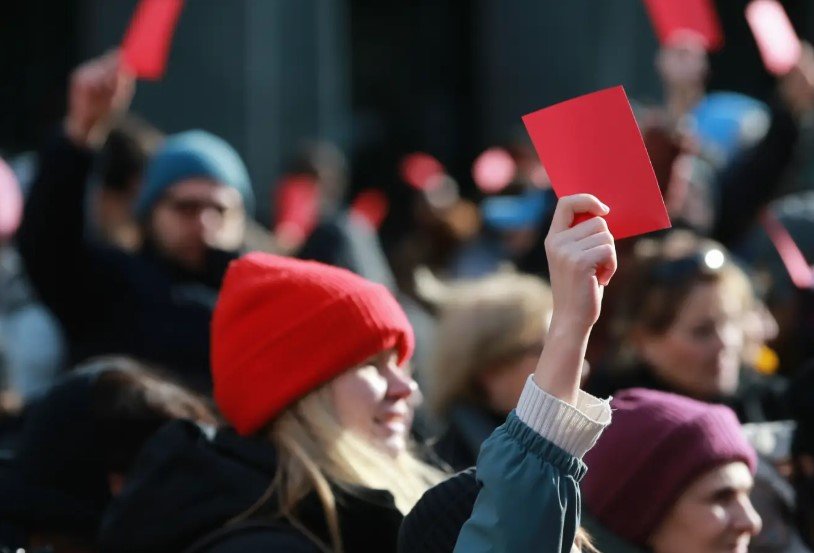
As Zourabichvili made her symbolic exit from the presidential palace, she donned the same white-and-black attire she wore during her inauguration six years ago, symbolizing her commitment to Georgia’s European identity. Protesters, waving the Georgian flag and holding red cards as a reference to Kavelashvili’s football career, marched toward the parliament building, demanding a rerun of the election.
The protests, which have been a regular feature of Georgian politics in recent months, have drawn thousands to the streets. The protesters believe that a new election is the only way to restore legitimacy to the government and ensure that Georgia’s pro-Western aspirations are not derailed by Moscow’s influence.
Some protesters, like Giorgi Mamatelashvili, have expressed frustration with the political standoff. “I expected Zourabichvili to stay in the palace,” he said. “But I understand it would have led to a too dramatic standoff. This is the only way forward.”
Though the protests have largely been peaceful, the growing tension in Tbilisi reflects a deeper national divide. As both sides hold firm in their positions, it remains unclear how Georgia will navigate its political future.
The Way Forward: Political Impasse or Opportunity?
As Georgia moves forward, the question of how the political impasse will be resolved looms large. With Zourabichvili continuing to claim legitimacy and thousands of Georgians protesting in support of her vision for a European future, the GD party’s insistence on Kavelashvili’s presidency has only deepened the country’s political divide.
While Zourabichvili has called for a rerun of the election, it remains uncertain whether the GD party, backed by its pro-Moscow allies, will allow such a step. For now, the protests continue, and the political crisis in Georgia shows no sign of abating.