Thousands gathered in Tbilisi, Georgia’s capital, as political tensions flared over the inauguration of Mikheil Kavelashvili as the country’s new president. While the ruling Georgian Dream party celebrated the occasion, outgoing president Salome Zourabichvili refused to concede, calling her successor illegitimate.
Crowds Rally Behind Zourabichvili’s Defiance
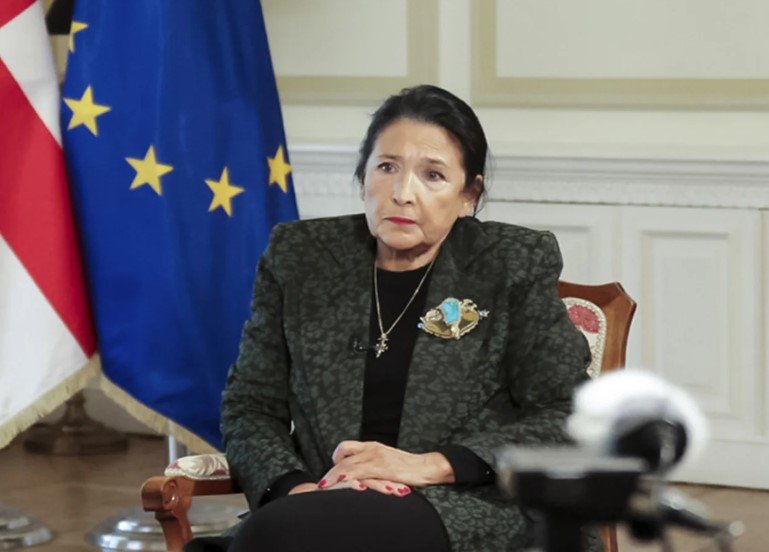
Outside the Orbeliani Palace, where Zourabichvili addressed her supporters, the atmosphere was charged. Her refusal to step down as president drew applause from those who see her as a bulwark against what they perceive as an increasingly authoritarian government.
“This building was a symbol only as long as a legitimate president was sitting here,” Zourabichvili declared. Protesters cheered her defiant words, holding Georgian and EU flags. Her speech underscored a growing divide between pro-European citizens and the Georgian Dream-led government, which has delayed EU membership aspirations.
Despite stepping away from the palace, Zourabichvili vowed to continue fighting for what she called the “true will” of the Georgian people.
A Controversial Inauguration
Just a short distance away, Kavelashvili was sworn in during a closed-door ceremony at the parliament building. Flanked by family members and Prime Minister Irakli Kobakhidze, Kavelashvili emphasized traditional values in his address.
“Our history shows that peace has always been a cornerstone for Georgians, even amid countless struggles to preserve our homeland and identity,” he said.
The ceremony was notable for its muted tone and lack of opposition participation. Kavelashvili, a former MP for the Georgian Dream party and the sole candidate for the presidency, took his oath on the Bible and the Georgian Constitution. However, the absence of dissenting voices highlighted the fraught nature of his election.
Opposition Groups Reject New Leadership
Georgia’s political opposition has been vocal in denouncing Kavelashvili’s presidency. Four major opposition groups boycotted the parliamentary session and dismissed the election process as illegitimate.
Zourabichvili, who has long championed pro-Western policies, echoed these sentiments. Her denunciation of Kavelashvili as a “travesty” of democratic values struck a chord with her supporters.
Meanwhile, Georgian Dream’s growing alignment with policies reminiscent of Russia’s authoritarian model, including media restrictions and laws targeting NGOs, has alarmed critics at home and abroad.
EU Membership Delayed, Public Frustration Mounts
The government’s recent announcement to delay EU accession talks until 2028 has fueled public discontent. This decision comes despite overwhelming public support for closer ties with the EU, a commitment enshrined in the country’s constitution.
Protests erupted in November following the suspension of the EU application process. Riot police used tear gas and water cannons to disperse crowds, while demonstrators responded with fireworks and stones.
On Saturday, a massive human chain stretched across Tbilisi as thousands of Georgians expressed their solidarity with the EU. The display of unity reflected a deep-seated desire for a European future, contrasting sharply with the government’s current trajectory.
The Road Ahead
As Kavelashvili assumes office, questions linger about his ability to bridge the widening divide between the government and its citizens. His focus on tradition and national identity appeals to some, but many view his presidency as a step backward.
For now, Zourabichvili remains a potent symbol of resistance for those advocating for democratic values and European integration. The political uncertainty in Georgia shows no signs of easing, leaving its people at the crossroads of tradition and change.