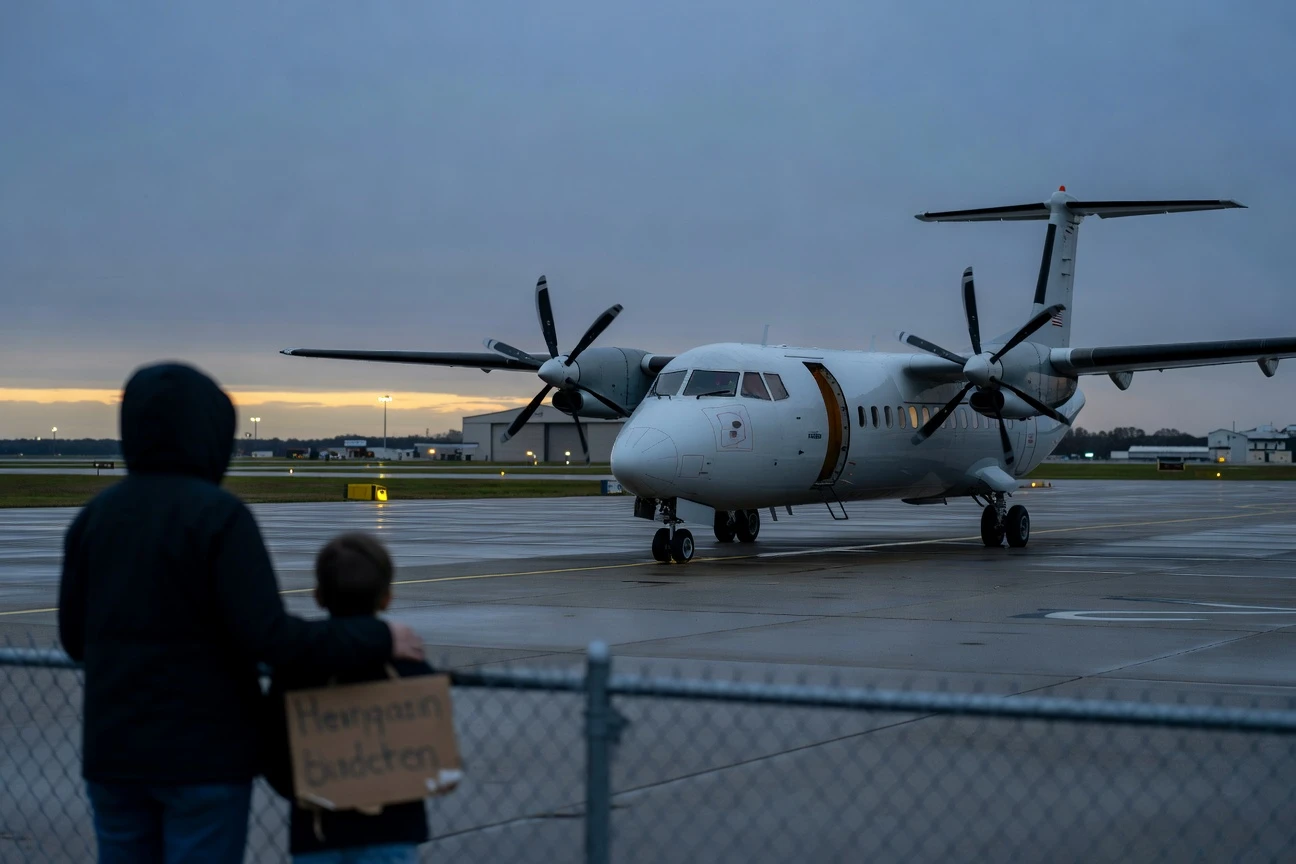
Soldiers from Bravo Company, 245th Aviation Regiment, lifted off from Marietta on Tuesday for a roughly nine-month rotation to Djibouti, where they will fly the C-26 Metroliner for U.S. Africa Command (AFRICOM, the unified combatant command covering 53 African nations). Their assignment is the quiet plumbing of the Horn of Africa mission: VIP transport, cargo lift, and casualty evacuation across a twelve-country beat.
That last task explains the airplane. A helicopter ride from Djibouti to a trauma center in Nairobi runs hundreds of nautical miles over open desert and ocean; a twin-engine turboprop covers it in a single hop, often with a medical team and a stretcher already strapped to the cabin floor.
What the Guardsmen Will Be Flying
The Metroliner is the military version of a Fairchild Swearingen civilian short-haul that first reached U.S. service in 1989. Its profile is workmanlike, per the Navy’s C-26 Metroliner program page: up to nineteen seats, 850 pounds of cargo, a five-thousand-foot runway requirement, and twin Garrett TPE331 turboprops at 1,100 shaft horsepower each. That gives the airframe the legs to cross most of East Africa without refueling. In the Guard inventory it is the small-ramp cousin to the larger C-130 and the contracted business jets that move senior officers around the continent.
Bravo Company is the only Georgia Army Guard fixed-wing company, parked at Dobbins Air Reserve Base on the northwest edge of Atlanta. Its pilots have flown the airframe stateside for years on counterdrug surveillance, instrument training, and operational support flights. That muscle memory matters when the mission shifts to a continent where alternate airfields are sparse and weather can swing from coastal humidity to high-desert turbulence inside an hour of takeoff.
The fixed-wing slot in the Horn has rotated through Guard states for more than a decade. New York’s C-12 Huron detachment held it from late 2022 into 2023 with seven-passenger turboprops; Illinois aviators carried it earlier in the cycle under the 2nd Battalion, 245th Aviation Regiment lineage. The handover this week keeps the Guard fingerprint on the command’s daily passenger and cargo grid, with a larger airframe, a longer cabin, and a different home-state cockpit roster.
The table below shows how the two most recent Guard fixed-wing options compare on the mission set the incoming team is about to inherit. The C-26’s passenger and cargo numbers are the reason it was selected for this rotation.
| Aircraft | Passenger Seats | Cargo Limit | Engines | Recent Horn of Africa Rotation |
|---|---|---|---|---|
| C-26 Metroliner | Up to 19 | 850 lbs | Twin Garrett TPE331 turboprop | Incoming (Bravo Co., 245th) |
| C-12 Huron | 7 | Limited cabin-load only | Twin Pratt & Whitney PT6 turboprop | Nov 2022 to Aug 2023 (New York) |
The Twelve-Country Mission Set
The Combined Joint Task Force, Horn of Africa, runs out of Camp Lemonnier, the Navy expeditionary base outside Djibouti City. Its area of responsibility stretches from the Red Sea down to the Tanzania-Mozambique border and across to the Seychelles in the Indian Ocean. A typical week for an AFRICOM fixed-wing crew includes any combination of the following:
- VIP lift for general officers, defense attachés, and visiting State Department staff moving between U.S. embassies on the continent
- Cargo runs delivering parts, mail, and rotational personnel to small detachments in Kenya, Somalia, and Uganda
- Casualty evacuation from the base or a forward site to a higher level of medical care, almost always Nairobi
- Liaison flights tied to training exercises with partner nations, including Justified Accord, the U.S.-Kenya-led multinational exercise the task force closed out in February
Maj. Charlie Snyder, the Bravo Company commander and a pilot with several prior tours behind him, framed the medical piece in plain terms before departure. “If somebody needs to get to a higher level of care down in Nairobi, which is obviously a little bit of a further helicopter ride, we would load them on the airplane and take them down there,” he said.
None of it is the kind of work that draws cameras. A turboprop landing at Manda Bay or Mogadishu does not generate a Pentagon press release. But pulling it out of the schedule would unravel a chain of mobility that lets the rest of the task force function.
The Casualty Chain From Lemonnier to the Kenyan Capital
The medical backbone in this theater is short and well-defined. Camp Lemonnier’s installation directory lists the Navy’s only standing forward Role II trauma facility on the African continent, an expeditionary medical unit that can stabilize, do limited surgery, and hold a patient for hours, not days.
Anything beyond that, head injuries, complex neurosurgery, prolonged intensive care, has to move to a Role III hospital, and the closest qualifying option is Aga Khan University Hospital in the Kenyan capital. The task force has been working on a formal partnership with the facility for two years.
The flight line between those two points is roughly 900 nautical miles. By rotary wing it is a multi-leg ordeal with fuel stops and weather risk. By twin turboprop it is a single mission, three to four hours block-to-block depending on winds. That is the precise gap a fixed-wing airframe plugs in this theater, with Landstuhl in Germany reserved for cases that survive long-haul flight to the U.S. Air Force aeromedical hub.
The task force’s surgeon cell told AFRICOM public affairs earlier this year that U.S. forces used medical evacuation services into the Kenyan capital roughly eight times over the prior twelve months, and that the volume was projected to climb as the command pushed deeper into Somalia-facing rotations and East African partner exercises. Most of those moves do not involve a battlefield wound. They involve a soldier with a kidney stone, a contractor with a cardiac event, a service member with a head injury from a vehicle rollover at a forward site.
For the families Snyder thanked in his remarks, that is the part of the mission that does not show up in the program of record. It is also the part that keeps a fixed-wing platform on alert at the base every day of the rotation.
A Pennsylvania-Georgia Combined Cockpit
Once in theater, the Marietta element will fold into a joint team with soldiers from the Pennsylvania Army National Guard. The combined arrangement, pilots from one state and non-commissioned officers from another, is the standard Guard model for fixed-wing rotations. It spreads the personnel demand across more than one state’s roster of qualified Metroliner aviators, which is a small population by design.
Col. Christopher Buck, the State Army Aviation Officer for the 78th Aviation Troop Command, told the unit at the Marietta armory that the merge was already locked in. “I am incredibly impressed with this team; I have zero worries about you guys being successful at the mission downrange,” Buck said. “They’re going to be providing transportation, both VIP, logistics, and other special missions.”
Before the team links up overseas, the incoming soldiers will spend a brief training period at the Continental U.S. Replacement Center at Fort Bliss, Texas, the Army’s processing hub for individual augmentees and small-element deployments. That stop covers theater-specific medical, legal, and equipment-issue items the home station cannot generate on its own, including the country-specific vaccine sequence required for the assignment.
The combined-state cockpit is also a Guard recruiting reality. Active Army fixed-wing seats are concentrated in operational support airlift commands and intelligence aviation, neither of which carries a routine Metroliner schedule in Africa. When the combatant command needs the airframe, the Guard is where it sits, and any single state’s bench is too thin to fill a nine-month rotation alone.
The Guard Rotation Pattern Across the Horn
The fixed-wing slot at the base has cycled through Guard units for more than a decade. The pattern is not formally chartered, but it is consistent: a small detachment, somewhere between five and a dozen personnel, deploys for roughly nine months, hands the airframe and the schedule to the next state, and rotates home. Each handover comes with a couple of weeks of left-seat, right-seat fly-along time on the ramp.
- Illinois aviators carried the rotation in 2014 and again in 2019, drawing pilots from the 2nd Battalion of the same regimental lineage
- New York’s Detachment 5, C Company stood up in theater in November 2022 with C-12 Hurons, returning home in August 2023
- Other multi-state contributions, including Pennsylvania security elements that took over the Horn of Africa security mission, supported the wider task force inside the same window
- The current handover is the first time the company has owned the fixed-wing slot, with Pennsylvania filling out the crew
The reason that ladder matters is institutional. Every Guard state that rotates through builds aircrew and maintenance personnel with current Horn of Africa time, which feeds back into stateside training, partner-nation exchanges, and the pool of pilots who can be tapped for short-notice support flights. The same readiness pipeline shows up in other recent Georgia Guard taskings inside the United States, where Atlanta-based troops have handled logistical and administrative roles at federal facilities.
It is also why the Guard, not the active component, owns this airframe. The Metroliner fleet was largely retired from active Army service years ago. The Guard kept it, modernized parts of it, and now flies it where the active component does not have a comparable platform standing by.
Snyder’s Countdown
Snyder has done this part of a deployment before. The brief he gave families on Tuesday was not about the flying. It was about the calendar, and about the fact that the worst stretch of a tour is the one before the airplane leaves.
Deployment is never fun. But the good news is, the countdown to going is kind of the part that you don’t like. Now we’re at the countdown of coming home. So as soon as we get on the airplane here and start heading out, we get to count down the days to come home. That’s the silver lining for today.
He thanked his own family from the podium before the buses left for the flight line. The crowd at the armory included spouses, parents, and small children holding handmade signs. The 78th Aviation Troop Command had organized the morning ceremony around a single departure window.
For the active-component pilots and the Pennsylvania crews already in theater, the incoming team’s arrival closes out a handover that has been moving in the background for months. For the families left behind on the Dobbins flight line, the rotation officially started the moment the wheels lifted off the runway in Marietta. They will track the months by mail call, video call, and the slow accumulation of marks on a kitchen calendar, while somewhere over the Atlantic the same calendar is already running in reverse for the company commander and the pilots in the back of his airplane.