
NEWS
WashU’s Parkway Bridge Still Funnels 600,000 Trips a Year
WashU’s 2018 Forest Park Parkway pedestrian bridge still carries about 600,000 trips a year while the same road keeps taking out lower crossings.

Washington University’s Forest Park Parkway pedestrian bridge reopened Nov. 2, 2018, more than 18 feet wide and built for about 600,000 trips a year.
The old deck was 8.5 feet. Walkers with strollers shared it with cyclists who came in fast. The rebuild split those users and left this span as the hole through a parkway that still blocks almost everyone else.
How Wide Is WashU’s Forest Park Parkway Bridge?
The new walkway is over 18 feet wide, more than double the 8.5 feet it replaced, with marked lanes for walkers and cyclists. Northbound cyclists leave on a switchback ramp that slows bicycle traffic. The extra width is why strollers and bikes no longer share a single squeeze.
OLD BRIDGE VS THE 2018 SPAN
| Feature | Old crossing | 2018 crossing |
|---|---|---|
| Walkway width | 8.5 feet | over 18 feet |
| How people move | One shared path | Separate walker and cyclist paths |
| Bike speed control | Earlier slowing attempts failed | Switchback ramp on the north exit |
| Steel structure | Narrow aging span | Two 21-foot-wide spans |
James Kolker, then associate vice chancellor and university architect, said pedestrians with strollers had found the old layout hard to share with cyclists traveling at high speed. He said past attempts to slow bikes had not worked, and that the marked paths would give both groups room.
The university also said 8.5 feet was less than half the width recommended for a joint bike-and-walker path. Access for strollers and for people who need a level route was part of the brief, not an add-on.
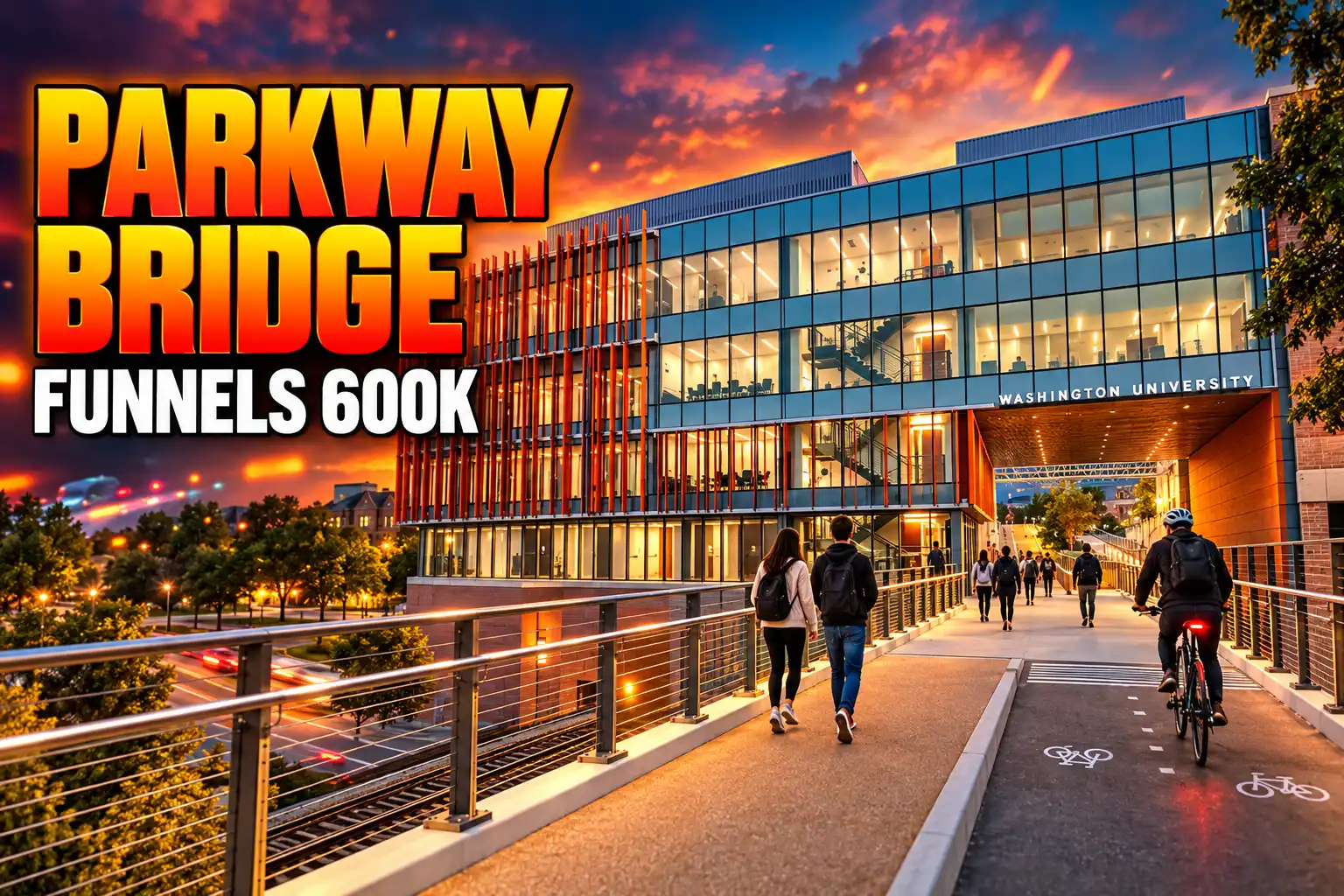
Two Steel Spans Went Up Over One Weekend
Tarlton, the contractor, priced the job at $12.3 million. Crews took down the old structure and, in a round-the-clock weekend lift that required trains to be rerouted and Forest Park Parkway to shut, set two 21-foot-wide steel bridge spans, each nearly 90 feet long and more than 50 tons.
New steel columns sit on three existing pier caps and on 24 new drilled piers north of MetroLink. After the spans landed, the crew poured an 8-inch structural deck, then curbs, cladding, cable guardrails, and a lighted handrail that needed hundreds of anchor bolts.
THE BUILD CALENDAR
- May 15, 2018: The university announces demolition for May 21 and an October reopening.
- May 21, 2018: Demolition of the old Centennial Greenway span begins.
- August 2018: Forest Park Parkway closes between Skinker and Big Bend for the span lift, with MetroLink detours around the work.
- Nov. 2, 2018: The bridge fully reopens to walkers and cyclists, later than the October target, along with stairs to the Academy Building and University Drive.
St. Louis County Transportation told drivers the parkway would close at 6 a.m. Friday, Aug. 3, between Skinker and Big Bend and reopen at 11:59 p.m. Monday, Aug. 6. The university had already warned that parkway lanes and MetroLink would shut off and on, and for a full weekend, while it worked with University City, St. Louis County, and Metro.
A Vital Link on the Centennial Greenway
Kolker called the span both a campus gateway and a piece of the Centennial Greenway. Great Rivers Greenway, which builds the regional trail network, had already treated it as a vital link, and the university still cites about 600,000 trips a year on this one crossing, the busiest section of that system at the time of the rebuild.
This bridge is both an important gateway to the Washington University campus and an integral part of the Centennial Greenway.
James Kolker, associate vice chancellor and university architect, WashU project announcement
Ayers Saint Gross, working with Trivers Associates on the adjacent Bryan Hall work, described an outdated, heavily used bridge that crossed a service corridor, a major city arterial, and light rail. The firm replaced it with a wider bimodal route to Millstone Plaza, tying a neighborhood park on the north side to a main campus quad on the south.
Oates Associates designed light-gage framing that holds decorative metal panels under the deck, a finish meant to match nearby building work in a highly visible spot over the parkway and the rail line. The Forest Park Parkway pedestrian bridge project was never only a campus sidewalk. It is the greenway’s hole through the road.
University City Traded Trees for the North Ramp
The north landing sits on University City parkland, where the ramp meets Ackert Walkway along Melville Avenue. Before the university could build a wider ramp, it needed an easement on that park strip. Neighbors had already fought a larger 2012 version of the same idea.
Rose Windmiller spoke for the university on government and community relations. She told University City officials the existing bridge and ramp were in poor shape. Cheryl Adelstein handled community relations in 2017 and said the old span was not safe and could not handle the mix of bicycles and pedestrians.
WHAT THE 2017 PLAN CHANGED
- Trees cut: The scaled plan called for removing 16 trees, mostly large sweet gums, down from 55 to 60 in 2012.
- Trees planted: Forty-three new canopy and ornamental trees would go in, fewer than the 80 proposed five years earlier.
- Ackert Walkway: The university dropped a bid to widen the popular path itself and shrunk the work zone.
- Ramp shape: An elbow, later built as the switchback, was meant to slow bikes before they met walkers.
Lighting and emergency blue phones were part of that package. The fight was never about whether people needed a crossing. It was about how much parkland and how many trees a wider ramp would take to make the greenway honest.
The Same Road Still Takes Out Low Bridges
Forest Park Parkway is still a wall. The Danforth span got out of the roadway and out of the train envelope. Other crossings on the same road did not get that treatment, and one of them is gone.
On Oct. 7, 2025, Forest Park Forever and the City of St. Louis closed a low-clearance pedestrian bridge over Forest Park Parkway and the MetroLink tracks in northeastern Forest Park, a different structure from the WashU deck. A vehicle had struck it. The Board of Public Service inspected the superstructure and said the span should be closed and removed, a permanent emergency shutdown.
Demolition was set for 7 p.m. on Oct. 10, 2025, and was to finish by 6 a.m. on Oct. 13. Westbound parkway lanes shut from Kingshighway to DeBaliviere; eastbound shut from Union to Kingshighway. After the hit, the instinct on the city’s thread was to repair the park span in place. Removal is what the city chose.
TWO CROSSINGS OF FOREST PARK PARKWAY
| Crossing | Where it sits | What happened |
|---|---|---|
| WashU Danforth span | Campus gateway at University City | Rebuilt in 2018; still open |
| Northeastern Forest Park span | Northeast park over parkway and MetroLink | Closed Oct. 7, 2025; taken down Oct. 10-13 |
The city pointed walkers to the Grand Drive overpass from West Pine Drive, or to Kingshighway and Hospital Drive past the Glade site. It said that when the Glade opens in late 2026, a new ADA path would run from Kingshighway to Steinberg Rink, and that the city and Forest Park Forever would study better ways into that corner of the park. The WashU crossing never entered that emergency, because the 2018 job had already lifted people off the pavement.
Eight More Greenway Bridges Are Coming
Great Rivers Greenway is still using bridges to jump the things trails cannot share with cars. In November 2025 the agency said it had 8+ greenway bridge projects in planning, design, or construction in 2026, the most in its history, across a network it put at 140 miles.
Greenway use is up. The agency recorded more than three million trips in 2024, a 50% increase from before 2020, by its own count. Mark Perkins, CEO of Great Rivers Greenway, put the point in barrier language that fits this parkway as well as any river.
Greenway bridges cross literal barriers such as rivers, creeks, and highways; but greenway projects also transcend perceived barriers like zip codes, city limits, wards and neighborhoods to connect us together.
Mark Perkins, CEO, Great Rivers Greenway, November 2025
GREAT RIVERS GREENWAY IN 2025
- Network length: 140 miles of existing greenways across the St. Louis region.
- Bridge load: 8+ greenway bridge projects in planning, design, or construction in 2026.
- Trip growth: A 50% increase from before 2020, per the agency.
- Origin vote: Nov. 7, 2000, Proposition C created dedicated local funding.
The Danforth span is the version of that idea that already exists on Forest Park Parkway. Walkers and cyclists still use it, in marked lanes, about 600,000 times a year, because the university paid to take them off the road.
Frequently Asked Questions
Is WashU’s Forest Park Parkway Bridge the One Torn Down in 2025?
No. The span taken down in October 2025 crossed Forest Park Parkway and MetroLink in northeastern Forest Park near West Pine, and the city sent people to the Grand Drive overpass while it studies new park access. WashU’s Danforth crossing is a separate rebuilt deck at the University City edge of campus, and it stayed open.
How Do Cyclists Get From the Bridge to Throop Drive?
Northbound cyclists can use bicycle troughs on the stairs north of Bryan Hall to reach Throop Drive, or they can stay on the span and ride straight onto campus across Millstone Plaza. The switchback is for slowing the descent off the bridge, not for that last turn toward Throop.
Who Designed and Built the WashU Parkway Bridge?
Ayers Saint Gross designed the new crossing in association with Trivers Associates, Tarlton built it, and Oates Associates engineered the light-gage framing for the metal panels under the deck. Project photos on the university’s campus board are credited to Brad Feinknopf for Ayers Saint Gross, and WashU Enterprise Physical Operations on the Danforth Campus managed the job.
When Was Forest Park Parkway Closed for the New Spans?
St. Louis County Transportation closed Forest Park Parkway between Skinker and Big Bend from 6 a.m. Friday, Aug. 3, 2018, until 11:59 p.m. Monday, Aug. 6, 2018, for the lift. The university had also flagged intermittent lane and MetroLink shutdowns through the summer, with walkers sent to Skinker or Big Bend and cyclists sent west on University Drive to Big Bend, then south to Forsyth.
Eight years after the lift, the marked lanes are still the way across. The parkway under them is still the reason the lanes had to be built in the air.

Greed Held After a $697 Million Crypto Long Flush

Fed Minutes Keep a Year-End Rate Hike Alive

A Nanny-Cam Tape Follows Tyreek Hill Into Free Agency

Star Wars Galactic Racer Makes a Crash End the Tour

Amazon Puts Apple’s June MacBook Prices Back on Sale

Sophia Wootten Turns the Miss Georgia Crown Toward Cleft Care

The iPhone 16 Pro Flipkart Cut Did Not Last

Microsoft Prints Azure’s $29.42 Billion Quarter and Shrinks the Map

UltraTech’s Ultravolt Launch Puts Cable Multiples on Trial

IXI Autofocus Glasses Still Lack a European CE Mark
-
 NEWS1 year ago
The iPhone 16 Pro Flipkart Cut Did Not Last
-
 ENTERTAINMENT4 months ago
Sophia Wootten Turns the Miss Georgia Crown Toward Cleft Care
-
 BUSINESS1 month ago
UltraTech’s Ultravolt Launch Puts Cable Multiples on Trial
-
 NEWS1 month ago
Microsoft Prints Azure’s $29.42 Billion Quarter and Shrinks the Map
-
 NEWS9 months ago
IXI Autofocus Glasses Still Lack a European CE Mark
-

 NEWS3 months ago
Little St. Simons Island Hatches Loggerheads at 72.4 Percent
-

 NEWS4 months ago
Georgia Beach Bacteria List Leaves Swim Areas Open
-

 NEWS3 years ago
Eyal Waldman Keeps a Two-State Bet After Gaza