Metro Atlanta is facing a growing crisis that residents can no longer ignore. Rising housing costs and endless traffic are now the top concerns across the region. A fresh analysis reveals a key reason behind both problems and points to one urgent solution that could reshape how the city grows.
Survey shows housing and traffic top concerns
A recent regional survey found that housing affordability and traffic congestion are the biggest worries for Metro Atlanta residents today. These two issues, often seen as separate, are deeply connected.
As home prices rise and affordable options shrink, more people are pushed farther away from job centers. That leads to longer commutes and heavier traffic on already crowded roads.
Key concerns reported by residents include:
- Rising rent and home prices
- Longer daily commute times
- Limited housing choices near workplaces
- Growing cost of living pressure
This is not just a housing issue. It is a daily life issue affecting time, money, and quality of life.
Zoning rules blamed for rising costs
A deep review of zoning laws across Metro Atlanta shows how local rules are shaping the crisis. Zoning controls what kind of buildings can be constructed in each area, and in many cases, it limits density.
Researchers studied tens of thousands of pages of zoning codes across cities and counties in the region. Their conclusion is clear.
Strict zoning rules are driving up housing costs and forcing urban sprawl.
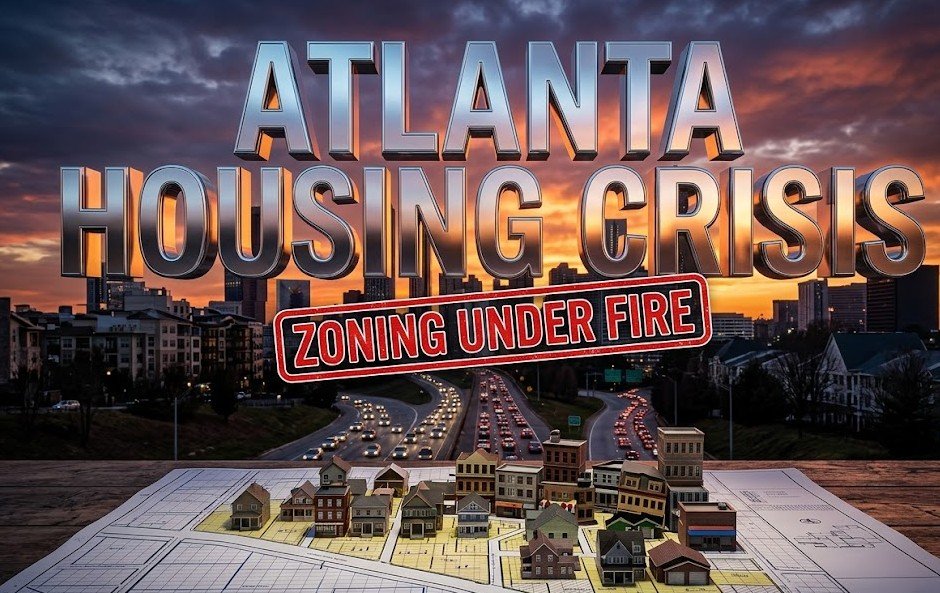
Here is how current zoning impacts the region:
| Zoning Restriction | Real World Impact |
|---|---|
| Limits on multi-family housing | Fewer affordable homes built |
| Single-use zoning | Separation of homes and workplaces |
| Low-density requirements | Expansion into suburbs |
| Parking mandates | Higher construction costs |
These rules make it harder to build duplexes, apartments, and mixed-use developments that are typically more affordable.
Lack of walkable neighborhoods adds to traffic
One of the most striking findings is how zoning shapes daily movement. Only a small share of land in Metro Atlanta allows homes to be built near shops, offices, or cafes.
That means most residents must drive for almost every daily need.
Simple activities like buying groceries or grabbing coffee often require a car trip. Over time, this design creates heavy dependence on vehicles.
The result is a cycle:
- Zoning limits mixed-use areas
- People live far from daily needs
- Car usage increases
- Traffic congestion worsens
In short, zoning is quietly turning residents into the traffic they complain about.
Efforts to improve housing face limits
Local leaders and agencies are aware of the crisis and are taking steps. The Atlanta Regional Commission is working on a long-term housing strategy to boost supply and improve affordability.
At the same time, projects like the BeltLine have made progress. Thousands of affordable housing units have already been built, with more in the pipeline.
But these efforts face a major challenge.
Without broader zoning reform, new housing supply cannot keep up with demand.
Even when policies like inclusionary zoning require affordable units in new developments, they only apply to limited areas. Large parts of the region still restrict denser housing.
This creates a gap between policy goals and real outcomes.
Why zoning reform is gaining urgency
Experts say reforming zoning laws could unlock several benefits at once.
Allowing more housing types in more areas could lower costs, reduce traffic, and improve community design.
Potential changes being discussed include:
- Allowing duplexes and townhomes in single-family zones
- Expanding mixed-use developments
- Reducing parking requirements
- Encouraging transit-friendly housing
These changes would help create neighborhoods where people can live closer to work, schools, and daily needs.
That shift could reduce long commutes and ease pressure on major highways.
What it means for the future of Metro Atlanta
Metro Atlanta stands at a turning point. The region continues to grow, but its current development pattern is under strain.
Housing demand is rising faster than supply. At the same time, infrastructure is struggling to keep up with population growth.
If zoning rules remain unchanged, both housing costs and traffic are likely to get worse.
On the other hand, reform could open the door to a more balanced and accessible city.
A future with shorter commutes, more housing choices, and vibrant neighborhoods is possible. But it will require political will and community support.
Metro Atlanta’s housing crisis is no longer a distant issue. It is shaping daily life for millions. The choices made now will define how the region lives, moves, and grows in the years ahead.