Google will let approved third-party Android app stores plug into the Google Play catalog starting July 22, closing out a six-year antitrust fight with Epic Games over who controls how apps reach American phones. The change comes from a federal court order, not a Google product decision.
Rival storefronts will be able to list app names, icons, screenshots and descriptions pulled straight from Google Play. But every one of those downloads will still be delivered by Google, and Google’s service fee still applies no matter which storefront a shopper used to find the app.
Rival Stores Get a Doorway Inside Google Play
The mechanics are narrower than “Android goes fully open.” Under the Play Catalog Access Program enrollment terms, a qualifying US app store can pull a developer’s existing Play listing, including its screenshots and video, and offer that same app to its own users starting July 22, 2026.
Google notified developers on June 22 that their US listings would be shared with participating stores by default unless they opted out before the deadline. Developers get three real choices.
- Publish – let every participating third-party store carry the listing automatically.
- Manage – approve or reject individual stores one at a time inside Play Console.
- Block – opt out of catalog sharing entirely before July 22.
Anyone who does nothing gets the default: shared. Rival stores, meanwhile, must clear a real bar to qualify. They must register as a US organization, serve only US users, keep malware under 1% of install attempts, and stay open to any developer on non-discriminatory terms, according to Google’s policy update for developers.
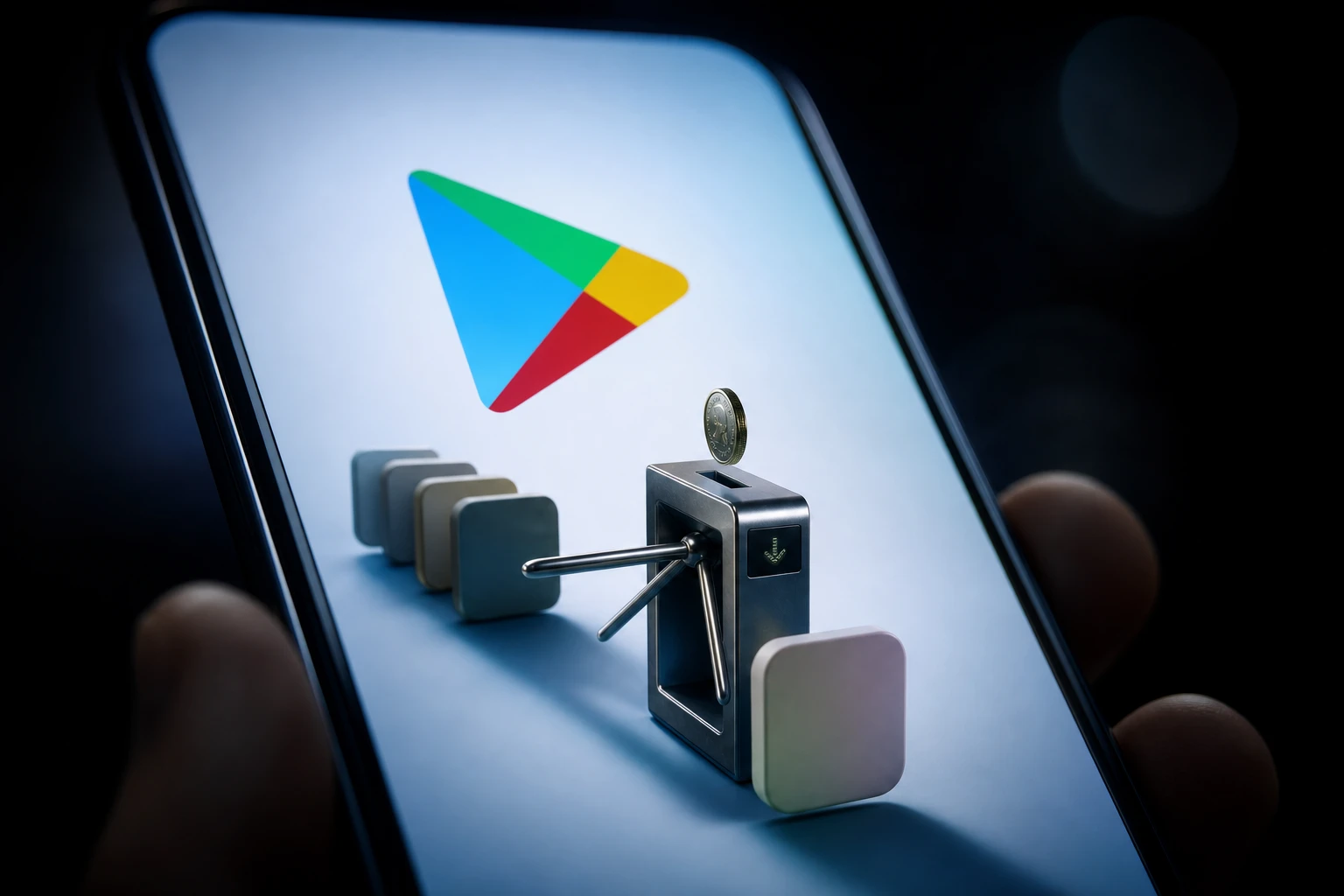
The Fees Still Flow to Google on Every Download
Here is the part that gets less attention than the headline. Whether a user taps “install” inside Google Play or inside a rival storefront living within Play, the file itself still moves through Google’s pipes, and Google’s cut still lands in Google’s account.
That matters because it changes what the ruling actually redistributes. It hands rival stores shelf space and discovery, not control of the transaction. Consumers spent an estimated $49.2 billion on the Google Play Store in 2025, a 13% jump from the year before, and none of that flow changes hands under the new program.
| Distribution Path | Google’s Cut | Security Check | Who Can Use It |
|---|---|---|---|
| Google Play, direct | Tiered service fee starting at 10% on a developer’s first $1 million a year, rising toward 20% on new installs above that | Play Protect scanning plus developer identity verification | Any Android user worldwide |
| Third-party store via Play Catalog Access | Google’s standard Play service fee still applies to every download, and the store itself pays Google $5,000 up front plus $5,000 a year | Store must hold malware under 1% of install attempts or lose access | US users only, store must enroll and target the US exclusively |
| Sideloading straight from a developer’s site | Historically $0 to Google | No Play Protect review unless the developer separately completes Google’s identity verification | Anywhere, though Google says sideloaded apps carry far higher malware exposure |
The bottom row is the one that used to worry Google most. Apps distributed by sideloading generated nothing for the company. Every rival store that now enrolls to sit inside Google Play, instead of asking users to download an installer from the open web, effectively routes that same demand back through Google’s own checkout.
Why Google Stopped Fighting the Injunction
Google spent months trying to swap the court’s remedy for something softer: a global “Registered App Stores” program, announced in March 2026, built around easier sideloading rather than in-Play distribution. On July 15 and 16, Google and Epic jointly withdrew that proposal instead of continuing to argue it.
We’ve agreed with Epic to withdraw our motion to modify the US Court’s injunction rather than prolonging this process which creates uncertainty for the ecosystem.
Dan Jackson, a Google spokesperson, gave that statement in a filing reported first by The Verge. The withdrawal leaves Judge James Donato’s original injunction, the tougher of the two options, as the only remedy left standing.
The retreat followed a broader thaw between the two companies. In March, Google cut its Play Store commissions and cleared Fortnite to return to Google Play worldwide, prompting Epic chief executive Tim Sweeney to write on X that Google was “opening up Android all the way with robust support for competing stores, competing payments, and a better deal for all developers,” adding simply, “Thanks Google!”
A Six-Year Fight That Began With a Fortnite Loophole
The case traces back to August 2020, when Epic quietly added code to Fortnite that let players buy V-Bucks directly, cutting Google’s payment system, and its cut, out of the transaction. Google pulled the game from Play the same day. Epic sued the same day too.
A California jury sided with Epic on every claim in December 2023. Judge Donato issued a permanent injunction in October 2024 ordering Google to host rival stores inside Google Play and share its catalog with them. The Ninth Circuit affirmed that ruling in mid-2025, and the Supreme Court declined to hear Google’s appeal later that year, leaving the injunction fully intact.
The stakes behind that ruling were concrete. Google Play handled roughly 95% of US Android app downloads as of 2020, according to the Ninth Circuit’s own findings, in a business generating a 71% operating profit as of 2021. Google and Epic tried once more, in November 2025, to settle on gentler terms. That attempt is the one both sides abandoned this week.
Is Google’s Security Warning Fair or Self-Serving?
Google says opening Play’s catalog to outside marketplaces genuinely raises risk, and it has data to back the claim: the company’s own research found sideloaded apps carry over 50 times more malware than apps sourced through Google Play. Critics counter that the warning conveniently doubles as a case for keeping control.
Both things can be checked against the record, and the record does not fully resolve the argument.
- Google told Techbuzz it has “built Google Play with security and privacy protections that have kept Android users safe for over a decade,” warning that unvetted stores “will create new risks for users and developers alike.”
- Epic Games and developer groups call that framing overstated, arguing the changes simply remove an artificial barrier; Epic’s own statement described the broader settlement as turning Android into “a true open platform with competition among stores.”
- Trade coverage disagrees on the fee itself: some outlets report a single $5,000 annual charge for third-party stores, others describe a separate $5,000 onboarding fee on top of $5,000 a year, and Google’s enrollment page confirms only the upfront figure.
The malware math is real regardless of motive. Android threats keep surfacing on the fringes of the platform, including a strain called Perseus malware targeting notes apps for sensitive user data. Independent researchers add a separate wrinkle: third-party app stores are a leading cause of infection globally, which is exactly the population the new program is designed to bring inside Play’s walls rather than leave outside them. Google has separately rolled out a Developer Verification requirement for anyone distributing apps outside Play at all, a move the nonprofit F-Droid warned could tighten Google’s grip on the platform even while this program loosens it.
Rivals Still Have to Win Users, Not Just Shelf Space
Catalog access solves a cold-start problem that has blocked Android competitors for a decade. Without a full catalog, users had no reason to try a rival store. Without users, no rival store could get developers to invest in it. That circular barrier is what the injunction breaks.
It does not solve the second problem: habit. Users still need an actual reason to open a different app store, whether that is a lower price, a direct developer relationship, or content Google Play does not carry.
Coverage of the rollout has floated Microsoft building an Xbox-branded storefront for titles like Call of Duty Mobile, distributed through the very channel Google fought to keep closed, though nothing has been confirmed publicly. The Epic Games Store is the most obvious near-term entrant, having spent years building an audience through sideloading alone. The program is also US-only for now; one account of Google’s rollout schedule reports Canadian users and other international markets will get broader access later, under the company’s longer settlement timeline running toward 2027.
Frequently Asked Questions
Do I Need to Do Anything Before July 22?
Developers do not have to act, and that is exactly what Google is flagging. Any app already live on Google Play in the US gets shared automatically with enrolled third-party stores unless a developer opens Play Console and chooses to manage listings store by store or block sharing entirely before the deadline.
Will This Change Anything Outside the United States?
Not yet. The Play Catalog Access Program is explicitly limited to US-based stores serving US users, and reporting on Google’s rollout schedule indicates Canadian users and other international markets will see broader access later, under the company’s longer settlement timeline.
Does This Affect the Apple App Store or iPhone Users?
No. This program only touches Android distribution through Google Play. Apple’s App Store faces separate pressure in the European Union under the Digital Markets Act (DMA, the bloc’s digital competition law), but that fight has no legal connection to the Epic Games v. Google case driving July 22.
What Happens if Google Rejects a Rival Store’s App?
Google is barred from unreasonably blocking a competing store’s app from being submitted to Google Play. Any dispute over what counts as unreasonable goes to a three-person Technical Committee the court created specifically to police compliance.
Which Companies Might Actually Launch a Store?
The Epic Games Store is the clearest candidate, already built after years of running outside Google Play entirely. Coverage of the rollout has also floated a Microsoft-run storefront for Xbox mobile titles, though no company besides Epic has confirmed plans to enroll.