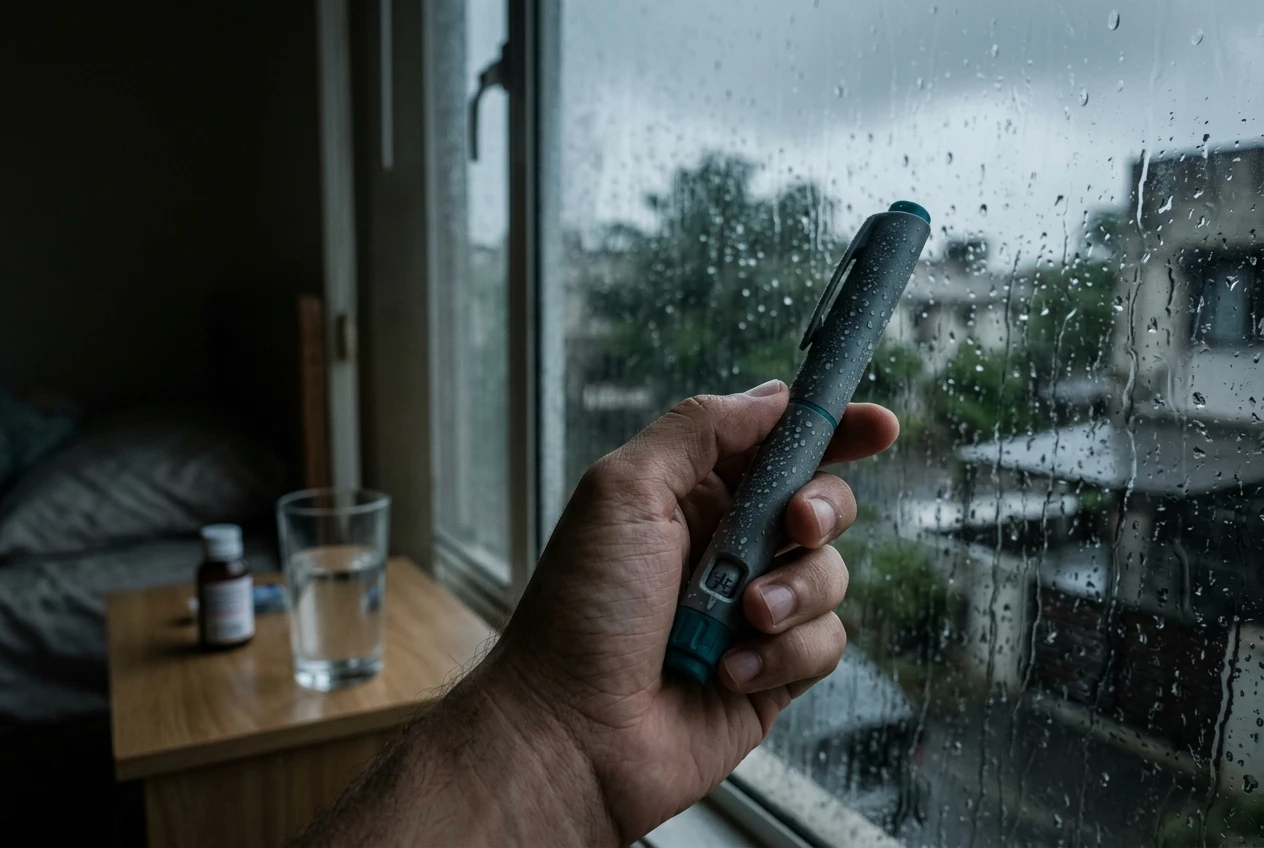
Monsoon humidity can quietly strip insulin of up to 20 percent of its biological potency without changing the way a vial or pen looks, leaving patients injecting a degraded dose and blaming themselves for the resulting blood-sugar spikes. That warning, drawn from clinical research on protein degradation and reinforced by an endocrinologist who treats patients through India’s rainy season, sits at the center of a new advisory on the insulin storage mistakes that arrive with the rains.
The concern is not heat alone. Insulin is a fragile protein hormone, and moisture attacks it through routes the eye cannot see. A clinical trial published in the Annals of Medicine journal found that high humidity paired with ambient heat causes conventional non-refrigerated storage methods to fail drastically because moisture limits natural evaporative cooling. For patients with type 1 and advanced type 2 diabetes, even partial potency loss directly threatens everyday glycemic control.
Why Insulin Breaks Down in Humid Air
Insulin is a delicate protein hormone whose function depends on a precise three-dimensional shape. That shape unravels under heat. Monsoon humidity attacks the same structure through moisture, though the damage takes a different and largely invisible form.
When ambient air is saturated, condensation collects on the outside of insulin pens, rubber stoppers, and vials, which the advisory identifies as a breeding ground for microscopic fungal growth that can compromise the sterile barrier of the container. Dr. Sameer Bhardwaj, a Senior Consultant Endocrinologist, told NDTV that moisture-driven protein breakdown and contamination of the rubber stopper are common consequences of poor storage in humid conditions. A landmark systematic review published in the systematic review on insulin thermal stability highlights that moisture exposure paired with ambient temperature acceleration leads to irreversible molecular changes. Active molecules clump into inactive protein aggregates, a process called insulin fibrillation. The same chemistry is visible in everyday storage, where the vial looks normal even as the dose loses strength.
Fibrillation is a well-documented pathway for insulin potency loss, confirmed in peer-reviewed work on solid-state insulin samples. A 2024 study on solid-state insulin degradation published in AAPS PharmSciTech exposed insulin powder to 60 °C and 75 percent relative humidity for up to seven days. The samples showed significant deamidation and covalent aggregation even when no unfolding of the protein was detectable. The result is potency that erodes in conditions less extreme than a tropical monsoon, which is the climate most Indian insulin users actually live in. In liquid insulin pens and vials stored in a humid kitchen or bedside drawer, the same chemistry runs on a slower clock, with the same end result. The implication is that the failure happens long before the patient notices anything physical.
What makes the moisture risk hard to catch is the lack of a sensory cue. Heat gives a patient a warm vial, a changed color, a clumpy texture. Humidity gives nothing, which is why the partial degradation can run for weeks before the dose looks wrong. The fix is structural rather than visual, and a small daily routine does most of the work.
Three numbers frame the risk:
- Humidity-driven protein degradation does not change color, clarity, or visible texture of the insulin.
- Monsoon humidity across India commonly reaches 80 to 90 percent relative humidity.
- Insulin held at 60 °C and 75 percent RH showed significant aggregation within one to seven days in a 2024 study.
The Three Storage Mistakes Patients Make
During dry summer months, the usual insulin storage advice holds up: keep pens cool, use a cooling wallet on the go, and avoid direct sunlight. Monsoon humidity breaks that advice. High atmospheric humidity, often 80 to 90 percent relative humidity, prevents water from evaporating from the pouch fabric, which means the standard evaporative cooling wallet stops working at exactly the moment it is most needed.
The first mistake is the evaporative cooling wallet. Its cooling depends entirely on ambient evaporation. When the air is already saturated, water cannot leave the pouch, the internal temperature rises, and the wallet becomes a warm, humid microenvironment that accelerates protein breakdown within days. The second mistake is the refrigerator door, where repeated opening introduces bursts of warm, humid room air onto cold vials, causing rapid condensation inside the cartridge shell and constant temperature swings that destabilize the active hormone. The third mistake is the assumption that clear-looking insulin is still working at full strength.
None of these mistakes produce an obvious warning sign. A pen or vial can look perfectly clear, sit in a closed kitchen cabinet, and still be losing potency through pathways the patient cannot see. That invisibility is what makes humidity the most under-discussed variable in monsoon diabetes care. A partially degraded vial can keep being used for weeks without anyone suspecting the supply.
| The mistake | What goes wrong in monsoon air | What it does to the insulin |
|---|---|---|
| Relying on an evaporative cooling wallet | Evaporative cooling depends on water leaving the pouch; at 80% to 90% relative humidity, the air is already saturated, so evaporation stalls | Wallet becomes a warm, humid microenvironment that breaks down active proteins within days |
| Storing vials in the refrigerator door | Each door opening sends a burst of warm, humid room air across cold vials, causing immediate condensation | Liquid volume shifts and temperature swings destabilize the active hormone |
| Trusting the visual appearance of the vial | Humidity-driven degradation does not change color, clarity, or visible texture | Insulin can lose potency while still looking safe to use |
When Clear Insulin Has Already Lost Potency
Many patients assume that unless an insulin vial turns cloudy, develops flakes, or changes color, it is safe to inject. How high humidity affects insulin effectiveness is often entirely invisible to the naked eye, a point Dr. Bhardwaj raised in the advisory. Clear-looking insulin can easily lose up to 20% of its biological potency without showing visual warning signs. Patients who keep injecting a compromised vial end up with severe, unpredictable blood-sugar spikes that have no obvious cause.
High atmospheric humidity is an invisible enemy for diabetic patients. Many people don’t realize that moisture buildup on the rubber stopper of an insulin vial can rapidly introduce contaminants or cause the protein structure to break down faster than it would in dry air.
Dr. Bhardwaj ties the storage mistakes to the spike pattern directly in his advisory to NDTV. The default response, increasing the dose, treats the symptom and ignores the cause. His recommended move is to suspect the vial first, hold the dose steady, and open a fresh, properly stored cartridge from a known-good supply.
When the Spike Looks Like a Diet Problem
The clinical pattern that follows is familiar to the endocrinologist cited in the advisory, who sees patients through the rainy season each year. A person follows the same diet, takes the same insulin dose, and watches post-meal readings climb. The numbers drift upward across a week, then across a month, and the patient adjusts the dose to match. By the time the patient visits the clinic, the dose is well above what their body actually needs once the supply is fixed.
The instinctive response, increasing the dose, makes the underlying problem worse. The next vial drawn from the same poorly stored supply is also degraded, and a larger dose of a less potent drug still delivers less active hormone than a smaller dose of a fresh one would. The patient ends up with a higher dose and the same undershoot in blood glucose control.
The right move is to discard the compromised supply first and reassess the dose with a fresh, properly stored vial. Switching to a fresh supply is the cleanest confirmation that the previous supply was the problem. Most patients see readings settle once the supply is fixed. The supply is the lever to pull first.
A Storage Routine That Holds Up in Monsoon
The advisory, covered in a recent report on monsoon insulin storage mistakes, offers a short, concrete routine that does not require any new equipment beyond a sealed container and a careful eye. The first move is to keep the in-use insulin away from open air, because the rubber stoppers and pen seals are the most vulnerable surface on the device. The second is to put backup supply where the temperature stays steady, not in the refrigerator door where the temperature swings each time it opens. The third is to treat any unexplained blood-sugar pattern as a storage problem first, and a dose problem second. The whole sequence runs on a sealed container, a steady shelf, and a willingness to discard the current vial when readings drift.
Three steps to follow this monsoon:
- Seal the active supply. Place in-use insulin pens and vials inside a clean, tightly sealed glass or plastic airtight container. That structural barrier stops airborne moisture from settling on the rubber injection seals.
- Move the backup off the door. Keep primary and backup insulin on the middle shelf of the refrigerator, toward the back. The middle shelf holds the steadiest temperature and is sheltered from the humid drafts that enter when the door opens.
- Treat the vial as the likely cause. If post-meal blood sugar climbs without a change in food or dose, do not increase the dose. Discard the current vial and open a fresh, properly stored cartridge from the central supply.
These three moves are the entire intervention. None of them requires a new device or a prescription change, and each one addresses a specific failure mode the advisory names directly. Patients who follow the routine through the rainy season can keep their full dose on the shelf, in both senses of the word.
Frequently Asked Questions
How can I tell if my insulin has lost its potency?
In most cases, you cannot tell by looking. The protein damage from humid air leaves the liquid perfectly clear, so the warning sign is a sudden pattern of unexplained post-meal blood-sugar spikes while the rest of the routine stays the same, per the advisory.
Where is the best place to store insulin during monsoon?
In-use pens and vials go in a sealed glass or plastic container at room temperature, away from sunlight. Backup supply stays on the middle shelf of the refrigerator, toward the back, never in the door, where each opening drives warm, humid air across cold vials.
Can humidity cause blood sugar levels to spike unexpectedly?
Indirectly, yes. A vial of insulin that has lost potency in humid air still looks the same but delivers less active hormone per dose. The result is a blood-sugar pattern that drifts upward with no obvious change in food, activity, or prescribed dose, per the advisory.
Are evaporative cooling wallets safe to use during monsoon?
No. Evaporative cooling depends on water leaving the pouch. At 80 to 90 percent relative humidity, common across India during the rainy season, the surrounding air is already saturated, evaporation stalls, and the pouch becomes a warm trap that can break down insulin within days.
How quickly does humidity damage insulin?
Solid-state insulin samples held at 60 °C and 75 percent relative humidity showed significant deamidation and covalent aggregation within one to seven days in a 2024 study. In real storage conditions during monsoon, where temperatures are lower but humidity stays consistently high, the same molecular changes happen more slowly, and the visible result is the same: degraded potency that the eye cannot see.
Disclaimer: This article provides general information only and is not a substitute for a qualified medical opinion. Always consult a specialist or your own doctor for personal medical guidance. The figures and clinical references above are accurate as of the advisory’s publication in July 2026.